

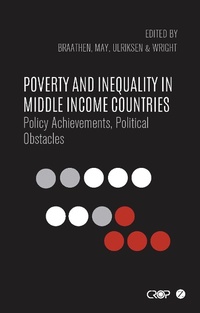
Poverty and Inequality in Middle Income Countries
Policy Achievements, Political Obstacles
1st Edition
Published on 15. April 2016
264 pages
978-1-78360-560-6 (ISBN)
Description

This collection offers a timely reassessment of viable ways of addressing poverty across the globe today. The profile of global poverty has changed dramatically over the past decade, and around three-quarters of the poor now live in middle income countries, making inequality a major issue. This requires us to fundamentally rethink anti-poverty strategies and policies, as many aspects of the established framework for poverty reduction are no longer effective. Featuring contributions from Latin America, Africa and Asia, this much-needed collection answers some of the key questions arising as development policy confronts the challenges of poverty and inequality on the global, national and local scale in both urban and rural contexts.
Providing poverty researchers and practitioners with valuable new tools to address new forms of poverty in the right way, Poverty and Inequality in Middle Income Countries shows how a radical switch from aid to redistribution-based social policies is needed to combat new forms of global poverty.
Providing poverty researchers and practitioners with valuable new tools to address new forms of poverty in the right way, Poverty and Inequality in Middle Income Countries shows how a radical switch from aid to redistribution-based social policies is needed to combat new forms of global poverty.
Reviews / Votes
The excellent group of papers in this volume throw much needed light upon the politics of poverty reduction in middle-income countries. They deserve a wide readership. * Armando Barrientos, University of Manchester * A welcome addition to the literature on poverty. In focusing on domestic actors and politics, the essays in this volume help to shed light on the social drivers of poverty and available instruments for effective poverty reduction. A must read for scholars, activists, and policymakers interested in the problem of poverty and poverty reduction. * Jimi Adesina, United Nations Research Institute for Social Development * This volume is a valuable contribution to our understanding of the causes of, and solutions to, poverty and inequality in the global South. Comparative and interdisciplinary in approach - it provides a comprehensive and critical analysis and is a timely addition to the literature on these issues. * Rebecca Surender, University of Oxford * This timely and important collection of essays breaths fresh air into the debate about what it means to be poor in today's world, and what can be done to end poverty. * Tony Addison, chief economist, United Nations University - World Institute for Development Economics Research *More details
Series
Edition
1. Auflage
Language
English
Place of publication
United Kingdom
Publishing group
Bloomsbury Publishing PLC
Target group
College/higher education
Illustrations
Tables, black and white 13 ; Figures 12
ISBN-13
978-1-78360-560-6 (9781783605606)
Copyright in bibliographic data and cover images is held by Nielsen Book Services Limited or by the publishers or by their respective licensors: all rights reserved.
Schweitzer Classification
Other editions
Additional editions
Einar Braathen | Julian May | Marianne Ulriksen
Poverty and Inequality in Middle Income Countries
Policy Achievements, Political Obstacles
Book
04/2016
Zed Books Ltd
€117.90
Shipment within 3-4 weeks
Persons
Einar Braathen is research professor in international studies at the Norwegian Institute for Urban and Regional Research (NIBR). A political scientist, he has specialized in governance and policy analysis in the global South, particularly the linkages between multilevel governance (central-local relations, municipality-community relations) and policy delivery (poverty reduction, service delivery, climate change adaptation). For the last ten years he has mainly worked on two BRICS countries, South Africa and Brazil. He co-edited and co-authored The Politics of Slums in the Global South (2016).
Julian May is director of the DST-NRF Centre of Excellence in Food Security at the University of the Western Cape. Professor May works on poverty reduction, including land reform, social grants, information technology and urban agriculture in southern and East Africa. He formerly held the South African Research Chair in Applied Poverty Impact Assessment.
Marianne S. Ulriksen is senior research fellow at the Centre for Social Development in Africa (CSDA), University of Johannesburg, South Africa. Marianne's research areas include comparative politics, the political economy of welfare policy development, social protection, social justice, poverty and inequality, mineral wealth and resource mobilization, and state-citizens relations. Her publications primarily focus on southern and eastern Africa, where she has lived and worked since 2000.
Gemma Wright is research director of the Southern African Social Policy Research Institute, and Southern African Social Policy Research Insights. She is professor extraordinarius at the University of South Africa and research associate at the Institute of Social and Economic Research at Rhodes University. Her areas of interest include social security policy and the definition and measurement of poverty.
Julian May is director of the DST-NRF Centre of Excellence in Food Security at the University of the Western Cape. Professor May works on poverty reduction, including land reform, social grants, information technology and urban agriculture in southern and East Africa. He formerly held the South African Research Chair in Applied Poverty Impact Assessment.
Marianne S. Ulriksen is senior research fellow at the Centre for Social Development in Africa (CSDA), University of Johannesburg, South Africa. Marianne's research areas include comparative politics, the political economy of welfare policy development, social protection, social justice, poverty and inequality, mineral wealth and resource mobilization, and state-citizens relations. Her publications primarily focus on southern and eastern Africa, where she has lived and worked since 2000.
Gemma Wright is research director of the Southern African Social Policy Research Institute, and Southern African Social Policy Research Insights. She is professor extraordinarius at the University of South Africa and research associate at the Institute of Social and Economic Research at Rhodes University. Her areas of interest include social security policy and the definition and measurement of poverty.
Content
Introduction: Poverty and Politics in Middle Income Countries - Einar Braathen, Julian May, Marianne S. Ulriksen and Gemma Wright
1. Policy-Relevant Measurement of Poverty in Low, Middle and High Income Countries - David Gordon and Shailen Nandy
2. Poverty, Inequality, Racism and Human Rights in Mexico and Latin America - Camilo Perez-Bustillo
3. South Africa, the OECD and BRICS - Tor Halvorsen
4. Universalizing Health Coverage in Emerging Economies - Amrit Kaur Virk
5. The Politics of Inequality in Botswana and South Africa - Marianne S. Ulriksen
6. Democratization, Disempowerment and Poverty in Nigeria - Samuel Ojo Oloruntoba
7. Urban Poverty and Inequality in Rio de Janeiro, Cape Town and Durban - Einar Braathen, David Jordhus-Lier, Berit Aasen and Catherine Sutherland
8. Adults Who Live on the Streets of Buenos Aires - Martin Boy
9. Grassroots Politics and Social Movement Mobilizations for Development in Brazil - Abdulrazak Karriem
10. Land-Alienation-Infused Poverty in India - Sony Pellissery
11. The Politics of Hunger Deaths in Odisha (India) - Rajakishor Mahana
1. Policy-Relevant Measurement of Poverty in Low, Middle and High Income Countries - David Gordon and Shailen Nandy
2. Poverty, Inequality, Racism and Human Rights in Mexico and Latin America - Camilo Perez-Bustillo
3. South Africa, the OECD and BRICS - Tor Halvorsen
4. Universalizing Health Coverage in Emerging Economies - Amrit Kaur Virk
5. The Politics of Inequality in Botswana and South Africa - Marianne S. Ulriksen
6. Democratization, Disempowerment and Poverty in Nigeria - Samuel Ojo Oloruntoba
7. Urban Poverty and Inequality in Rio de Janeiro, Cape Town and Durban - Einar Braathen, David Jordhus-Lier, Berit Aasen and Catherine Sutherland
8. Adults Who Live on the Streets of Buenos Aires - Martin Boy
9. Grassroots Politics and Social Movement Mobilizations for Development in Brazil - Abdulrazak Karriem
10. Land-Alienation-Infused Poverty in India - Sony Pellissery
11. The Politics of Hunger Deaths in Odisha (India) - Rajakishor Mahana
