

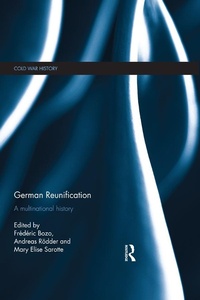
German Reunification
A Multinational History
Published on 5. August 2016
242 pages
978-1-317-33604-4 (ISBN)
Description

This book provides a multinational history of German reunification based on empirical work by leading scholars.
The reunification of Germany in 1989-90 was one of the most unexpected and momentous events of the twentieth century. Embedded within the wider process of the end of the Cold War, it contributed decisively to the dramatic changes that followed: the end of the division of Europe, the collapse of the Warsaw Pact, the origins of NATO's eastward expansion and, not least, the creation of the European Union. Based on the wealth of evidence that has become available from many countries involved, and relying on the most recent historiography, this collection takes into account the complex interaction of multinational processes that were instrumental in shaping German reunification in the pivotal years 1989-90. The volume brings together renowned international scholars whose recent works, based on their research in multiple languages and sources, have contributed significantly to the history of the end of the Cold War and of German reunification. The resulting volume represents an important contribution to our knowledge and understanding of a significant chapter in recent history.
This book will be of much interest to students of German politics, Cold war history, international and multinational history and IR in general.
The reunification of Germany in 1989-90 was one of the most unexpected and momentous events of the twentieth century. Embedded within the wider process of the end of the Cold War, it contributed decisively to the dramatic changes that followed: the end of the division of Europe, the collapse of the Warsaw Pact, the origins of NATO's eastward expansion and, not least, the creation of the European Union. Based on the wealth of evidence that has become available from many countries involved, and relying on the most recent historiography, this collection takes into account the complex interaction of multinational processes that were instrumental in shaping German reunification in the pivotal years 1989-90. The volume brings together renowned international scholars whose recent works, based on their research in multiple languages and sources, have contributed significantly to the history of the end of the Cold War and of German reunification. The resulting volume represents an important contribution to our knowledge and understanding of a significant chapter in recent history.
This book will be of much interest to students of German politics, Cold war history, international and multinational history and IR in general.
More details
Series
Language
English
Place of publication
London
United Kingdom
Publishing group
Taylor & Francis Ltd
Target group
College/higher education
Professional and scholarly
Product notice
Reflowable
Illustrations
1 s/w Tabelle
1 Tables, black and white
File size
1,39 MB
ISBN-13
978-1-317-33604-4 (9781317336044)
Copyright in bibliographic data and cover images is held by Nielsen Book Services Limited or by the publishers or by their respective licensors: all rights reserved.
Schweitzer Classification
Other editions
Additional editions
Book
01/2018
1st Edition
Routledge
€89.32
Shipment within 10-20 days
Book
08/2016
1st Edition
Routledge
€231.70
Shipment within 10-20 days
Persons
Frederic Bozo is Professor of Contemporary History, Sorbonne (University of Paris III), and author/editor of numerous titles, including Mitterrand, the End of the Cold War, and German Unification (2009).
Andreas Roedder is Professor of Contemporary History at Johannes Gutenberg University Mainz, and author of multiple titles, including Deutschland einig Vaterland: The History of Reunification (2009).
Mary Elise Sarotte is Dean's Professor of History at the University of Southern California (USC), and author of, most recently, The Collapse: The Accidental Opening of the Berlin Wall (2014).
Andreas Roedder is Professor of Contemporary History at Johannes Gutenberg University Mainz, and author of multiple titles, including Deutschland einig Vaterland: The History of Reunification (2009).
Mary Elise Sarotte is Dean's Professor of History at the University of Southern California (USC), and author of, most recently, The Collapse: The Accidental Opening of the Berlin Wall (2014).
Content
Introduction: On the Politics of History, the Making of Deals, and the Way the Old Becomes the New, Frederic Bozo, Andreas Roedder, and Mary Elise Sarotte
Part I: The Two Germanies and Unification
1. The Revolution in Germany: The End of the SED Dictatorship, East German Society and Reunification, Ilko-Sascha Kowalczuk
2. Transferring a Civil Revolution into High Politics: The West German Drive for Unification and the New European Order, Andreas Roedder
Part II: Superpowers React
3. "His East European Allies Say They Want to Be in NATO": US Foreign Policy, German Unification, and NATO's Role in European Security, 1989-1990, Mary Elise Sarotte
4. Gorbachev, German Reunification, and Soviet Demise, Vladislav Zubok
Part III: Western Europe Reacts
5. From "Yalta" to Maastricht: Mitterrand's France and German Unification, Frederic Bozo
6. Not a Wholly New Europe: How the Integration Framework Shaped the End of the Cold War in Europe, Piers Ludlow
7. The United Kingdom: Divided Counsels, Global Concerns, Patrick Salmon
Part IV: Central and Eastern Europe React
8. Pivots in Poland's Response to German Unification, Gregory Domber
9. Germany's Unification, Its Eastern Neighbors, and European Security, Vojtech Mastny
Part I: The Two Germanies and Unification
1. The Revolution in Germany: The End of the SED Dictatorship, East German Society and Reunification, Ilko-Sascha Kowalczuk
2. Transferring a Civil Revolution into High Politics: The West German Drive for Unification and the New European Order, Andreas Roedder
Part II: Superpowers React
3. "His East European Allies Say They Want to Be in NATO": US Foreign Policy, German Unification, and NATO's Role in European Security, 1989-1990, Mary Elise Sarotte
4. Gorbachev, German Reunification, and Soviet Demise, Vladislav Zubok
Part III: Western Europe Reacts
5. From "Yalta" to Maastricht: Mitterrand's France and German Unification, Frederic Bozo
6. Not a Wholly New Europe: How the Integration Framework Shaped the End of the Cold War in Europe, Piers Ludlow
7. The United Kingdom: Divided Counsels, Global Concerns, Patrick Salmon
Part IV: Central and Eastern Europe React
8. Pivots in Poland's Response to German Unification, Gregory Domber
9. Germany's Unification, Its Eastern Neighbors, and European Security, Vojtech Mastny
