

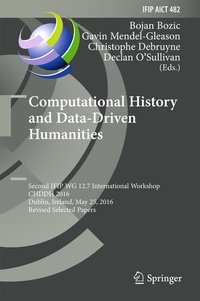
Computational History and Data-Driven Humanities
Second IFIP WG 12.7 International Workshop, CHDDH 2016, Dublin, Ireland, May 25, 2016, Revised Selected Papers
Published on 7. November 2016
X, 127 pages
978-3-319-46224-0 (ISBN)
Description

This book constitutes the refereed post-proceedings of the Second IFIP WG 12.7 International Workshop on Computational History and Data-Driven Humanities, held in Dublin, Ireland, in May 2016.
The 7 full papers presented together with 2 invited talks and 4 lightning talks were carefully reviewed and selected from 14 submissions. The papers focus on the challenge and opportunities of data-driven humanities and cover topics at the interface between computer science, social science, humanities, and mathematics.
The 7 full papers presented together with 2 invited talks and 4 lightning talks were carefully reviewed and selected from 14 submissions. The papers focus on the challenge and opportunities of data-driven humanities and cover topics at the interface between computer science, social science, humanities, and mathematics.
More details
Series
Edition
1st ed. 2016
Language
English
Place of publication
Cham
Switzerland
Publishing group
Springer International Publishing
Target group
Professional and scholarly
Product notice
Reflowable
Illustrations
X, 127 p. 29 illus.
File size
10,02 MB
ISBN-13
978-3-319-46224-0 (9783319462240)
DOI
10.1007/978-3-319-46224-0
Schweitzer Classification
Other editions
Additional editions
Bojan Bozic | Gavin Mendel-Gleason | Christophe Debruyne
Computational History and Data-Driven Humanities
Second IFIP WG 12.7 International Workshop, CHDDH 2016, Dublin, Ireland, May 25, 2016, Revised Selected Papers
Book
11/2016
Springer
€53.49
Shipment within 10-15 days
Content
- Intro
- Preface
- Organization
- Contents
- Keynotes
- Ritual and Social Evolution: Understanding Social Complexity Through Data
- 1 Introducing Seshat
- 2 The Theory of Modes of Religiosity
- 3 Modes of Religiosity over Time and Space
- 4 Using Seshat to Test the Modes Theory
- References
- The Dacura Data Curation System
- 1 Introduction
- 2 Use Case and Requirements
- 3 Dacura System and Quality Control
- 4 Conclusion
- References
- Full Papers
- Digital History: Towards New Methodologies
- 1 Introduction
- 2 Tools and Data
- 3 Top-Down and Bottom-Up Approaches
- 3.1 Canonization of People
- 3.2 Tracing Concepts Through Time
- 4 Conclusions
- References
- Epidemics in Venice: On the Small or Large Nature of the Pre-modern World
- 1 Introduction
- 2 Method
- 2.1 Venice Transportation Network
- 2.2 Epidemic Model
- 3 Simulation
- 4 Conclusions
- References
- Neoclassica - A Multilingual Domain Ontology
- 1 Introduction
- 2 Neoclassica Framework
- 2.1 Epistemological Considerations
- 2.2 The Proposed Framework
- 3 Why a New Domain Ontology?
- 3.1 Basic Objective
- 3.2 CIDOC-CRM and Neoclassica
- 3.3 Current State
- 4 The Structure of the Neoclassica-Ontology
- 5 Practical Examples
- 5.1 Multilinguality and the Presence/Absence of Concepts in Languages
- 5.2 Descriptive Power
- 6 Conclusion and Outlook on Future Development
- References
- Improving Part-of-Speech Tagging of Historical Text by First Translating to Modern Text
- 1 Introduction
- 2 Related Work
- 3 Translation Methods
- 3.1 Machine Translation
- 3.2 Historical Lexicons
- 3.3 Extracting Lexicons from Parallel Text
- 3.4 Orthographic Rules
- 4 Part-of-Speech Tagging Evaluation
- 5 Concluding Remarks
- References
- The Sense and Sensibility of Different Sliding Windows in Constructing Co-occurrence Networks from Literature
- 1 Introduction
- 2 Related Work
- 2.1 Social Networks in Literature
- 2.2 Term Co-occurrence Analysis
- 3 Methods
- 3.1 Data Preparation
- 3.2 Character Networks
- 3.3 Collinear Co-occurrence Window Strategy
- 3.4 Coplanar Co-occurrence Window Strategy
- 3.5 Combined Sliding Window Strategy
- 4 Results
- 4.1 Network Analysis
- 4.2 Discussion: Literary Implications for Character Networks
- 5 Conclusions
- References
- Storyteller: Visualizing Perspectives in Digital Humanities Projects
- 1 Introduction
- 2 Humanities Data and Visualizations
- 3 Storyteller
- 4 Visualizing the Data
- 4.1 Newsreader
- 4.2 BiographyNet
- 4.3 Embodied Emotions
- 4.4 Summary
- 5 Conclusions
- References
- Will Historians Ever Have Big Data?
- Abstract
- 1 Introduction
- 2 What Is 'Data?'
- 3 Three Challenges to Building Big Data Infrastructure for History
- 3.1 Revisiting the Complexity of Humanistic Data
- 3.2 Dealing with 'hidden' Data
- 3.3 Knowledge Organisation and Epistemics of Data
- 4 Conclusion
- Acknowledgements
- References
- Lightning Talks
- Object Classification in Images of Neoclassical Furniture Using Deep Learning
- 1 Introduction
- 2 Experiment
- 3 Conclusion
- References
- Publishing and Consuming Irish Administrative Boundaries as Linked Data
- 1 Introduction
- 2 OSi's Linked Data Platform
- 3 Consuming Ireland's Boundary Data
- 4 Conclusions and Future Work
- References
- Erratum to: Computational History and Data-Driven Humanities
- Erratum to: B. Bozic et al. (Eds.): Computational History and Data-Driven Humanities DOI: 10.1007/978-3-319-46224-0
- Short Lightning Talks
- Automated Monitoring of Data Quality in Linked Data Systems
- Abstract
- 1 Introduction
- 2 Experiments
- 3 Conclusion and Future Work
- References
- SWIMing: Supporting Use Case Data Requirements Modelling for Managing Data Across the Building Life Cycle
- Abstract
- 1 Introduction
- 2 Short Presentation of Work
- Author Index
