

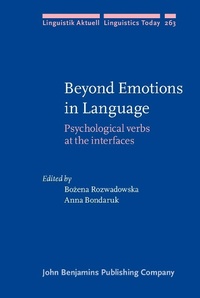
Beyond Emotions in Language
Psychological verbs at the interfaces
1st Edition
Published on 8. December 2020
339 pages
978-90-272-6076-5 (ISBN)
Description

This book sheds new light on the puzzle of psychological predicates in a cross-linguistic perspective by looking at them from a variety of angles at the interfaces between event structure, lexical and viewpoint aspect, syntax and information structure. The individual chapters focus on Polish and Spanish psych verbs, which manifest new overt contrasts that often remain covert in languages such as English, e.g., aspectual distinctions, the peculiarities of dative constructions, or the role of information structure in determining the word order. One of the main contributions of the book lies in positing a new typology of basic event types enriched with the initial boundary events. Moreover, due attention is devoted to dative experiencers as compared to accusative experiencers. Although couched in the generative tradition, the main insights presented in this collection are theory neutral and may be of interest to linguists of all persuasions.
More details
Other editions
Additional editions
Book
12/2020
John Benjamins Publishing Co
€123.30
Shipment within 10-15 days
Content
- Intro
- Beyond Emotions in Language
- Editorial page
- Title page
- Copyright page
- Table of contents
- Acknowledgements
- Notes on contributors
- List of abbreviations
- 1. Psych verbs
- 1. The state of the art in synchronic studies
- 2. Psych verbs from diachronic perspective
- 2.1 Case selection in English psych verbs from diachronic perspective
- 2.2 Impersonal/personal shift in English
- 2.3 OE/SE shift
- 2.4 The rise of the progressive with psych verbs
- 2.5 Causativity and inchoativity of psych verbs
- 3. An overview of the chapters
- References
- 2. Polish psych verbs as non-achievements
- 1. Introduction
- 2. Final end-point oriented accounts of psych verbs
- 3. Initial events
- 3.1 Terminology
- 3.2 Initial points in Skwxwu7mesh: Bar-el (2005)
- 3.3 Marín and McNally's (2011) initial point approach to psych verbs
- 4. Polish Psych verbs vs. achievements
- 5. Passivization of psych verbs in Polish
- 6. Analysis
- 7. Conclusions
- References
- 3. Encoding inception in the domain of psych verbs in Polish
- 1. Introduction
- 2. Prefixation as an event structure diagnostic
- 2.1 Lexical and superlexical prefixes
- 2.1.1 Lexical prefixes
- 2.1.2 Superlexical prefixes
- 2.2 Syncretism of prefixes
- 2.3 Event structure
- 2.4 Event structure and prefixation
- 2.5 Prefixation and aspectual classes
- 2.6 Event structure of psych verbs
- 2.6.1 SE verbs and states
- 2.6.2 SE verbs as simple events
- 2.6.3 The event structure status of OE verbs
- 2.7 Interim conclusion
- 3. Lexicalization of inception
- 3.1 Inception and the verb root
- 3.2 The morphology of inception
- 4. Conclusion
- References
- 4. Initiators, states and passives in Spanish psych verbs
- 1. The problem
- 2. Class 1 (acosar): Verbs that allow passive in an unrestricted way
- 3. Class 2 (sorprender 'surprise'): Verbs that only admit non-specific passives
- 4. The two subclasses in group 3 (enfadar and aburrir): Verbs that reject the passive form
- 5. Analysis
- 6. How to obtain an eventive process if there is none
- 7. Conclusions
- References
- 5. The syntax of accusative and dative Experiencers in Polish
- 1. Introduction
- 2. Accusative and dative Experiencers in Polish - General characteristics
- 3. Binding properties of accusative and dative Experiencers in Polish
- 3.1 Condition A effects with accusative and dative Experiencers in Polish
- 3.1.1 The Anaphor Agreement Effect
- 3.1.2 The way to obviate the AAE
- 3.1.3 Anti-Cataphora Effects
- 3.1.4 Backward binding by accusative and dative Experiencers
- 3.1.5 Forward binding
- 3.2 Pronominal variable binding with accusative and dative Experiencers in Polish
- 3.3 Binding of accusative and dative Experiencers - the summary
- 4. Passivization of accusative and dative Experiencers in Polish
- 4.1 Verbal and adjectival passives in Polish
- 4.2 Verbal passives formed of OE verbs with accusative Experiencers in Polish
- 4.3 Verbal passives formed of OE verbs with dative Experiencers in Polish
- 4.4 Why don't stative OE verbs with accusative and dative Experiencers passivize in Polish?
- 4.5 Adjectival passives formed of stative OE verbs with accusative and dative Experiencers
- 4.6 Passivization of accusative and dative Experiencers - the summary
- 5. Derivation of T/SM-first and Experiencer-first orders with stative Class II and Class III OE verbs in Polish
- 5.1 Arguments against the Spec,ApplP position of dative Experiencers in Polish
- 5.2 Deriving the T/SM-first order with stative Class II and Class III OE verbs in Polish
- 5.3 Deriving the Experiencer-first order with stative Class II and Class III OE verbs in Polish
- 6. Conclusions
- References
- 6. The information structure of high and low datives and their psychological import
- 1. Introduction
- 2. Towards a semantic classification of datives
- 3. Two diagnostics for two types of datives
- 4. High and low applicatives and information structure
- 4.1 High applicatives, intervention and information structure
- 4.2 Low applicatives, information structure and word order
- 5. Concluding remarks
- References
- 7. Polish impersonal middles with a dative as syntactically derived experience events
- 1. Introduction
- 2. Background: DIMs in prior minimalist approaches
- 2.1 The Involuntary State Construction (Rivero 2003, et seq.)
- 2.2 DIMs as personal middles with an applied dative Benefactive (Krzek, 2013)
- 2.3 Interim conclusion
- 3. Polish DIMs: Basic facts and assumptions
- 3.1 Is there a syntactically represented implicit Agent in DIMs?
- 3.2 The source of the agentive "flavor" of DIMs
- 3.3 The adverbial within and beyond the DIM construction
- 3.4 The syntactic status of the dative constituent in DIMs
- 4. DIMs as syntactically derived experience events
- 4.1 Experiencer argument in the absence of an (overt) lexical Experiencer predicate
- 4.1.1 The non-selected dative Experiencer as an argument of a null Experiencer verb
- 4.1.2 The non-selected Experiencer as an argument of a null syntactic head
- 4.2 The syntactic decomposition of Polish DIMs: The verb/VP, the dative argument, and the adverbial
- 4.3 The syntactic decomposition of Polish DIMs: Voice, (un)expected accusative, and default verbal a
- 5. Conclusions
- References
- Name Index
- Subject Index
