

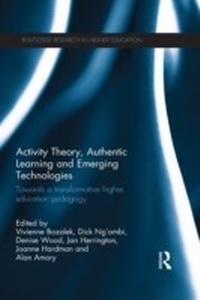
Activity Theory, Authentic Learning and Emerging Technologies
Towards a transformative higher education pedagogy
1st Edition
Published on 15. September 2014
272 pages
978-1-317-67654-6 (ISBN)
Description

Although emerging technologies are becoming popularised for teaching, learning and research, the relationship between their use and transformative effects on higher education remain largely unexplored. This edited collection seeks to fill this gap by providing a nuanced view, locating higher education pedagogical practices at an intersection of emerging technologies, authentic learning and activity systems.
Providing numerous case studies as examples, the book draws from a wide range of contexts to illustrate how such a convergence has the potential to track transformative teaching and learning practices in the higher education sector. Chapters provide the reader with a variety of transformative higher education pedagogical practices in southern contexts, theorised within the framework of Cultural Historical Activity Theory (CHAT) and tool mediation, while using authentic learning as a pedagogical model upon which this theoretical framework is based.
The topics covered in the book have global relevance, with research paying particular attention to South Africa, Australia and New Zealand, where the authors are based. The book will be of interest to educators, researchers and practitioners in higher education, as well as those interested in emerging technologies in education more generally.
Providing numerous case studies as examples, the book draws from a wide range of contexts to illustrate how such a convergence has the potential to track transformative teaching and learning practices in the higher education sector. Chapters provide the reader with a variety of transformative higher education pedagogical practices in southern contexts, theorised within the framework of Cultural Historical Activity Theory (CHAT) and tool mediation, while using authentic learning as a pedagogical model upon which this theoretical framework is based.
The topics covered in the book have global relevance, with research paying particular attention to South Africa, Australia and New Zealand, where the authors are based. The book will be of interest to educators, researchers and practitioners in higher education, as well as those interested in emerging technologies in education more generally.
More details
Series
Language
English
Place of publication
London
United Kingdom
Publishing group
Taylor & Francis Ltd
Target group
College/higher education
Professional and scholarly
Product notice
Reflowable
Illustrations
29 s/w Abbildungen, 15 s/w Tabellen, 1 s/w Photographie bzw. Rasterbild, 28 s/w Zeichnungen
15 Tables, black and white; 28 Line drawings, black and white; 1 Halftones, black and white; 29 Illustrations, black and white
File size
11,46 MB
ISBN-13
978-1-317-67654-6 (9781317676546)
Copyright in bibliographic data and cover images is held by Nielsen Book Services Limited or by the publishers or by their respective licensors: all rights reserved.
Schweitzer Classification
Other editions
Additional editions
Vivienne Bozalek | Dick Ng'ambi | Denise Wood
Activity Theory, Authentic Learning and Emerging Technologies
Towards a transformative higher education pedagogy
Book
01/2017
1st Edition
Routledge
€76.70
Shipment within 10-20 days
Vivienne Bozalek | Dick Ng'ambi | Denise Wood
Activity Theory, Authentic Learning and Emerging Technologies
Towards a transformative higher education pedagogy
Book
09/2014
1st Edition
Routledge
€242.00
Shipment within 10-20 days
Persons
Vivienne Bozalek is Professor of Social Work and Director of Teaching and Learning at the University of the Western Cape, South Africa.
Dick Ng'ambi is Associate Professor and Masters Programme Convenor in the School of Education, University of Cape Town, South Africa.
Denise Wood is Professor of Learning, Equity, Access and Participation, Central Queensland University, Australia.
Jan Herrington is Professor of Education in the School of Education, Murdoch University, Australia.
Joanne Hardman is Senior Lecturer in the School of Education, University of Cape Town, South Africa.
Alan Amory is Professor and Director of the Centre for Academic Technologies, University of Johannesburg, South Africa.
Dick Ng'ambi is Associate Professor and Masters Programme Convenor in the School of Education, University of Cape Town, South Africa.
Denise Wood is Professor of Learning, Equity, Access and Participation, Central Queensland University, Australia.
Jan Herrington is Professor of Education in the School of Education, Murdoch University, Australia.
Joanne Hardman is Senior Lecturer in the School of Education, University of Cape Town, South Africa.
Alan Amory is Professor and Director of the Centre for Academic Technologies, University of Johannesburg, South Africa.
Content
Foreword Anna Stetsenko. Introduction Vivienne Bozalek, Dick Ng'ambi, Denise Wood, Jan Herrington, Joanne Hardman and Alan Amory Part 1: Activity Theory Introduction to CHAT and Tool Mediation Joanne Hardman and Alan Amory. Learning in Sites of Practice through a CHAT Lens James Garraway and Jolanda Morkel. CHAT as a Framework for Exploring the Impact of the Anagu Tertiary Education Program (AnTEP) in Remote Northern South Australia Denise Wood, Deirdre Tedmanson, Bruce Underwood, Makinti Minutjukur and Katrina Tjitayi. Mediating Learning in a Postgraduate Course Dick Ng'ambi and Cheryl Brown Part 2: Authentic Learning Introduction to Authentic Learning Jan Herrington. Learning to do Research by Doing: A Case Study in a Health Education Programme Brenda Leibowitz, Walter Liebrich, Ilse Meyer, Chivaugn Gordon and Carina de Kock. Authentic Learning in an Undergraduate Research Methodologies Course Tamara Shefer and Lindsay Clowes. Facilitating Creative Problem Solving in the Entrepreneurship Curriculum through Authentic Learning Activities Noel Lindsay and Denise Wood Part 3: Emerging Technologies Introduction to Emerging Technologies Dick Ng'ambi and Vivienne Bozalek. Twenty First Century Pedagogies: Portraits of South African Higher Educators using Emerging Technologies Vivienne Bozalek, Daniela Gachago and Kathy Watters. Emerging technologies in New Zealand Thomas Cochrane, Vickel Narayan and James Oldfield. The Affordances of Three-Dimensional Virtual Worlds as Authentic Learning Environments Denise Wood Part 4: Case Studies Case Studies Using CHAT Joanne Hardman, Alan Amory, Irina Verenikina, Lotte Latukefu, Najma Agherdien, Rita Kizito, Nomakhaya Mashiyi, Roisin Kelly Laubscher, Daniela Gachago, Veronica Barnes and Eunice Ivala. Case Studies of Authentic Learning Jan Herrington, Veronica Mitchell, Michael Rowe and Simone Titus. Case Studies of Emerging Technologies Dick Ng'ambi, Vivienne Bozalek, Daniela Gachago, Jolanda Morkel, Eunice Ivala, Anita Campbell, Sibongile Simelane, Dorothea Methudi Dimpe, Patient Rambe and Aaron Bere. Conclusion - Towards a Transformative Higher Education Pedagogy Vivienne Bozalek, Dick Ng'ambi, Denise Wood, Jan Herrington, Joanne Hardman and Alan Amory.
