

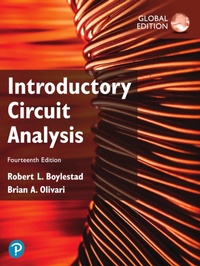
Introductory Circuit Analysis, Global Edition
14th Edition
Published on 4. April 2023
1147 pages
978-1-292-45199-2 (ISBN)
Description

Introductory Circuit Analysis has been the number one acclaimed text in the field for over 50 years. Boylestad presents complex subject matter clearly and with an eye on practical applications. He provides detailed guidance in using the TI 89 Titanium calculator, the choice for this text, to perform all the required math techniques. Challenging chapter-ending review questions help you deepen your grasp of the material.
Updated with the most current, relevant content, the 14th Edition places greater emphasis on fundamentals and has been redesigned with a more modern, accessible layout. Topics requiring a solid understanding of Power Factor, Lead and Lag concepts have been significantly enhanced throughout the text.
Updated with the most current, relevant content, the 14th Edition places greater emphasis on fundamentals and has been redesigned with a more modern, accessible layout. Topics requiring a solid understanding of Power Factor, Lead and Lag concepts have been significantly enhanced throughout the text.
More details
Edition
14th edition
Language
English
Place of publication
Harlow
United Kingdom
Target group
College/higher education
File size
108,33 MB
ISBN-13
978-1-292-45199-2 (9781292451992)
Copyright in bibliographic data and cover images is held by Nielsen Book Services Limited or by the publishers or by their respective licensors: all rights reserved.
Schweitzer Classification
Other editions
Additional editions
Robert Boylestad
Introductory Circuit Analysis, Global Edition
Book
04/2023
14th Edition
Pearson Education Limited
€130.93
Shipment within 10-20 days
Person
About our authors Robert L. Boylestad signed the original contract for Introductory Circuit Analysis in 1965, resulting in a publishing date of 1968: a current life history of some 60 years. He wrote the first 13 editions, with an average timespan of 4.5 years between editions. With each edition, he felt upon completion that he'd done all he could to make it the best available. However, as the years pass there is always something such as content, coverage, examples or problems that can withstand some improvement.
For the 14th edition, Professor Boylestad felt it wise to join hands with Professor Brian Olivari (Maine Maritime Academy) to be sure he was fully aware of recent trends in the scope and depth of coverage in various subject areas. He feels it has been a wonderful union in developing the content of this edition.
His history in the educational field includes some 45 years at various professorial ranks in the City University New York. There was also a period of some 10 years as assistant dean at the Thayer School of Engineering at Dartmouth.
During his teaching career, he was fortunate enough to find the time to write some 7 texts related to the electrical/electronics field. The two most successful are Introductory Circuit Analysis and Electronic Devices and Circuit Theory (co-authored with Professor Louis Nashelsky). The first is now in this 14th edition and the latter in its 11th edition. Both texts have been translated into foreign languages, with Introductory Circuit Analysis translated into 7 languages: Arabic, Chinese, French, Korean, Portuguese, Spanish and Taiwanese.
In addition to Introductory Circuit Analysis, there was the publication of manuals and texts related to computer languages: BASIC Applied to Circuit Analysis, Manual for the IBM PC jr and BASJC for Electronics and Computer Technologies.
Professor Boylestad looks forward to any response from users of this 14th edition to ensure the text remains current in the years to come.
Professor Brian A. Olivari is honored to have been asked by Professor Boylestad to collaborate on the 14th edition of Introductory Circuit Analysis. He could never have imagined being co-authors on the latest edition when he first used Professor Boylestad's Electronic Devices and Circuit Theory textbook as a student back in 1977, and then the 11th edition of Introductory Circuit Analysis as a professor in 2008.
As a faculty member at Maine Maritime Academy for over 15 years, Professor Olivari has focused his teaching on both electrical engineering and mathematics. In engineering, his primary interest has been in circuit analysis and power control electronics. In mathematics, he has been committed to preparing his math students to be successful at solving engineering problems.
Prior to teaching at Maine Maritime Academy, Professor Olivari gained much of his professional experience in the telecommunications industry. He worked at Western Electric, Rochester Telephone and, most notably, Bell Labs, where he was part of a team of engineers (systems, mechanical, electrical and software) that developed the first-of-its-kind stored-program controlled D5 Digital Channel Bank System. Additionally, he served as associate editor of the IEEE Solid-State Circuits Conference Digest of Technical Papers and taught briefly at Rochester Institute of Technology.
For the 14th edition, Professor Boylestad felt it wise to join hands with Professor Brian Olivari (Maine Maritime Academy) to be sure he was fully aware of recent trends in the scope and depth of coverage in various subject areas. He feels it has been a wonderful union in developing the content of this edition.
His history in the educational field includes some 45 years at various professorial ranks in the City University New York. There was also a period of some 10 years as assistant dean at the Thayer School of Engineering at Dartmouth.
During his teaching career, he was fortunate enough to find the time to write some 7 texts related to the electrical/electronics field. The two most successful are Introductory Circuit Analysis and Electronic Devices and Circuit Theory (co-authored with Professor Louis Nashelsky). The first is now in this 14th edition and the latter in its 11th edition. Both texts have been translated into foreign languages, with Introductory Circuit Analysis translated into 7 languages: Arabic, Chinese, French, Korean, Portuguese, Spanish and Taiwanese.
In addition to Introductory Circuit Analysis, there was the publication of manuals and texts related to computer languages: BASIC Applied to Circuit Analysis, Manual for the IBM PC jr and BASJC for Electronics and Computer Technologies.
Professor Boylestad looks forward to any response from users of this 14th edition to ensure the text remains current in the years to come.
Professor Brian A. Olivari is honored to have been asked by Professor Boylestad to collaborate on the 14th edition of Introductory Circuit Analysis. He could never have imagined being co-authors on the latest edition when he first used Professor Boylestad's Electronic Devices and Circuit Theory textbook as a student back in 1977, and then the 11th edition of Introductory Circuit Analysis as a professor in 2008.
As a faculty member at Maine Maritime Academy for over 15 years, Professor Olivari has focused his teaching on both electrical engineering and mathematics. In engineering, his primary interest has been in circuit analysis and power control electronics. In mathematics, he has been committed to preparing his math students to be successful at solving engineering problems.
Prior to teaching at Maine Maritime Academy, Professor Olivari gained much of his professional experience in the telecommunications industry. He worked at Western Electric, Rochester Telephone and, most notably, Bell Labs, where he was part of a team of engineers (systems, mechanical, electrical and software) that developed the first-of-its-kind stored-program controlled D5 Digital Channel Bank System. Additionally, he served as associate editor of the IEEE Solid-State Circuits Conference Digest of Technical Papers and taught briefly at Rochester Institute of Technology.
Content
Introduction
Voltage and Current
Resistance
Ohm's Law, Power, and Energy
Series dc Circuits
Parallel dc Circuits
Series-Parallel Circuits
Methods of Analysis and Selected Topics (dc)
Network Theorems
Capacitors
Inductors
Magnetic Circuits
Sinusoidal Alternating Waveforms
The Basic Elements and Phasors
Series ac Circuits
Parallel ac Circuits
Series-Parallel ac Networks
Methods of Analysis and Selected Topics (ac)
Network Theorems (ac)
Power (ac)
Resonance
Decibels, Filters, and Bode Plots
Transformers
Polyphase Systems
Pulse Waveforms and the R-C Response
Nonsinusoidal Circuits
APPENDICES
Conversion Factors
Determinants
Greek Alphabet
Magnetic Parameter Conversions
Maximum Power Transfer Conditions
Answers to Selected Odd-Numbered Problems
Voltage and Current
Resistance
Ohm's Law, Power, and Energy
Series dc Circuits
Parallel dc Circuits
Series-Parallel Circuits
Methods of Analysis and Selected Topics (dc)
Network Theorems
Capacitors
Inductors
Magnetic Circuits
Sinusoidal Alternating Waveforms
The Basic Elements and Phasors
Series ac Circuits
Parallel ac Circuits
Series-Parallel ac Networks
Methods of Analysis and Selected Topics (ac)
Network Theorems (ac)
Power (ac)
Resonance
Decibels, Filters, and Bode Plots
Transformers
Polyphase Systems
Pulse Waveforms and the R-C Response
Nonsinusoidal Circuits
APPENDICES
Conversion Factors
Determinants
Greek Alphabet
Magnetic Parameter Conversions
Maximum Power Transfer Conditions
Answers to Selected Odd-Numbered Problems
