

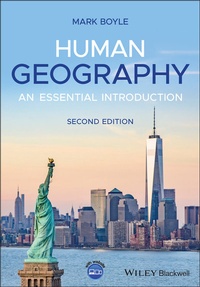
Human Geography
Description

Drawing on nearly three decades of instructional experience and a wealth of testing pedagogical innovations with students, Mark Boyle has revised and expanded this authoritative and comprehensive introduction to Human Geography. As with the First Edition, Boyle follows the premise that "history makes geography whilst geography makes history," and that the key to studying the principal demographic, social, political, economic, cultural and environmental processes in any region in the world today is to look at how that region has been impacted by, and in turn has impacted, the story of the rise, reign, and decline of the West. Moreover he argues that Human Geog-raphy itself is best understood as both an intellectual endeavour and a historical, political, and institutional project.
Informed by recent developments in post-colonial scholarship, the book covers key concepts, seminal thinkers, and influential texts in the field. Although designed for the beginner student, Boyle does not shy away from ideas and debates often avoided in introductory texts, clearly communicating theory without condescension. In addition, he places human geography in its larger academic context, discussing the influences on the field from related subjects. Notable features in the Second Edition include:
* Extensive revision and updating of coverage of key ideas, developments, debates and case studies
* New chapter on uneven geographical development at different scales and development theory and practice
* Dedicated coverage of Covid-19s geographies
* New learning resources (figures, tables, plates, maps, Deep Dive boxes, etc.) throughout the text, plus learning objectives, essay questions, checklists summarizing key ideas, and guidance for further reading
* Updated and expanded companion website with MP4 and MP3 chapter-by-chapter lectures and PowerPoint slides for each chapter, new multiple-choice exam paper and additional essay-style exam questions, and a wide range of student tutorial exercises
Human Geography: An Essential Introduction, Second Edition is an excellent foundational text for undergraduate courses in human geography, globalization, Western civilization, historiographies of intellectual thought, the grand public problems confronting humanity in the twenty first century, and other wider social science courses.
More details
Other editions
Additional editions
Person
MARK BOYLE is Professor and Chair of Urban Studies, Director of the Heseltine Institute for Public Policy, Practice and Place at the University of Liverpool, UK, and Professor of Human Geography at Maynooth University, Ireland. He has taught introductory and advanced courses in human geography for nearly 30 years. He has also researched and published widely on the history of human geography, postcolonial human geography, urban and regional development, geography and public problems, and migration. He holds a BSc (Hons) from the University of Glasgow and a PhD from the University of Edinburgh, both in Geography.
Content
List of Figures xv
List of Plates xvii
List of Maps xx
List of Tables xxii
Acknowledgments xxiii
List of Abbreviations xxvi
A Guide to Reading the Second Edition of Human Geography: An Essential Introduction xxix
1 Introducing Human Geography 1
Chapter Learning Objectives 1
Introduction 2
What Is Human Geography? 3
One Planet, Many Cultures, Unconscionable Inequality 9
The Origins of Our Unequal World: The Rise,Reign, and Faltering of the West 9
Four Theories Explaining the Rise, Reign,and Faltering of the West 15
Conclusion 20
Checklist of Key Ideas 21
Chapter Essay Questions 21
References and Guidance for Further Reading 22
Website Support Material 23
2 Human Geography: A Brief History 24
Chapter Learning Objectives 24
Introduction 25
Telling the Story of the History of Human Geography 26
Human Geography in the Premodern Era 34
Human Geography in the Modern Era 35
Early Modern Period 35
Modern Period 38
Late Modern Period 43
Human Geography in the Postmodern Era 47
Postmodern Human Geography: On Relativisers and Responsibility 47
Postfoundational and Anti-Relativist Human Geographies 48
Human Geographies in Real Time: Geocomputation and Spatial Data Science 51
Conclusion 53
Checklist of Key Ideas 54
Chapter Essay Questions 55
References and Guidance for Further Reading 55
Website Support Material 57
3 Big History: Watersheds in Human History 58
Chapter Learning Objectives 58
Introduction 59
Introducing Big History: From the Big Bang to the Sixth Mass Extinction! 59
First Watershed: The Origins of the Human Species 60
Second Watershed: First Migrations and the Peopling of the Planet 64
Third Watershed: The Development of Human
Culture and Invention of Settled Agriculture 71
Fourth Watershed: The Rise and Fall of Civilizations 78
Fifth Watershed: The Rise of Western Civilization from the Tenth Century bce? 82
Conclusion 85
Checklist of Key Ideas 86
Chapter Essay Questions 87
References and Guidance for Further Reading 87
Website Support Material 89
4 The Commanding Heights: A Brief History of the European World Capitalist Economy from 1450 90
Chapter Learning Objectives 90
Introduction 91
Key Concepts: Global Commodity Chains, Value Chains, and Production Networks 91
The Rise of the European World Economy, 1450-1945: Wallerstein's World-Systems Analysis 93
The Fate of the European World Economy After the Age of Empire 97
Stabilizing Capitalism: Parisian Regulation Theory 98
The Thirty Glory Years of Capitalism in the Core: The Fordist-Keynesian Compromise (1945-1975) 99
An Early Response: The New International Division of Labor (NIDL) 101
Boom and Carnage in the Core: The Neoliberal Juggernaut (1979-Present) 106
2050: Toward a Fourth Industrial Revolution (IR4)? 112
Conclusion 118
Checklist of Key Ideas 119
Chapter Essay Questions 120
References and Guidance for Further Reading 120
Website Support Material 122
5 Power: The Governmental Machine of the West 123
Chapter Learning Objectives 123
Introduction 124
Power: The Governmental Machine of the West 124
The Rise (and Fall?) of the "European" Nation-State 128
Beyond Medieval Polities: The Rise of the "European" Nation-State from 1648 and 1848 128
Is the Sovereign Nation-State Obsolete? Back to Medieval Polities? 132
Europe's Nation-States and Empires: Europe's Scramble for the World 136
The Age of European Empires 136
Case Study: Europe's Scramble for Africa 141
American Empire: The Eagle, the Bear, the Theocrat, and the Dragon 147
Conclusion 154
Checklist of Key Ideas 154
Chapter Essay Questions 155
References and Guidance for Further Reading 155
Website Support Material 158
6 Worlds of Meaning: Power, Landscape, and Place 159
Chapter Learning Objectives 159
Introduction 160
Enlightenment(s): The West's Culture(s) 161
Cultural Geography and the Study of Western Culture 163
Sauerian Cultural Geography: Culture as a Superorganism 163
New Directions in Cultural Geography from the 1980s 165
Social Formations and Symbolic Landscapes 166
The West in the Cultural Landscape: On the Imperialism of the Straight Line 168
Haussmann's Paris: The Capital City of Modernity 168
L'Enfant and McMillan's Washington, DC, and National Mall 169
Worlds of Meaning: Landscapes of Power and Living Landscapes 172
The Ville and the Cite: Building and Dwelling in Western Spaces 172
Case Study 1: The Metropolis and the Mind: Early Conjectures 175
Case Study 2: Beyond the Pale - Clean Lines and Crooked Colonies 177
Case Study 3: Slums and Projects: The African-American Search for a Sense of Place 183
Conclusion 186
Checklist of Key Ideas 186
Chapter Essay Questions 187
References and Guidance for Further Reading 187
Website Support Material 190
7 (Under)Development: Challenging Inequalities Globally 191
Chapter Learning Objectives 191
Introduction 192
Market Fundamentalism and the Promise of Convergence 194
Tracking and Mapping Development and Human Welfare from 1800 195
Geographies of Human Development and Poverty from 1800 197
Geographies of Income and Wealth Inequality from 1800 204
A Brief Annotated History of Development Theory and Practice 209
The Western Tradition of Development Theory and Practice 209
Challenging Inequalities Globally in the Twenty-First Century 216
Development Alternatives and Alternatives to Development 220
Conclusion 222
Checklist of Key Ideas 223
Chapter Essay Questions 224
References and Guidance for Further Reading 224
Website Support Material 228
8 10 000 000 000: The Modern Rise in World Population from 1750 229
Chapter Learning Objectives 229
Introduction 230
Introduction to the Demographic Transition Model 231
Histories and Geographies of Demographic Transitions 234
The Demographic Transition Model and Mortality Decline 240
Explaining Mortality Decline 240
Policies for Improved Global Health 244
The Demographic Transition Model and Fertility Decline 247
Explaining Fertility Decline 247
Policies for Lowering and Increasing Fertility Levels 249
Demographic Transition: The Case of China from 1949 250
Conclusion 258
Checklist of Key Ideas 259
Chapter Essay Questions 259
References and Guidance for Further Reading 260
Website Support Material 262
9 A Planet in Distress: Humanity's War on the Earth 263
Chapter Learning Objectives 263
Introduction 264
Perspectives on Humanity's War on the Earth 264
The Pessimists: Rediscovering Malthus in the Age of the Anthropocene 264
The Optimists: Cornucopians and the Age of Green Technology and Clean Growth 269
The Political Ecologists: Marx in the Age of the Capitalocene 271
A Planet in Distress: The Global Climate and Ecology Crisis 273
Global Warming: Decarbonizing Our Overheating Planet 274
Biodiversity: Avoiding a Sixth Mass Extinction 278
Air Quality: Detoxing the Air We Breathe 282
Growing Waste: From "Cradle to Cradle" 282
Water Insecurity: Water, the New Gold? 284
Case Study: Tackling the Global Climate and Ecological Crisis in the Liverpool City Region 285
A New Model of Political Economy for a Cleaner and Greener Planet Earth? 289
Conclusion 291
Checklist of Key Ideas 291
Chapter Essay Questions 292
References and Guidance for Further Reading 292
Website Support Material 295
10 Homo urbanus: Urbanization and Urban Form from 1800 296
Chapter Learning Objectives 296
Introduction 297
The Modern Rise of the City from 1800 298
Europe, Capitalism, Industrialization, Urbanization, and the Industrial City 298
The Form of the Industrial City: The Chicago School of Urban Sociology and Beyond 302
The Creative Destruction of the Industrial City: Insights from Glasgow 306
Mapping the Urban Age 312
Urban Form After the Age of the Industrial City: The Shape of Things to Come? 315
Megalopolis: From Cities to Networks and Urban Galaxies? 316
Los Angeles: The 100-Mile City and Our Postmetropolis Future? 316
Slums in the Global South: Urbanization Without Industrialization? 318
China's Instant Megacities: State-Orchestrated Urbanization? 321
Planetary Urbanization: Urban Studies After the Age of the City? 323
Conclusion 325
Checklist of Key Ideas 325
Chapter Essay Questions 326
References and Guidance for Further Reading 326
Website Support Material 329
11 The Walling of the West: Migration, Hospitality, and Settling 330
Chapter Learning Objectives 330
Introduction 331
The Great Human Diasporas 332
Diaspora (¿¿asp¿¿¿¿) 332
Case Study: The Atlantic Slave Trade and African Diaspora in the Americas 333
Global Migration Stocks and Flows: Definitions, Patterns, and Trends 341
Rethinking Integration: On the Politics of Hospitality 347
Host Country Integration: Policies and Outcomes 347
Thinking Integration: Assimilation, Multiculturalism, Diaspora Space, and Securitization 350
Rethinking Integration: Migrant Settling and Settling Services 354
Case Study: The Syrian Refugee and IDP Crisis 355
Conclusion 361
Checklist of Key Ideas 361
Chapter Essay Questions 362
References and Guidance for Further Reading 362
Website Support Material 365
12 At Risk: Hazards, Society, and Resilience 366
Chapter Learning Objectives 366
Introduction 367
Global Risks: Hazards by Likelihood and Impact 367
Understanding Risk: What Causes Hazards to Become Disasters and Disasters to Become Catastrophes? 370
Gilbert White: Pioneering Human Geographical Interest in Natural Hazards 370
When Hazards Become Disasters: Risk = Hazard × Vulnerability (R = H × V) 372
Mapping the World at Risk 375
Disaster Risk Reduction: What Stops Hazards from Becoming Disasters and Disasters from Becoming Catastrophes? 382
The Sendai Framework for Disaster Risk Reduction 2015-2030 382
Resilience Politics: Robustness, Recovery, Reform, or Redesign? 388
Conclusion 394
Checklist of Key Ideas 395
Chapter Essay Questions 396
References and Guidance for Further Reading 396
Website Support Material 398
13 Remaking the West, Remaking Human Geography 399
Chapter Learning Objectives 399
Introduction 400
Summary: Making the West, Making Human Geography 401
Remaking the West 405
Remaking Human Geography 409
Remaking the West, Remaking Human Geography 413
Conclusion 422
Checklist of Key Ideas 422
Chapter Essay Questions 423
References and Guidance for Further Reading 423
Website Support Material 426
Coda on Covid-19 428
Coda Learning Objectives 428
Covid-19: The West's Barium Meal? 429
Covid-19's Unexpected Geographies 432
Explaining Covid-19's Geographies: Risk = Hazard × Vulnerability 433
Exposure to Covid-19: Uneven Geographies of Viral Load 434
Vulnerability to Covid-19: Susceptibility, Adaptation, and Coping 436
Vulnerability Wrought by Socio-structural Disadvantages and Heightened Susceptibility 437
Vulnerability Wrought by Weak Institutional Capacity for Advanced Adaptation and Preparation 439
Vulnerability Wrought by Poor Coping and the Speed, Quality, and Efficacy of Government Responses 441
Commentary: Disentangling Covid-19's Complex Causality 442
Covid-19: A Portal to Another World? 447
Checklist of Key Ideas 450
Chapter Essay Questions 450
References and Guidance for Further Reading 450
Website Support Material 451
Glossary 452
Index 463
List of Plates
Plate x.1 To infinity and beyond! "Broad, wholesome, charitable views of men and things cannot be acquired by vegetating in one little corner of the earth all of one's lifetime." - Mark Twain. Plate x.2 Rotterdam Centraal Station, Rotterdam, the Netherlands. Plate x.3 The Great Plains of the United States: Breadbasket to the world. Plate 1.1 Black marble: The United States by night. Plate 1.2 De Wallen, the Red Light District in Amsterdam, the Netherlands. Plate 1.3 Father and child walk through smog near the Shanghai Bund. Plate 1.4 Thomas Cole's The Course of Empire: The Savage State (1834). Plate 1.5 Thomas Cole's The Course of Empire: The Arcadian or Pastoral State (1834). Plate 1.6 Thomas Cole's The Course of Empire: The Consummation of Empire (1836). Plate 1.7 Thomas Cole's The Course of Empire: Destruction (1836). Plate 1.8 Thomas Cole's The Course of Empire: Desolation (1836). Plate 1.9 Monument to the Discoveries, Lisbon, Portugal. Plate 2.1 Cartographies of power: Mapping Britain's Empire, 1886. Plate 2.2a Front cover of an 1886 publication by the Sociedade de Geografia de Lisboa (SGL) on Portuguese colonies in India. Plate 2.2b Plate taken from the same 1886 SGL publication as in 2.2a showing Portuguese civilization of tropical Goa. Plate 2.2c Map of the Island of Angediva, Goa, in the same 1886 SGL publication as in figure 2.2a. Plate 2.3 Data everywhere and everywhere data? Human geographies in real time. Plate 3.1 The origins of agriculture: The Fertile Crescent, Syria. Plate 3.2 Palmyra, Homs Governorate, Syria. Plate 3.3 Teotihuacan, Mexico (in 450ce, perhaps the largest city in the world). Plate 3.4 Spanish Conquistador like Hernán Cortés de Monroy y Pizarro Altamirano brought diseases like smallpox to Mexico, which played a significant role in the demise of the Aztec Empire. Plate 4.1 Harvesting natural rubber from the Havea Brasiliensis tree in Vietnam. Plate 4.2 Three influential twentieth-century economists: from left to right Friedrich August von Hayek, John Maynard Keynes and Milton Friedman. Plate 4.3 Intel microchip. Plate 4.4 A symbol of aggressive neoliberal capitalism: The Bull of Wall Street, New York, NY. Plate 4.5 Post-Fordism at Ford! A post-Fordist assembly line in Ford's car production factory in Chennai, India. Plate 4.6 Map of the Silicon Valley area of California: from San Jose to San Francisco. Plate 5.1 The Israeli-Palestinian interface: peace wall or apartheid? Plate 5.2 The Great Irish Famine (1847-1851) Memorial IFSC, Dublin, Ireland. Plate 5.3 "The Rhodes Colossus" - cartoon by Edward Linley Sambourne, published in Punch after Cecil Rhodes announced plans for a telegraph line from Cape Town to Cairo in 1892. Plate 5.4 President John F. Kennedy at a press conference on the Vietnam War, 23 March 1961. Plate 6.1 A Palladian villa near Venice, Italy. Plate 6.2 Haussmann's City of Light: The Arc de Triomphe at the center of the Place Charles de Gaulle, also known as the "Place de l'Etoile." Plate 6.3 Street view, Arc de Triomphe, from Avenue des Champs-Élysées, Paris. Plate 6.4 The McMillan Plan of 1901: Laying out the National Mall in Washington, DC. Plate 6.5 The National Mall (Lincoln Memorial Reflecting Pool and Washington Mall), Washington, DC. Plate 6.6a Exporting the imperialism of the straight line. India Gate War Memorial at the Rajpath and the "ceremonial axis" of central New Delhi, India (ex-colony of Britain). Plate 6.6b Exporting the imperialism of the straight line. Avenida 9 de Julio, Buenos Aires, Argentina (ex-colony of Spain). Plate 6.6c Exporting the imperialism of the straight line. The Australian Parliament, Canberra, Australia (ex-colony of Britain). Plate 6.6d Exporting the imperialism of the straight line. Brasilia Esplanada dos Ministérios, Brasilia, Brazil (ex-colony of Portugal). Plate 6.6e Exporting the imperialism of the straight line. Nir Sultan (Astana), Kazakhstan (ex-colony of USSR but designed by Japanese architect Kisho Kurokawa). Plate 6.7 British Singapore: Raffles Place, 1966. Plate 6.8 Asian experiments in worlding cities: Marina Bay, Singapore. Plate 6.9 President Jimmy Carter tours the South Bronx, October 5, 1977. Plate 6.10 Street dance, or hip-hop dance cipher on the street corner 1970s style, the Bronx, New York. Plate 7.1 Aerial of Palm Tree Lined Street Beverly Hill Los Angeles. Plate 7.2 Dharavi slum, central Mumbai. Plate 8.1 Mao Tse-tung and Deng Xiaoping. Plate 9.1 Greta Thunberg's skolstrejk för klimatet (school strike for climate) at the Swedish Parliament. Plate 9.2 Solar farm, Región de Antofagasta, Chile. Plate 9.3 The "lungs of the earth": the Amazon River basin rainforest. Plate 9.4 Waste pickers at the Ghazipur landfill site, Delhi, India. Plate 9.5 Protesters from the climate change group Extinction Rebellion hold a "die-in" protest at Liverpool's Anglican Cathedral underneath Gaia 2019. Plate 10.1 Laurence Stephen ("LS") Lowry, 1887-1976, Industrial Landscape (1958) in the North of England. Plate 10.2 An aerial view of Chicago. Plate 10.3 The RMS Empress of Britain, built at John Brown's Shipyard, Glasgow, between 1928 and 1931 and owned by the Canadian Pacific Steamship Company. Alas, the Empress was sunk by a Nazi U-boat in 1940. Plate 10.4 Glasgow's Miles Better campaign: regeneration, civic boosterism, and place marketing in Glasgow in the early 1980s. Plate 10.5 Tokyo, with a population of 37 million, is the largest city on earth. Plate 10.6 Los Angeles' sprawling urban carpet: view from Mulholland Drive, Santa Monica Mountains of southern California. Plate 10.7 Dharavi Mumbai, India, considered to be one of Asia's largest slums. Plate 10.8 Dharavi Mumbai, India: everyday life. Plate 11.1 Slaves cutting sugar cane on a plantation on the Island of Antigua, 1823. Plate 11.2 Signs carried by marchers during the 'March on Washington' for equal rights August 28, 1963. Plate 11.3 Sidewalk in Minneapolis where George Perry Floyd Jr. (October 14, 1973-May 25, 2020) was...
