

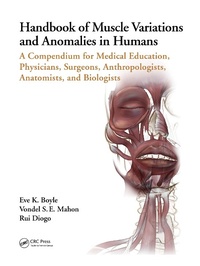
Handbook of Muscle Variations and Anomalies in Humans
A Compendium for Medical Education, Physicians, Surgeons, Anthropologists, Anatomists, and Biologists
1st Edition
Published on 8. March 2022
392 pages
978-1-000-54498-5 (ISBN)
Description

Most textbooks and atlases of human anatomy chronicle only a few cases of muscle variations in the "normal" human population, or of muscle anomalies within congenital malformations. Consequently, there is a misconception of what is considered "normal" human anatomy and what that looks like. Each person within the "normal" population has at least a few muscle variations, and there are millions of individuals born globally each year with muscle anomalies. There are crucial knowledge gaps between what is taught, what students learn, what textbooks and atlases show, and what truly happens in nature and within our species. This handbook fills this gap by: 1) providing a comparative evolutionary context for muscle variations and defects in humans, 2) summarizing the major types of variations and anomalies found in humans, and 3) including didactic figures for a visually engaging learning experience. This book is of interest to students, professors, and researchers in biological anthropology, comparative anatomy, functional morphology, zoology, and evolutionary and developmental biology, as well as to clinicians and practicing health professionals.
Key Features
Summarizes most recorded variations and anomalies for each muscle in the human body
Provides information on the comparative anatomy of each muscle, including evolutionary differences from our closest living relatives, the apes
Includes didactic illustrations of the variations and anomalies for a visually engaging learning experience
Comprehensively reviews literature to document prevalence information for each variation and anomaly, within humans
Related Titles
Brown, D. E. Human Biological Diversity, 2nd ed. (ISBN 978-1-138-03753-3)
Diogo, R., et al. Understanding Human Anatomy and Pathology: An Evolutionary and Developmental Guide for Medical Students (ISBN 978-1-4987-5384-5)
Diogo, R. Muscles of Chordates: Development, Homologies, and Evolution (ISBN 978-1-138-57116-7)
Key Features
Summarizes most recorded variations and anomalies for each muscle in the human body
Provides information on the comparative anatomy of each muscle, including evolutionary differences from our closest living relatives, the apes
Includes didactic illustrations of the variations and anomalies for a visually engaging learning experience
Comprehensively reviews literature to document prevalence information for each variation and anomaly, within humans
Related Titles
Brown, D. E. Human Biological Diversity, 2nd ed. (ISBN 978-1-138-03753-3)
Diogo, R., et al. Understanding Human Anatomy and Pathology: An Evolutionary and Developmental Guide for Medical Students (ISBN 978-1-4987-5384-5)
Diogo, R. Muscles of Chordates: Development, Homologies, and Evolution (ISBN 978-1-138-57116-7)
More details
Edition
1. Auflage
Language
English
Place of publication
London
United Kingdom
Publishing group
Taylor & Francis Ltd
Target group
College/higher education
Professional and scholarly
Product notice
Reflowable
Illustrations
57 Line drawings, color; 57 Illustrations, color
ISBN-13
978-1-000-54498-5 (9781000544985)
Copyright in bibliographic data and cover images is held by Nielsen Book Services Limited or by the publishers or by their respective licensors: all rights reserved.
Schweitzer Classification
Other editions
Additional editions
Eve K. Boyle | Vondel S. E. Mahon | Rui Diogo
Handbook of Muscle Variations and Anomalies in Humans
A Compendium for Medical Education, Physicians, Surgeons, Anthropologists, Anatomists, and Biologists
Book
05/2024
1st Edition
CRC Press
€113.80
Shipment within 15-20 days
Eve K. Boyle | Vondel S. E. Mahon | Rui Diogo
Handbook of Muscle Variations and Anomalies in Humans
A Compendium for Medical Education, Physicians, Surgeons, Anthropologists, Anatomists, and Biologists
Book
03/2022
1st Edition
CRC Press
€210.46
Shipment within 15-20 days
Persons
Eve K. Boyle is an evolutionary anthropologist with expertise in informal science education, public engagement, project management, and broadening participation initiatives. She received her Ph.D. from the Center for the Advanced Study of Human Paleobiology of George Washington University in 2019. As a postdoctoral fellow at Howard University from 2019 to 2020, she was the first project manager for the Visible Ape Project. She served as an AAAS Science & Technology Policy Fellow at the National Science Foundation from 2020 to 2022.
Vondel S.E. Mahon is a Medical Illustrator at Mahon Illustrations LLC and at private enterprise. He received his M.A. in Medical and Biological Illustration from the Department of Art as Applied to Medicine at the Johns Hopkins University School of Medicine. For his master's thesis he developed a novel tool for orthopedic trauma education with the Johns Hopkins University Computer Aided Medical Procedures Laboratory and the Johns Hopkins Medicine Technology Innovation Center. He holds interest in the use of Extended Reality (XR) technology in healthcare and medical education. He is also a proud member of the Association of Medical Illustrators (AMI).
Rui Diogo is a multi-awarded researcher, speaker and writer that is renowned worldwide for addressing broader scientific questions and societal issues using state-of-the-art empirical data from many different fields of science. He obtained his Bachelor's degree in Biology from the University of Aveiro, Portugal, and later did a PhD at the University of Liege, Belgium, a postdoc at the King's College of London, and then a master's and a Ph.D. at the Department of Biology of George Washington University, U.S. A wonderer and a wanderer, he has done research, gave speeches, or travelled in more than 120 countries. He is the author of more than 150 papers in top journals and 20 books, including "Learning and understanding human anatomy and pathology" - used at several medical schools worldwide -, "Evolution driven by organismal behavior" - often listed among the ten best evolutionary books in 2017, and the already highly acclaimed "Meaning of life, human nature, and delusions".
Vondel S.E. Mahon is a Medical Illustrator at Mahon Illustrations LLC and at private enterprise. He received his M.A. in Medical and Biological Illustration from the Department of Art as Applied to Medicine at the Johns Hopkins University School of Medicine. For his master's thesis he developed a novel tool for orthopedic trauma education with the Johns Hopkins University Computer Aided Medical Procedures Laboratory and the Johns Hopkins Medicine Technology Innovation Center. He holds interest in the use of Extended Reality (XR) technology in healthcare and medical education. He is also a proud member of the Association of Medical Illustrators (AMI).
Rui Diogo is a multi-awarded researcher, speaker and writer that is renowned worldwide for addressing broader scientific questions and societal issues using state-of-the-art empirical data from many different fields of science. He obtained his Bachelor's degree in Biology from the University of Aveiro, Portugal, and later did a PhD at the University of Liege, Belgium, a postdoc at the King's College of London, and then a master's and a Ph.D. at the Department of Biology of George Washington University, U.S. A wonderer and a wanderer, he has done research, gave speeches, or travelled in more than 120 countries. He is the author of more than 150 papers in top journals and 20 books, including "Learning and understanding human anatomy and pathology" - used at several medical schools worldwide -, "Evolution driven by organismal behavior" - often listed among the ten best evolutionary books in 2017, and the already highly acclaimed "Meaning of life, human nature, and delusions".
Content
Table of Contents
Preface
Acknowledgements
Extended table of contents listing individual muscles
1. Introduction
1.1 Why do humans have anatomical variations and anomalies?
1.2 Towards a more holistic approach to human anatomy and evolution
1.3 Brief notes about our methodology
2. Head and neck muscles
2.1 Facial muscles
2.2 Muscles of mastication
2.3 Extrinsic muscles of the ear and middle ear muscles
2.4 Muscles of the tongue
2.5 Muscles of the soft palate
2.6 Pharyngeal muscles
2.7 Laryngeal muscles
2.8 Infrahyoid muscles
2.9 Suprahyoid muscles
2.10 Extraocular muscles
2.11 Scalene, prevertebral, and suboccipital muscles
2.12 Posterolateral neck muscles
3. Upper limb muscles
3.1 Axial pectoral girdle muscles
3.2 Pectoral girdle and arm muscles
3.3 Anterior forearm muscles
3.4 Posterior forearm muscles
3.5 Muscles of the hand
4. Trunk muscles
4.1 Muscles of the abdominal region
4.2 Perineal, coccygeal, and anal musculature
4.3 Thorax, spine, and back muscles
5. Lower limb muscles
5.1 Gluteal and thigh muscles
5.2 Posterior muscles of the lower leg
5.3 Anterior and lateral muscles of the lower leg
5.4 Muscles of the foot
6. References
7. Index
Preface
Acknowledgements
Extended table of contents listing individual muscles
1. Introduction
1.1 Why do humans have anatomical variations and anomalies?
1.2 Towards a more holistic approach to human anatomy and evolution
1.3 Brief notes about our methodology
2. Head and neck muscles
2.1 Facial muscles
2.2 Muscles of mastication
2.3 Extrinsic muscles of the ear and middle ear muscles
2.4 Muscles of the tongue
2.5 Muscles of the soft palate
2.6 Pharyngeal muscles
2.7 Laryngeal muscles
2.8 Infrahyoid muscles
2.9 Suprahyoid muscles
2.10 Extraocular muscles
2.11 Scalene, prevertebral, and suboccipital muscles
2.12 Posterolateral neck muscles
3. Upper limb muscles
3.1 Axial pectoral girdle muscles
3.2 Pectoral girdle and arm muscles
3.3 Anterior forearm muscles
3.4 Posterior forearm muscles
3.5 Muscles of the hand
4. Trunk muscles
4.1 Muscles of the abdominal region
4.2 Perineal, coccygeal, and anal musculature
4.3 Thorax, spine, and back muscles
5. Lower limb muscles
5.1 Gluteal and thigh muscles
5.2 Posterior muscles of the lower leg
5.3 Anterior and lateral muscles of the lower leg
5.4 Muscles of the foot
6. References
7. Index
