

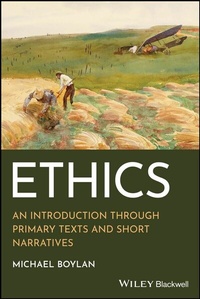
Ethics
Description

An innovative introduction to ethics through philosophy and fiction
Ethics: An Introduction with Primary Texts and Short Fictive Narratives offers a distinctive and pedagogically effective approach to ethical inquiry. Fostering a deep understanding of theory and its practical implications, the book begins with an accessible introduction to metaethics, addressing the foundational concepts that ground moral reasoning. It then moves through carefully abridged and newly translated selections from three pillars of Western ethical theory-Aristotle's Nicomachean Ethics, Kant's Groundwork, and Mill's Utilitarianism. These translations have been curated to highlight the central arguments and transitions within each thinker's system, allowing readers to engage directly and critically with major ethical frameworks.
What sets this volume apart is its innovative integration of the short fictional narratives and poetry of Michael Boylan, richly illustrating the dimensions of moral philosophy. These narratives serve as applied ethics case studies, encouraging readers to bridge theoretical knowledge with real-life decision-making. Structured exercises, study questions, and feedback sections support active learning, while the philosophical treatment of fictive narrative invites reflection on the nature and power of storytelling in ethical discourse.
Authored by a leading scholar with expertise in both ethical theory and creative writing. Ethics: An Introduction with Primary Texts and Short Narratives:
- Enables direct engagement with core arguments of Virtue Ethics, Deontology, and Utilitarianism
- Applies the concept of "fictive narrative philosophy" to stimulate reflective and critical ethical reasoning
- Provides a unified conceptual approach through the Personal and Shared Community Worldview Imperatives
- Employs a structured, progressive framework that integrates metaethics, normative theory, and applied ethics
- Supports interdisciplinary learning with content relevant to philosophy, literature, political science, and law
Ethics: An Introduction with Primary Texts and Short Narratives is ideal for introductory and intermediate undergraduate courses such as Introduction to Ethics, Ethical Theory, and Applied Ethics in degree programs across the humanities, social sciences, business, pre-professional studies, and other fields where ethical literacy is an essential skill.
More details
Other editions
Additional editions
Person
MICHAEL BOYLAN is Professor of Philosophy at Marymount University. He is the author of 45 books and over 150 academic articles. His work spans both analytic and literary disciplines, with emphasis on ethics, human rights, and narrative philosophy. His fiction and poetry have been published internationally, and his philosophical ideas have been presented at leading universities worldwide.
Content
Introduction
Part One: First Order Meta-Ethical Principles and Normative Ethical Theories
Chapter One: Boylan's First Order Meta-Ethical Principles
Chapter Two: Virtue Ethics (Selections from Aristotle's Nicomachean Ethics)
Chapter Three: Deontological Ethics (Selections from Kant's Groundwork)
Chapter Four: Utilitarianism (Selections from Mill's Utilitarianism)
Chapter Five: Structured Feed-back, Part One: First Order Meta-Ethical Principles and Normative Ethical Theories
Part Two: Short Narrative Fiction
The Theory
Chapter Six: The Logic and Domain of Fictive Narrative Philosophy
The Stories
Chapter Seven: "Starting Over and Under"
Chapter Eight: "The Natural Order"
Chapter Nine: "Ruby's Choice"
Chapter Ten: "Icing Dreamers"
Chapter Eleven: "Murder in Londonderry"
Chapter Twelve: "Executing the Will"
Chapter Thirteen: "Heading off to College"
Chapter Fourteen: "All's Fair in Love and War"
Chapter Fifteen: Structured Feed-back, Part Two & Final Paper Project
Appendix One: Theory: Using Poetry as Compressed Fictive Narratives Appendix Two: Examples of Poetry Making Claims Concerning Ethical and Social/Political Issues
Index of People and Ideas
Chapter 1
First-order Metaethical Principles: Boylan's Philosophical Work on Ethics and Personhood Theory
Introduction
We begin our express voyage into ethical theory with an examination of first-order ethical principles as set out by this author. As mentioned earlier, there are two forms of metaethics: first and second order. In the first order the author sets out intellectual presuppositions that are necessary in order to structure some normative theory. These principles can apply to any of the realistic, naturalistic theories that are set out in the subsequent chapters: virtue ethics, utilitarianism, and deontology.
The anti-realistic theories set out that my definition of ethics - the science of the right and wrong in human action - is wrong. These authors do not think ethics is a "science" at all. A science looks at the world and discovers facts about how it operates. These facts are separate from the practitioner. The anti-realist believes that ethics is conventional and that individuals and communities impose these random commands upon their members just because they can. The sources of this justification are various. Let's quickly look at three.
First is ethical intuitionism. Ethical intuitionism is an approach to ethics that espouses to rely upon an immediate grasping of ethical truths. According to proponents, certain ethical responses are hard-wired into the human consciousness. Whether the cause of this hard-wiring is evolution or divine modeling (or both), it is not measurable and therefore cannot count as a fact about the world. Ethical intuitionism may be the most prevalent approach to ethics in the world. This is because of its mode of transmission: adages. These moral maxims are passed down from parents and grandparents in the form of pithy slogans. Sometimes these pithy slogans contradict each other, such as "Look before you leap" and "Faint heart never won fair maiden." In these situations, intuition alone picks the one that is cogent to the situation at hand. In other situations, it is up to the practitioner to pick out one or more adages that are relevant to the present problem. It is also possible for the practitioner to create a novel response invented by herself. The principal advantage of this approach is that it is easy to apply and easy to pass on to others (such as one's children). The downside is that there is no intersubjective objective data through which a discussion might be enjoined in cases of disagreement. Whenever this is the result in normative instances, violence or force is the deciding factor. So, unless one is a kraterist (an advocate of "might makes right"), ethical intuitionism has severe drawbacks.
Second is ethical contractarianism.1 Under this approach whatever people agree to is ethical because of the agreement. Obviously, this biases toward individual and group autonomy as being the highest. Whatever is the result of free exchange among parties is all right. There are, of course, many instances in which consent is adequate for going forward. For example, if one goes to the doctor and there is a surgical procedure, then the physician solicits an informed consent form in order to proceed. This is an instance of consent within the agency realm of the individual only. When we expand the purview, Consent (with a capital "C") it is unclear how agency is decisive to normativity at all.2 This realm of Consent affects communities of all sizes. This is because the group can be skewed in its outlook - such as a majority population discriminating against a minority population. The fact that the members of the majority population agree to this arrangement is not decisive - even if some members of the minority population go along with it.3 People may also agree to conditions because they do not have adequate information and do not perform due diligence. Finally, there is the situation in which actors' consent to actions that most moral codes would find offensive (as defined by those normative ethical theories).4 Certainly, autonomy is a capacity that all would endorse, and its exhibition in interpersonal interactions via consent should be supported. However, it is not clear whether this transfers over to Consent as a justification for ethics. This author is dubious.
Third is ethical non-cognitivism. This is a very popular form of normative ethics that is supported principally by those interested in linguistics, psychology, sociology, and anthropology. This social science interest in non-cognitivism has to do with the general approach within the social sciences with the environmental effect of social institutions and apparatus upon the pliable human agent. For example, on the linguistic side, some would venture toward linguistic determinism in which the adoption of a language (and all that entails) reveals common normative bias. Then, on the social side, there is the effect of nurture via culture. This may be revealed via normal social analysis and may again bring in language (as a measure of behavior). Finally, psychology comes in as a way of expressing emotions: we create normative value on issues that we personally are interested in promoting. In all its forms ethical non-cognitivism is the most complex form of moral anti-realism. Because its language is social science and because social science has some basis in empiricism, this form of anti-realism is very compelling to those who (by disposition) are opposed to moral realism. And in the end, there is no way to prove either the realists or the anti-realists to be right in a way that is non-question begging for all.5
In contrast to the anti-realistic ethical position, realistic theories will be those accounts which set out that there are moral facts that are true or false. Anti-realistic theories assert that ethical theories are not about moral facts, but rather are expressions of emotion, or cultural conditioning, or artifacts of linguistic expression, or agreements entered upon by a group of people for particular purposes - such as laws. In each of these anti-realistic arrangements there are no facts that are true or false, but rather conventions that vary from time to time and from place to place. Under these accounts ethics is really a subject of anthropology and sociology: descriptive in its origin. Prescriptive power comes from social sanction and police departments only.
Naturalism refers to those realists who believe that the facts that they endorse exist in the natural world and can be discovered by people. Non-naturalists believe that the facts are not of this world, but of some other domain. Some ethicists and some religious moralists hold this position.6
This short text will take the position of realistic naturalism. It will examine first some first-order ethical principles as set out by this author in his own writings and then it will present three primary readings from three prominent philosophers: Aristotle, Kant, and Mill. In the end there are some pedagogical apparatuses to tie the textbook to the novels in the form of written assignments that fall in line with this approach.
Boylan's First-order Metaethical Principles
For our purposes the extent of the first-order ethical principles will be: (i) the personal worldview imperative, (ii) the shared community worldview imperative (and other community worldview imperatives), (iii) the argument for the moral status of basic goods, and (iv) the table of embeddedness. These are not exhaustive, but they will serve our purposes here.7
The Personal Worldview Imperative
The personal worldview imperative is: "All people must develop a single comprehensive and internally coherent worldview that is good and that we strive to act out in our daily lives." There are four parts to the personal worldview imperative: completeness, coherence, connection to a theory of the good, and practicality. Let's briefly say something about each.
First is completeness. Completeness refers to the ability of a theory or ethical system to handle all cases put before it and to determine an answer based upon the system's recommendations. This is functionally achieved via the creation of a goodwill. The goodwill is a mechanism by which we decide how to act in the world. The goodwill provides completeness to everyone who develops one.
There are two senses of the goodwill. The first is the rational goodwill, which means that each agent will develop an understanding about what reason requires of us as we go about our business in the world. Completeness means that reason (governed by the personal worldview and its operational ethical standpoint) should always be able to come up with an answer to a difficult life decision. In the case of ethics, the rational goodwill requires engaging in a rationally based philosophical ethics and abiding by what reason demands. Often this plays out practically in examining and justifying various moral maxims - such as maxim-alpha: "one has a moral responsibility to follow through on one's commitments, ceteris paribus." This maxim is about promise making - call it maxim-alpha. For example, one could imagine that an employer named Fred hired Olga on the basis of her résumé and a Skype interview which did not reveal her mobility challenges (she needs a walker to get from points A to B for perambulation). Fred promises Olga the job but when she shows up to work Fred determines that Olga does not fit the image of the company that he wishes to exude:...
