

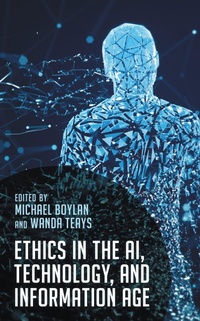
Ethics in the AI, Technology, and Information Age
1st Edition
Published on 11. May 2022
352 pages
979-8-8818-7543-5 (ISBN)
Description

Increasingly, technology, the Internet and social media are playing a major part in our lives. What should we think about the ethical issues that arise, such as the changing role of intelligent machines in this Information Age? The impact of technology upon society is a perennial question, but the power of computing and artificial intelligence has ratcheted up the ethical implications of this relationship. It merits careful consideration.
Ethics in the AI, Technology, and Information Age brings together a cohort of international scholars to explore the ethical ramifications of the latest technologies and their effects on our lives. This it does in three parts: (1) theoretical considerations, (2) practical applications, and (3) challenges. Beginning with theoretical essays, the book investigates the relationship between technology and nature, the limits of being "human" versus "machine," and the moral implications of artificial intelligence. The book then examines key questions; such as ownership of technology, artificial intelligence's replacement of human jobs and functions, privacy and cybersecurity, the ethics of self-driving cars, and the problematic aspects of drone warfare.
With an appendix of films and documentaries to inspire further discussion on these topics, students and scholars will find Ethics in the AI, Technology, and Information Age an essential and engaging resource both in the classroom and in their daily technology-filled lives.
Ethics in the AI, Technology, and Information Age brings together a cohort of international scholars to explore the ethical ramifications of the latest technologies and their effects on our lives. This it does in three parts: (1) theoretical considerations, (2) practical applications, and (3) challenges. Beginning with theoretical essays, the book investigates the relationship between technology and nature, the limits of being "human" versus "machine," and the moral implications of artificial intelligence. The book then examines key questions; such as ownership of technology, artificial intelligence's replacement of human jobs and functions, privacy and cybersecurity, the ethics of self-driving cars, and the problematic aspects of drone warfare.
With an appendix of films and documentaries to inspire further discussion on these topics, students and scholars will find Ethics in the AI, Technology, and Information Age an essential and engaging resource both in the classroom and in their daily technology-filled lives.
More details
Other editions
Additional editions
Michael Boylan | Wanda Teays
Ethics in the AI, Technology, and Information Age
Book
05/2022
Rowman & Littlefield Publishers
€152.20
Shipment within 3-4 weeks
Persons
Michael Boylan is professor of philosophy at Marymount University. He received his PhD at The University of Chicago. He has written extensively on ethical issues-both in theory and practice. His 2004 monograph, A Just Society was published by Rowman & Littlefield.
Wanda Teays is professor emerita at Mount Saint Mary's University in Los Angeles. She has an M.A. in Phi of Math ( University of Alberta), an MTS (Harvard), and PhD in Humanities (Concordia, Montreal). She has books and articles in the fields of applied ethics, critical thinking, ethics & film, human rights, torture, and bioethics-including Global Bioethics and Human Rights published by Rowman & Littlefield.
Wanda Teays is professor emerita at Mount Saint Mary's University in Los Angeles. She has an M.A. in Phi of Math ( University of Alberta), an MTS (Harvard), and PhD in Humanities (Concordia, Montreal). She has books and articles in the fields of applied ethics, critical thinking, ethics & film, human rights, torture, and bioethics-including Global Bioethics and Human Rights published by Rowman & Littlefield.
Content
Preface
PART ONE: THEORETICAL BACKGROUND
Section 1: Ethical Theory, Applied Ethics, and Professional Ethics
Michael Boylan, "Ethical Reasoning"Michael Boylan, "'Nature' as a Background Condition"Section 2: Humans and Machines: A New Ethical Paradigm?
Morgan Luck and Stephen Clarke, "Transformative Technologies, the Status Quo and (Religious) Institutions"Felicia Nimue Ackerman, "Transhumanism: Is this a Step Forward?"Mark Vopat, "A.I. and Human Rights: Present and Future Moral Challenges"PART TWO: APPLICATIONS
Section 1: The Practical Scope of TechnologyEthics
David E. McClean, "Is There a Need for a New, a Technology, Ethic?"Marvin T. Brown, "Technology, Environmentalism, and American Prosperity"Section 2: The Ownership of Technology and Technology Transfer
David Koepsell, "Ownership of Information Technology"Luciano Floridi, "The Fight for Digital Sovereignty"Section 3: Information Technology and Social Media
Dean Cocking and Jeroen van den Hoven, "The Moral Fog of Social Media"Dean Cocking and Brigid Evans, "Becoming Good and Growing up Online"Edward H. Spence, "The Privacy Paradox"PART THREE: CHALLENGES
Section 1: AI and its Applications
Rita Manning,"AI in Health Care: Ethical Issues"Jens Kipper, "The Ethics of Self-vDriving Cars"Sven Nyholm, "Moral Dilemmas of Self-Driving Cars"Section 2: Cybersecurity
Seumas Miller, "AI and Criminal Justice: Individual Autonomy, Joint Rights and Collective Responsibility"Rosalie Waelen and Philip Brey, "Ethical Dimensions of Facial Recognition and Video Analytics in Surveillance"Karsten Weber and Nadine Kleine, "Cybersecurity in Health Care"Section 3: Technology and War
Wanda Teays "The Ethics of Drone Killings and Assassinations"Shannon E. French, "War and Technology: Should Data Decide Who Lives, Who Dies?"Appendix: Films and Documentaries on Technology Ethics
PART ONE: THEORETICAL BACKGROUND
Section 1: Ethical Theory, Applied Ethics, and Professional Ethics
Michael Boylan, "Ethical Reasoning"Michael Boylan, "'Nature' as a Background Condition"Section 2: Humans and Machines: A New Ethical Paradigm?
Morgan Luck and Stephen Clarke, "Transformative Technologies, the Status Quo and (Religious) Institutions"Felicia Nimue Ackerman, "Transhumanism: Is this a Step Forward?"Mark Vopat, "A.I. and Human Rights: Present and Future Moral Challenges"PART TWO: APPLICATIONS
Section 1: The Practical Scope of TechnologyEthics
David E. McClean, "Is There a Need for a New, a Technology, Ethic?"Marvin T. Brown, "Technology, Environmentalism, and American Prosperity"Section 2: The Ownership of Technology and Technology Transfer
David Koepsell, "Ownership of Information Technology"Luciano Floridi, "The Fight for Digital Sovereignty"Section 3: Information Technology and Social Media
Dean Cocking and Jeroen van den Hoven, "The Moral Fog of Social Media"Dean Cocking and Brigid Evans, "Becoming Good and Growing up Online"Edward H. Spence, "The Privacy Paradox"PART THREE: CHALLENGES
Section 1: AI and its Applications
Rita Manning,"AI in Health Care: Ethical Issues"Jens Kipper, "The Ethics of Self-vDriving Cars"Sven Nyholm, "Moral Dilemmas of Self-Driving Cars"Section 2: Cybersecurity
Seumas Miller, "AI and Criminal Justice: Individual Autonomy, Joint Rights and Collective Responsibility"Rosalie Waelen and Philip Brey, "Ethical Dimensions of Facial Recognition and Video Analytics in Surveillance"Karsten Weber and Nadine Kleine, "Cybersecurity in Health Care"Section 3: Technology and War
Wanda Teays "The Ethics of Drone Killings and Assassinations"Shannon E. French, "War and Technology: Should Data Decide Who Lives, Who Dies?"Appendix: Films and Documentaries on Technology Ethics
