

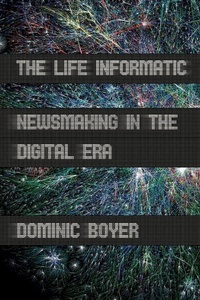
The Life Informatic
Newsmaking in the Digital Era
Published on 15. May 2013
240 pages
978-0-8014-6734-9 (ISBN)
Description

News journalism is in the midst of radical transformation brought about by the spread of digital information and communication technology and the rise of neoliberalism. What does it look like, however, from the inside of a news organization? In The Life Informatic, Dominic Boyer offers the first anthropological ethnography of contemporary office-based news journalism. The result is a fascinating account of journalists struggling to maintain their expertise and authority, even as they find their principles and skills profoundly challenged by ever more complex and fast-moving streams of information.
Boyer conducted his fieldwork inside three news organizations in Germany (a world leader in digital journalism) supplemented by extensive interviews in the United States. His findings challenge popular and scholarly images of journalists as roving truth-seekers, showing instead the extent to which sedentary office-based "screenwork" (such as gathering and processing information online) has come to dominate news journalism. To explain this phenomenon Boyer puts forth the notion of "digital liberalism"-a powerful convergence of technological and ideological forces over the past two decades that has rebalanced electronic mediation from the radial (or broadcast) tendencies of the mid-twentieth century to the lateral (or peer-to-peer) tendencies that dominate in the era of the Internet and social media. Under digital liberalism an entire regime of media, knowledge, and authority has become integrated around liberal principles of individuality and publicity, both unmaking and remaking news institutions of the broadcast era. Finally, Boyer offers some scenarios for how news journalism will develop in the future and discusses how other intellectual professionals, such as ethnographers, have also become more screenworkers than fieldworkers.
Boyer conducted his fieldwork inside three news organizations in Germany (a world leader in digital journalism) supplemented by extensive interviews in the United States. His findings challenge popular and scholarly images of journalists as roving truth-seekers, showing instead the extent to which sedentary office-based "screenwork" (such as gathering and processing information online) has come to dominate news journalism. To explain this phenomenon Boyer puts forth the notion of "digital liberalism"-a powerful convergence of technological and ideological forces over the past two decades that has rebalanced electronic mediation from the radial (or broadcast) tendencies of the mid-twentieth century to the lateral (or peer-to-peer) tendencies that dominate in the era of the Internet and social media. Under digital liberalism an entire regime of media, knowledge, and authority has become integrated around liberal principles of individuality and publicity, both unmaking and remaking news institutions of the broadcast era. Finally, Boyer offers some scenarios for how news journalism will develop in the future and discusses how other intellectual professionals, such as ethnographers, have also become more screenworkers than fieldworkers.
Reviews / Votes
"Boyer analyzes the nuances of screen-oriented news-work in truly exemplary fashion; indeedmany journalism studies scholars and budding newsroom ethnographers could learn a great deal from this practicing anthropologist about how to so newsroom fieldwork well... we must take the arguments of The Life Informatic seriously. It certainly stands as a remarkably important piece of ethnographic and anthropological scholarship." -C.W. AndersonCollege of Staten Island (CUNY)(Anthropological Quarterly) Dominic Boyer's thoughtful exploration of news production in Germany is a standout among recent newsroom studies based on ethnography, observation, or participant observation....Boyer writes that he envisioned The Life Informatic as 'short, accessible, and above all teachable,' and it is all those things. Any of the ethnographic chapters could be used in a graduate or advanced undergraduate course without the instructor feeling that he or she needed to assign the entire book.
- Susan Keith (Journalism) In his intriguing new study The Life Informatic: Newsmaking in the Digital Era, anthropologist Dominic Boyer.. brings a rich ethnographic focus on daily labor practices rather than on industry-or organization-scale relationships....[this] deep ethnographic study reveals in sharp detail one aspect of the 'life informatic' when it comes to the competitive environment of global, digital, and often entertainment-focused journalism.
- Greg Downey (Technology and Culture) In The Life Informatic, Dominic Boyer examines the changing news industry by observing journalists at work, in the hope that mapping the flow of information between and within newsrooms will help us understand how news is made in today's post-broadcast era. Boyer is ultimately successful in presenting a contemporary account of the converged newsroom and adding to a body of evidence-based thought about how to build a sustainable industry in the future.
- Scott Bridges (Inside Story) This book offers much that will interest advanced students of journalism and anthropology.
(Choice)
More details
Series
Language
English
Place of publication
Ithaca
United States
Product notice
Reflowable
Illustrations
10 halftones, 2 line drawings - 10 Halftones, black and white
ISBN-13
978-0-8014-6734-9 (9780801467349)
Copyright in bibliographic data and cover images is held by Nielsen Book Services Limited or by the publishers or by their respective licensors: all rights reserved.
Schweitzer Classification
Other editions
Additional editions
Book
05/2013
Cornell University Press
€43.33
Article not available at the moment
Book
05/2013
Cornell University Press
€148.56
Shipment within 10-20 days
Person
Dominic Boyer is Associate Professor of Anthropology at Rice University. He is the author of Understanding Media: A Popular Philosophy and Spirit and System: Media, Intellectuals and the Dialectic in Modern German Culture.
Content
PrologueIntroduction: News Journalism Today1. The Craft of Slotting: Screenwork, Attentional Practices, and News Value at an International News Agency2. Click and Spin: Time, Feedback, and Expertise at an Online News Portal3. Countdown: Professionalism, Publicity, and Po liti cal Culture in 24/7 News Radio4. The News Informatic: Five Refl ections on Journalism in the Era of Digital LiberalismEpilogue: Informatic Unconscious: On the Evolution of Digital Reason in AnthropologyNotes
Bibliography
Bibliography
