

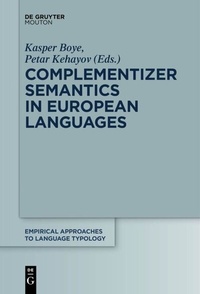
Complementizer Semantics in European Languages
1st Edition
Published on 11. July 2016
XVI, 894 pages
978-3-11-041661-9 (ISBN)
Description

Complementizers may be defined as conjunctions that have the function of identifying clauses as complements. In recent years, it has become increasingly clear that they have additional functions. Some of these functions are semantic in the sense that they represent conventional contributions to the meanings of the complements. The present book puts a focus to these semantic complementizer functions.
More details
Series
Language
English
Place of publication
Berlin/Boston
Germany
Publishing group
de Gruyter Mouton
Target group
Professional and scholarly
US School Grade: College Graduate Student
File size
3,56 MB
ISBN-13
978-3-11-041661-9 (9783110416619)
DOI
http://www.degruyter.com/isbn/9783110416619
Schweitzer Classification
Other editions
Additional editions
Kasper Boye | Petar Kehayov
Complementizer Semantics in European Languages
Book
06/2018
1st Edition
De Gruyter Mouton
€54.95
Shipment within 7-9 days
Kasper Boye | Petar Kehayov
Complementizer Semantics in European Languages
Book
07/2016
1st Edition
De Gruyter Mouton
€189.95
Shipment within 7-9 days
Kasper Boye | Petar Kehayov
Complementizer Semantics in European Languages
E-Book
07/2016
1st Edition
De Gruyter Mouton
€189.95
Available for download
Persons
Kasper Boye, University of Copenhagen, Denmark; Petar Kehayov, University of Tartu, Estland & University of Regensburg, Germany.
Content
- Intro
- Foreword
- Table of contents
- List of contributors
- List of gloss abbreviations
- Complementizer semantics - an introduction
- Part I: Indo-European languages
- Finite clause complementizers in Celtic
- Syntactic and semantic aspects of Romance complementizers
- Complementizer semantics in the Germanic languages
- Complementizers in Slavonic (Russian, Polish, and Bulgarian)
- Semantic functions of complementizers in Baltic
- The semantics and syntax of complementation markers as an areal phenomenon in the Balkans, with special attention to Albanian
- Semantics of complementation in Ossetic
- Complementizers in Romani
- Part II: Non-Indo-European languages
- On the semantic function and selection of Basque finite complementizers
- Semantic functions of complementizers in Maltese
- Complementation marker semantics in Finnic (Estonian, Finnish, Karelian)
- Semantic functions of complementizers in Permic languages
- Modal functions of the complementizer hogy 'that' in Hungarian
- Clausal complementation in Turkish and Noghay in a semantic perspective
- Complementizers in Kalmyk
- Semantics of complementation in Adyghe
- Complementizers in Hinuq
- Complementizers and the complementizing function - structure and pragmatics in a panchronic perspective
- Complementizer semantics in European languages: Overview and generalizations
- Language index
- Subject index
