

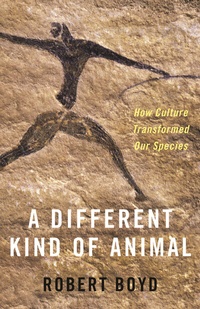
A Different Kind of Animal
How Culture Transformed Our Species
1st Edition
Published on 10. September 2018
248 pages
978-1-4008-8852-8 (ISBN)
Description

How our ability to learn from each other has been the essential ingredient to our remarkable success as a species
Human beings are a very different kind of animal. We have evolved to become the most dominant species on Earth. We have a larger geographical range and process more energy than any other creature alive. This astonishing transformation is usually explained in terms of cognitive ability-people are just smarter than all the rest. But in this compelling book, Robert Boyd argues that culture-our ability to learn from each other-has been the essential ingredient of our remarkable success.
A Different Kind of Animal demonstrates that while people are smart, we are not nearly smart enough to have solved the vast array of problems that confronted our species as it spread across the globe. Over the past two million years, culture has evolved to enable human populations to accumulate superb local adaptations that no individual could ever have invented on their own. It has also made possible the evolution of social norms that allow humans to make common cause with large groups of unrelated individuals, a kind of society not seen anywhere else in nature. This unique combination of cultural adaptation and large-scale cooperation has transformed our species and assured our survival-making us the different kind of animal we are today.
Based on the Tanner Lectures delivered at Princeton University, A Different Kind of Animal features challenging responses by biologist H. Allen Orr, philosopher Kim Sterelny, economist Paul Seabright, and evolutionary anthropologist Ruth Mace, as well as an introduction by Stephen Macedo.
Human beings are a very different kind of animal. We have evolved to become the most dominant species on Earth. We have a larger geographical range and process more energy than any other creature alive. This astonishing transformation is usually explained in terms of cognitive ability-people are just smarter than all the rest. But in this compelling book, Robert Boyd argues that culture-our ability to learn from each other-has been the essential ingredient of our remarkable success.
A Different Kind of Animal demonstrates that while people are smart, we are not nearly smart enough to have solved the vast array of problems that confronted our species as it spread across the globe. Over the past two million years, culture has evolved to enable human populations to accumulate superb local adaptations that no individual could ever have invented on their own. It has also made possible the evolution of social norms that allow humans to make common cause with large groups of unrelated individuals, a kind of society not seen anywhere else in nature. This unique combination of cultural adaptation and large-scale cooperation has transformed our species and assured our survival-making us the different kind of animal we are today.
Based on the Tanner Lectures delivered at Princeton University, A Different Kind of Animal features challenging responses by biologist H. Allen Orr, philosopher Kim Sterelny, economist Paul Seabright, and evolutionary anthropologist Ruth Mace, as well as an introduction by Stephen Macedo.
More details
Language
English
Place of publication
Princeton, NJ
United States
Publishing group
De Gruyter
Target group
Professional and scholarly
Edition type
Digital original
Product notice
Reflowable
Illustrations
5 halftones. 21 line illus. 1 table.
ISBN-13
978-1-4008-8852-8 (9781400888528)
Schweitzer Classification
Other editions
Additional editions
Book
11/2019
Princeton University Press
€21.00
Shipment within 10-20 days
Book
11/2017
Princeton University Press
€27.28
Shipment within 10-20 days
Person
Robert Boyd is Origins Professor in the School of Human Evolution and Social Change at Arizona State University. His books include How Humans Evolved, Not by Genes Alone: How Culture Transformed Human Evolution, and The Origin and Evolution of Cultures. He lives in Phoenix, Arizona.
Content
Acknowledgments vii
Introduction
Stephen Macedo 1
1 Not by Brains Alone: The Vital Role of Culture in Human Adaptation 9
2 Beyond Kith and Kin: Culture and the Scale of Human Cooperation 63
COMMENTS
3 Imitation, Hayek, and the Significance of Cultural Learning 125
H. Allen Orr
4 Adaptation without Insight? 135
Kim Sterelny
5 Inference and Hypothesis Testing in Cultural Evolution 152
Ruth Mace
6 Adaptable, Cooperative, Manipulative, and Rivalrous 160
Paul Seabright
RESPONSE
7 Culture, Beliefs, and Decisions 173
Notes 197
References 207
Contributors 223
Index 225
