

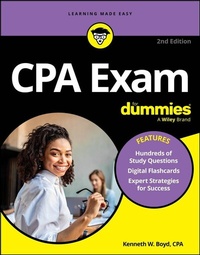
CPA Exam For Dummies
2nd Edition
Published on 4. April 2024
304 pages
978-1-394-24601-4 (ISBN)
Description

Pass the CPA exam with clear study material, online practice, and up-to-date content
CPA Exam For Dummies gives you a solid overview of everything you need to know to pass the Uniform CPA Examination--updated to reflect the 2024 exam updates. Only about half of aspiring CPAs pass the test their first time around. You can be in that one-and-done group, thanks to the concrete study plans in this book. You'll also get access to online resources, including study questions for each section of the exam and digital flashcards so you can really know your stuff on test day. Passing your exam is not just about the nuts and bolts. If you want to score your highest, you'll also need to understand how the test is organized and what to expect on text day. This Dummies study guide has you covered, with an overview of the updated exam and strategies for doing your very best.
* Review all content covered on the updated Uniform CPA Examination
* Answer practice questions and study with digital flashcards to solidify your knowledge
* Follow detailed study plans that will help you keep your test prep on track
* Maximize your score, pass the test, and launch your career as a CPA
Anyone on the CPA track needs a copy of CPA Exam For Dummies. It's great as a supplement to review and prep courses, or all on its own.
CPA Exam For Dummies gives you a solid overview of everything you need to know to pass the Uniform CPA Examination--updated to reflect the 2024 exam updates. Only about half of aspiring CPAs pass the test their first time around. You can be in that one-and-done group, thanks to the concrete study plans in this book. You'll also get access to online resources, including study questions for each section of the exam and digital flashcards so you can really know your stuff on test day. Passing your exam is not just about the nuts and bolts. If you want to score your highest, you'll also need to understand how the test is organized and what to expect on text day. This Dummies study guide has you covered, with an overview of the updated exam and strategies for doing your very best.
* Review all content covered on the updated Uniform CPA Examination
* Answer practice questions and study with digital flashcards to solidify your knowledge
* Follow detailed study plans that will help you keep your test prep on track
* Maximize your score, pass the test, and launch your career as a CPA
Anyone on the CPA track needs a copy of CPA Exam For Dummies. It's great as a supplement to review and prep courses, or all on its own.
More details
Other editions
Additional editions
Person
Kenneth W. Boyd, CPA, has more than 30 years of experience in accounting and education. Ken worked as a CPA in KPMG's Audit department and in his own tax and consulting practice. He currently teaches accounting and finance online through his own firm, St. Louis Test Preparation. Ken is the author of Cost Accounting For Dummies.
Content
- Intro
- Title Page
- Copyright Page
- Table of Contents
- Introduction
- About This Book
- Foolish Assumptions
- Icons Used in This Book
- Beyond the Book
- Where to Go from Here
- Part 1 Getting Started with the CPA Exam
- Chapter 1 So You Want to Become a CPA
- Added Responsibilities with a CPA Designation
- Considering What a CPA Does
- Accounting work and controller positions
- Auditing, reviews, and compilations
- Reviewing jobs in the field
- Going over the audit process
- Preparing tax returns
- Branching out into other careers
- Comparing a CPA to Other Credentials
- Checking out the chartered financial analyst (CFA) credential
- Mulling over the certified valuation analyst (CVA) credential
- Understanding the CPA Licensing Requirements
- Going over education requirements
- Meeting the experience requirement
- Addressing ethics
- Walking through CPA Exam Topics
- Chapter 2 Getting Acquainted with the CPA Exam
- Knowing What's on the Exam
- The three discipline tests
- Choosing the business analysis and reporting (BAR) test
- Going with the information systems and controls (ISC) test
- Studying for the tax compliance and planning (TCP) test
- Financial accounting and reporting
- Auditing and attestation
- Taxation and regulation
- Understanding the Exam Format
- Navigating the online tests
- Encountering different types of questions
- Looking at the structure of the tests
- Going Over the Skills You Need to Succeed on the Exam
- Understanding How the Tests Are Weighted
- How Did You Do? Knowing How the Exam Is Graded
- Chapter 3 Applying, Scheduling, and Planning for Your Exam Day
- Making Sure You've Met the Prerequisites
- Considering your amount of education
- Adding in your experience
- Reviewing the licensing requirements
- Applying to Take the Exam
- Applying for Special Accommodations
- Scheduling the Exam
- Where to take the test
- When to take it
- Canceling and rescheduling your test date
- Considerations Before the Exam
- Having a study plan
- Psyching yourself up
- Arriving at the Test Center
- Sitting at the Exam
- Following the rules
- Helping to improve the exam for others
- Chapter 4 Implementing a Study Program
- Reaching Your Goal of Passing the Exam
- Setting an Overall Study Schedule
- Scheduling factors to consider
- Noting how much time you have before your tests
- Looking at recent accounting classes
- Taking job and travel issues into account
- Including personal and family issues
- Deciding on your best time of day
- Using a study planner
- Creating a Study Plan for Each Test
- Auditing and attestation study plan
- Dealing with auditing language
- Preparing for report questions
- Separating definitions of risk
- Financial accounting and reporting study plan
- Understanding source documents
- Calculating answers correctly
- Comparing cash and accrual basis accounting
- Taxation and regulation study plan
- Getting an overview of taxation
- Evaluating business entities
- Adding in business ethics
- Discipline test study plan
- Working with currency risk
- Handling financial ratios and formulas
- Segregating duties
- Following Up after Your Tests
- Considering your results
- Appealing your score
- Chapter 5 Understanding the Types of CPA Questions
- Adopting a Useful Mindset for Taking the Exam
- Putting Together a Strategy for Multiple-Choice Questions
- Going over the structure of a question
- Mulling over traits of a well-written question
- Answering a multiple-choice question
- Considering Task-Based Simulations
- Auditing and attestation (AUD) simulation
- Financial accounting and reporting (FAR) simulation
- Reviewing Six Key Concepts to Improve Your Score
- Emphasizing the balance sheet formula
- Distinguishing between realized gains and recognized gains
- Keeping total depreciation in mind
- Comparing depreciation and amortization
- Working with bond amortization
- Wrapping up with dilutive securities
- Part 2 Discipline Tests
- Chapter 6 Understanding the Business Analysis and Reporting Test
- Using Business Analysis
- Understanding financial ratios
- Thinking about liquidity ratios
- Considering solvency ratios
- Mulling over profitability ratios
- Moving to performance ratios
- Managing with a balanced scorecard
- Applying cost accounting concepts
- Working with Technical Accounting and Reporting
- Thinking about the business cycle
- Analyzing capital structure
- Financing for the short term
- Using cost of capital for long-term financing
- Applying asset valuation methods
- Working with goodwill
- Dealing with internally-generated software
- Evaluating risk management issues
- Understanding COSO
- Segregating duties to reduce risk
- Considering economic factors
- Reviewing your competition
- Working with marginal utility
- Accounting for State and Local Governments
- Working with statement of net position
- Going over statement of activities
- Chapter 7 Reviewing the Information Systems and Controls Test
- Going Over Information Systems and Data Management
- Reviewing cloud computing and ERPs
- Analyzing disaster recovery plans and business continuity
- Mulling over change management
- Considering data management
- Evaluating Security, Confidentiality, and Privacy
- Reviewing important regulatory bodies
- Evaluating potential threats and attacks
- Implementing mitigation strategies
- Testing controls
- Understanding System and Organization Controls (SOC) Engagements
- Defining SOC engagements
- Going over risk assessment
- Considering materiality
- Testing procedures
- Chapter 8 Going Over the Tax Compliance and Planning Test
- Reviewing Tax Planning for Individuals
- Calculating gross income
- Working with the taxable income formula
- Activities included in income
- Activities excluded from income
- Understanding alternative minimum tax
- Working with deductions and payments
- Using itemized deductions
- Calculating estimated tax payments
- Addressing the gift tax and the estate tax
- Considering the impact of taxes on investments
- Dealing with gains and losses
- Understanding basis and historical cost
- Thinking About Business Tax Compliance
- Using a C corporation
- Reviewing graduated tax rates
- Going over C corporation distributions
- Strategies for C corporation tax planning
- Planning for S corporations
- Understanding partnership tax compliance
- Going over partnership basis
- Checking out partnership withdrawals
- Analyzing taxation of trusts and estates
- Introducing distributable net income
- Commenting on trust taxation
- Working on estate taxation
- Chapter 9 Discipline Practice Questions
- Business Management
- IT Issues
- Financial Ratios and Metrics
- Accounting Transactions
- Taxation
- Chapter 10 Answers and Explanations to Discipline Test Practice Questions
- Business Management
- IT Issues
- Financial Ratios and Metrics
- Accounting Transactions
- Taxation
- Part 3 Financial Accounting and Reporting
- Chapter 11 Taking a Closer Look at the Financial Accounting and Reporting Test
- Starting with Standards for Financial Statements
- Reviewing regulators and reporting methods
- Going over specific financial statements
- Starting with the balance sheet and income statement
- Considering the statement of cash flows
- Adding in other statements and disclosures
- Reporting on a segment
- Choosing an accounting basis
- Going through the Accounts
- Checking out asset accounts
- Going over prepaid assets
- Reviewing bad debt and accounts receivable
- Mulling over inventory valuation
- Recalling fixed assets
- Planning with future value and present value
- Working with intangible assets
- Leasing assets
- Looking at nonmonetary exchanges
- Accounting for investments
- Valuing certain investments
- Catching up on liabilities and equity
- Accruing liabilities
- Dealing with long-term debt
- Amortizing bonds
- Throwing in other long-term debts
- Finishing with equity
- Posting gains and losses from stock options
- Wrapping up with revenue
- Considering Important Transactions and Events
- Correcting errors and reviewing accounting changes
- Changing the accounting records
- Dealing with consolidations and combinations
- Going over other income statement activity
- Looking over earnings per share
- Adding in extraordinary and unusual items to find net income
- Nailing down comprehensive income
- Adding other required disclosures
- Remembering related parties
- Disclosing subsequent events
- Dealing with contingent liabilities
- Accounting for Government Entities
- Checking out financial reports for a general fund
- Presenting appropriations, encumbrances, and expenditures
- Keeping Up with Not-for-Profits
- Starting with the statement of financial position
- Moving on to the statement of activities
- Adding in the statement of cash flows and notes
- Chapter 12 Financial Accounting and Reporting Practice Questions
- Business Combinations and Consolidations
- Basic Concepts
- Error Correction
- Accounting Changes
- Financial Statements
- Inventory
- Fixed Assets
- Monetary Current Assets and Liabilities
- Present Value Fundamentals
- Present Value Bonds
- Present Value Debt Restructure
- Present Value Pension
- Present Value Leases
- Deferred Taxes
- Stockholders' Equity
- Investments
- Statement of Cash Flows
- Personal Financial Statements
- Interim Reporting
- Segment Reporting
- Partnership Accounting
- Chapter 13 Answers and Explanations to Financial Accounting and Reporting Practice Questions
- Business Combinations and Consolidations
- Basic Concepts
- Error Correction
- Accounting Changes
- Financial Statements
- Inventory
- Fixed Assets
- Monetary Current Assets and Liabilities
- Present Value Fundamentals
- Present Value Bonds
- Present Value Debt Restructure
- Present Value Pension
- Present Value Leases
- Deferred Taxes
- Stockholders' Equity
- Investments
- Statement of Cash Flows
- Personal Financial Statements
- Interim Reporting
- Segment Reporting
- Partnership Accounting
- Part 4 Auditing and Attestation
- Chapter 14 Taking a Closer Look at the Auditing and Attestation Test
- Understanding the Engagement
- Defining an audit
- Gaining knowledge of the client
- Going over the nature and scope of the audit
- Walking through assertions
- Planning in more detail
- Looking over an engagement letter
- Reading a sample engagement letter
- Kicking around the work of internal auditors and outside specialists
- Assessing the Company and Internal Controls
- Resolving materiality, risk assessment, and fraud
- Starting with materiality
- Judging the balance sheet
- Linking materiality to the income statement
- Performing risk assessment and fraud risk
- Reviewing an internal control environment
- Performing Audit Procedures
- Deciding on procedures for the audit
- Using audit software
- Moving on to internal audit work and test of controls
- Introducing sampling
- Understanding sampling basics
- Comparing risks related to sampling
- Auditing inventories
- Using estimates and subsequent events
- Considering the Results of Your Audit Work
- Reading an unqualified audit opinion
- Adding explanatory language to an unqualified report
- Reporting on a scope limitation with an emphasis- of-matter paragraph
- Explaining the work of another auditor
- Going over other audit opinions: Qualified, adverse, or no opinion
- Working with a qualified opinion
- Dealing with an adverse opinion
- Deciding to disclaim an opinion
- Creating reports on internal controls and other work
- Going Over Accounting and Review Engagements
- Meeting minimum SSARS requirements
- Working on a compilation engagement
- Going over a review engagement
- Moving through Professional Responsibilities
- Chapter 15 Auditing and Attestation Practice Questions
- Auditing and Review Services
- Auditing with Technology
- Audit Sampling
- Engagement Planning
- Evidence
- Internal Control
- Reporting
- Professional Responsibilities
- Chapter 16 Answers and Explanations to Auditing and Attestation Practice Questions
- Auditing and Review Services
- Auditing with Technology
- Audit Sampling
- Engagement Planning
- Evidence
- Internal Control
- Reporting
- Professional Responsibilities
- Part 5 Taxation and Regulation
- Chapter 17 Taking a Closer Look at the Taxation and Regulation Test
- Addressing the CPA's Responsibilities
- Understanding ethics requirements for a CPA practice
- Considering your legal duties and responsibilities
- Mulling Over Business Law Issues
- Presenting the concept of agency
- Going over agency liability issues
- Adding in tort liability
- Getting up to speed on contracts
- Forming a contract
- Considering defenses and remedies
- Understanding third-party contracts
- Using the Uniform Commercial Code (UCC) and credit relationships
- Going over sales
- Plugging in sales warranties and sales liabilities
- Putting in negotiable instruments and using titles
- Relating debtors to creditors
- Reviewing Chapter 7 and 11 bankruptcy rules
- Digging into Chapter 7 bankruptcy
- Continuing with Chapter 11 bankruptcy
- Choosing a business structure and other regulations
- Picking a partnership structure
- Choosing a corporate structure
- Taking on security regulation
- Considering the Securities Act of '33
- Moving to the Securities Act of '34
- Remembering property transfers
- Taxing Individuals
- Filing a return
- Going over filing status
- Reviewing head of household status
- Chapter 18 Taxation and Regulation Practice Questions
- Agency
- Bankruptcy
- Business Structure
- Contracts
- Commercial Paper
- Debtor-Creditor Relationships
- Regulation of Employment
- Federal Securities
- Professional/Legal Responsibilities
- Taxation
- Property
- Sales
- Secured Transactions
- Chapter 19 Answers and Explanations to Taxation and Regulation Practice Questions
- Agency
- Bankruptcy
- Business Structure
- Contracts
- Commercial Paper
- Debtor-Creditor Relationships
- Regulation of Employment
- Federal Securities
- Professional/Legal Responsibilities
- Property
- Sales
- Secured Transactions
- Part 6 The Part of Tens
- Chapter 20 Ten Common Mistakes on the CPA Exam
- Skipping Your Notes When You Review Your Answers
- Not Knowing the Language in Audit Reports
- Not Understanding Segregating Duties
- Applying Accounting Policy Inconsistently
- Not Reviewing Financial Ratios by Type
- Forgetting to Consider the Type of Taxation
- Not Memorizing the Tax Format on Form 1040
- Confusing Present Value and Future Value
- Failing to Keep the Big Four Type of Costs Straight
- Not Considering Employer Responsibilities for Individual Contractors
- Chapter 21 Ten Important Formulas to Understand
- Breakeven in Total Dollars and Units Sold
- Accrued Interest Paid by a Bond Buyer
- Double-Declining Balance Depreciation
- Multi-Step Income Statement
- Inventory Turnover
- Receivable Turnover
- Effective Interest Rate Method
- Special-Order Profitability
- Individual Taxation Formula: Form 1040
- Liquidity and Solvency Formulas
- Glossary of Accounting Terms
- Index
- EULA
