

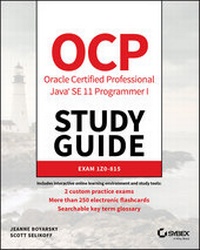
OCP Oracle Certified Professional Java SE 11 Programmer I Study Guide
Exam 1Z0-815
1st Edition
Published on 19. November 2019
608 pages
978-1-119-58472-8 (ISBN)
Description

This OCP Oracle Certified Professional Java SE 11 Programmer I Study Guide: Exam 1Z0-815 and the Programmer II Study Guide: Exam 1Z0-816 were published before Oracle announced major changes to its OCP certification program and the release of the new Developer 1Z0-819 exam.
No matter the changes, rest assured both of the Programmer I and II Study Guides cover everything you need to prepare for and take Exam 1Z0-819. If you've purchased one of the Programmer Study Guides, purchase the other one and you'll be all set.
NOTE: The OCP Java SE 11 Programmer I Exam 1Z0-815 and Programmer II Exam 1Z0-816 have been retired (as of October 1, 2020), and Oracle has released a new Developer Exam 1Z0-819 to replace the previous exams. The Upgrade Exam 1Z0-817 remains the same.
The comprehensive study aide for those preparing for the new Oracle Certified Professional Java SE Programmer I Exam 1Z0-815
Used primarily in mobile and desktop application development, Java is a platform-independent, object-oriented programming language. It is the principal language used in Android application development as well as a popular language for client-side cloud applications. Oracle has updated its Java Programmer certification tracks for Oracle Certified Professional.
OCP Oracle Certified Professional Java SE 11 Programmer I Study Guide covers 100% of the exam objectives, ensuring that you are thoroughly prepared for this challenging certification exam. This comprehensive, in-depth study guide helps you develop the functional-programming knowledge required to pass the exam and earn certification. All vital topics are covered, including Java building blocks, operators and loops, String and StringBuilder, Array and ArrayList, and more. Included is access to Sybex's superior online interactive learning environment and test bank--containing self-assessment tests, chapter tests, bonus practice exam questions, electronic flashcards, and a searchable glossary of important terms. This indispensable guide:
* Clarifies complex material and strengthens your comprehension and retention of key topics
* Covers all exam objectives such as methods and encapsulation, exceptions, inheriting abstract classes and interfaces, and Java 8 Dates and Lambda Expressions
* Explains object-oriented design principles and patterns
* Helps you master the fundamentals of functional programming
* Enables you to create Java solutions applicable to real-world scenarios
There are over 9 millions developers using Java around the world, yet hiring managers face challenges filling open positions with qualified candidates. The OCP Oracle Certified Professional Java SE 11 Programmer I Study Guide will help you take the next step in your career.
No matter the changes, rest assured both of the Programmer I and II Study Guides cover everything you need to prepare for and take Exam 1Z0-819. If you've purchased one of the Programmer Study Guides, purchase the other one and you'll be all set.
NOTE: The OCP Java SE 11 Programmer I Exam 1Z0-815 and Programmer II Exam 1Z0-816 have been retired (as of October 1, 2020), and Oracle has released a new Developer Exam 1Z0-819 to replace the previous exams. The Upgrade Exam 1Z0-817 remains the same.
The comprehensive study aide for those preparing for the new Oracle Certified Professional Java SE Programmer I Exam 1Z0-815
Used primarily in mobile and desktop application development, Java is a platform-independent, object-oriented programming language. It is the principal language used in Android application development as well as a popular language for client-side cloud applications. Oracle has updated its Java Programmer certification tracks for Oracle Certified Professional.
OCP Oracle Certified Professional Java SE 11 Programmer I Study Guide covers 100% of the exam objectives, ensuring that you are thoroughly prepared for this challenging certification exam. This comprehensive, in-depth study guide helps you develop the functional-programming knowledge required to pass the exam and earn certification. All vital topics are covered, including Java building blocks, operators and loops, String and StringBuilder, Array and ArrayList, and more. Included is access to Sybex's superior online interactive learning environment and test bank--containing self-assessment tests, chapter tests, bonus practice exam questions, electronic flashcards, and a searchable glossary of important terms. This indispensable guide:
* Clarifies complex material and strengthens your comprehension and retention of key topics
* Covers all exam objectives such as methods and encapsulation, exceptions, inheriting abstract classes and interfaces, and Java 8 Dates and Lambda Expressions
* Explains object-oriented design principles and patterns
* Helps you master the fundamentals of functional programming
* Enables you to create Java solutions applicable to real-world scenarios
There are over 9 millions developers using Java around the world, yet hiring managers face challenges filling open positions with qualified candidates. The OCP Oracle Certified Professional Java SE 11 Programmer I Study Guide will help you take the next step in your career.
More details
Other editions
Additional editions
Jeanne Boyarsky | Scott Selikoff
OCP Oracle Certified Professional Java SE 11 Programmer I Study Guide
Exam 1Z0-815
Book
12/2019
1st Edition
Sybex Inc.,U.S.
€56.00
Article exhausted; check different version
Persons
Jeanne Boyarsky, OCA/OCP 8 and OCP 11, has worked as a Java developer for a major bank for more than 17 years. She is a senior moderator at CodeRanch, and trains and mentors students of all levels, including the programming division of a FIRST robotics team.
Scott Selikoff, OCA/OCP 8 and OCP 11, has been a professional Java Enterprise developer for over 20 years. He currently operates Selikoff Solutions, LLC, which provides software consulting services to businesses in the tri-state New York City area.
Scott Selikoff, OCA/OCP 8 and OCP 11, has been a professional Java Enterprise developer for over 20 years. He currently operates Selikoff Solutions, LLC, which provides software consulting services to businesses in the tri-state New York City area.
Content
- Intro
- OCP Oracle Certified Professional Java SE 11 Programmer I: Study Guide
- Acknowledgments
- About the Authors
- Contents at a Glance
- Contents
- Introduction
- Taking the Assessment Test
- The Assessment Test
- Answers to Assessment Test
- Chapter 1 Welcome to Java
- Learning About the Java Environment
- Major Components of Java
- Downloading a JDK
- Identifying Benefits of Java
- Understanding the Java Class Structure
- Fields and Methods
- Comments
- Classes vs. Files
- Writing a main() Method
- Creating a main() Method
- Passing Parameters to a Java Program
- Running a Program in One Line
- Understanding Package Declarations and Imports
- Wildcards
- Redundant Imports
- Naming Conflicts
- Creating a New Package
- Compiling and Running Code with Packages
- Using an Alternate Directory
- Compiling with JAR Files
- Creating a JAR File
- Running a Program in One Line with Packages
- Ordering Elements in a Class
- Code Formatting on the Exam
- Summary
- Exam Essentials
- Review Questions
- Chapter 2 Java Building Blocks
- Creating Objects
- Calling Constructors
- Reading and Writing Member Fields
- Executing Instance Initializer Blocks
- Following Order of Initialization
- Understanding Data Types
- Using Primitive Types
- Using Reference Types
- Distinguishing between Primitives and Reference Types
- Declaring Variables
- Identifying Identifiers
- Declaring Multiple Variables
- Initializing Variables
- Creating Local Variables
- Passing Constructor and Method Parameters
- Defining Instance and Class Variables
- Introducing var
- Managing Variable Scope
- Limiting Scope
- Nesting Scope
- Tracing Scope
- Applying Scope to Classes
- Reviewing Scope
- Destroying Objects
- Understanding Garbage Collection
- Tracing Eligibility
- Summary
- Exam Essentials
- Review Questions
- Chapter 3 Operators
- Understanding Java Operators
- Types of Operators
- Operator Precedence
- Applying Unary Operators
- Logical Complement and Negation Operators
- Increment and Decrement Operators
- Working with Binary Arithmetic Operators
- Arithmetic Operators
- Numeric Promotion
- Assigning Values
- Assignment Operator
- Casting Values
- Compound Assignment Operators
- Assignment Operator Return Value
- Comparing Values
- Equality Operators
- Relational Operators
- Logical Operators
- Short-Circuit Operators
- Making Decisions with the Ternary Operator
- Summary
- Exam Essentials
- Review Questions
- Chapter 4 Making Decisions
- Creating Decision-Making Statements
- Statements and Blocks
- The if Statement
- The else Statement
- The switch Statement
- Writing while Loops
- The while Statement
- The do/while Statement
- Comparing while and do/while Loops
- Infinite Loops
- Constructing for Loops
- The for Loop
- The for-each Loop
- Controlling Flow with Branching
- Nested Loops
- Adding Optional Labels
- The break Statement
- The continue Statement
- The return Statement
- Unreachable Code
- Reviewing Branching
- Summary
- Exam Essentials
- Review Questions
- Chapter 5 Core Java APIs
- Creating and Manipulating Strings
- Concatenation
- Immutability
- Important String Methods
- Method Chaining
- Using the StringBuilder Class
- Mutability and Chaining
- Creating a StringBuilder
- Important StringBuilder Methods
- Understanding Equality
- Comparing equals() and ==
- The String Pool
- Understanding Java Arrays
- Creating an Array of Primitives
- Creating an Array with Reference Variables
- Using an Array
- Sorting
- Searching
- Comparing
- Varargs
- Multidimensional Arrays
- Understanding an ArrayList
- Creating an ArrayList
- Using an ArrayList
- Wrapper Classes
- Autoboxing and Unboxing
- Converting Between array and List
- Using Varargs to Create a List
- Sorting
- Creating Sets and Maps
- Introducing Sets
- Introducing Maps
- Calculating with Math APIs
- min() and max()
- round()
- pow()
- random()
- Summary
- Exam Essentials
- Review Questions
- Chapter 6 Lambdas and Functional Interfaces
- Writing Simple Lambdas
- Lambda Example
- Lambda Syntax
- Introducing Functional Interfaces
- Predicate
- Consumer
- Supplier
- Comparator
- Working with Variables in Lambdas
- Parameter List
- Local Variables inside the Lambda Body
- Variables Referenced from the Lambda Body
- Calling APIs with Lambdas
- removeIf()
- sort()
- forEach()
- Summary
- Exam Essentials
- Review Questions
- Chapter 7 Methods and Encapsulation
- Designing Methods
- Access Modifiers
- Optional Specifiers
- Return Type
- Method Name
- Parameter List
- Optional Exception List
- Method Body
- Working with Varargs
- Applying Access Modifiers
- Private Access
- Default (Package-Private) Access
- Protected Access
- Public Access
- Applying the static Keyword
- Designing static Methods and Fields
- Accessing a static Variable or Method
- Static vs. Instance
- static Variables
- Static Initialization
- Static Imports
- Passing Data among Methods
- Overloading Methods
- Varargs
- Autoboxing
- Reference Types
- Primitives
- Generics
- Arrays
- Putting It All Together
- Encapsulating Data
- Summary
- Exam Essentials
- Review Questions
- Chapter 8 Class Design
- Understanding Inheritance
- Single vs. Multiple Inheritance
- Inheriting Object
- Creating Classes
- Extending a Class
- Applying Class Access Modifiers
- Accessing the this Reference
- Calling the super Reference
- Declaring Constructors
- Creating a Constructor
- Default Constructor
- Calling Overloaded Constructors with this()
- Calling Parent Constructors with super()
- Constructors and final Fields
- Order of Initialization
- Reviewing Constructor Rules
- Inheriting Members
- Calling Inherited Members
- Inheriting Methods
- Hiding Variables
- Understanding Polymorphism
- Object vs. Reference
- Casting Objects
- The instanceof Operator
- Polymorphism and Method Overriding
- Overriding vs. Hiding Members
- Summary
- Exam Essentials
- Review Questions
- Chapter 9 Advanced Class Design
- Creating Abstract Classes
- Introducing Abstract Classes
- Defining Abstract Methods
- Creating a Concrete Class
- Reviewing Abstract Class Rules
- Implementing Interfaces
- Defining an Interface
- Inserting Implicit Modifiers
- Inheriting an Interface
- Polymorphism and Interfaces
- Reviewing Interface Rules
- Introducing Inner Classes
- Defining a Member Inner Class
- Using a Member Inner Class
- Summary
- Exam Essentials
- Review Questions
- Chapter 10 Exceptions
- Understanding Exceptions
- The Role of Exceptions
- Understanding Exception Types
- Throwing an Exception
- Recognizing Exception Classes
- RuntimeException Classes
- Checked Exception Classes
- Error Classes
- Handling Exceptions
- Using try and catch Statements
- Chaining catch Blocks
- Applying a Multi-catch Block
- Adding a finally Block
- Finally Closing Resources
- Throwing Additional Exceptions
- Calling Methods That Throw Exceptions
- Declaring and Overriding Methods with Exceptions
- Printing an Exception
- Summary
- Exam Essentials
- Review Questions
- Chapter 11 Modules
- Introducing Modules
- Exploring a Module
- Benefits of Modules
- Creating and Running a Modular Program
- Creating the Files
- Compiling Our First Module
- Running Our First Module
- Packaging Our First Module
- Updating Our Example for Multiple Modules
- Updating the Feeding Module
- Creating a Care Module
- Creating the Talks Module
- Creating the Staff Module
- Diving into the module-info File
- exports
- requires transitive
- provides, uses, and opens
- Discovering Modules
- The java Command
- The jar Command
- The jdeps Command
- The jmod Command
- Reviewing Command-Line Options
- Summary
- Exam Essentials
- Review Questions
- Appendix Answers to Review Questions
- Chapter 1: Welcome to Java
- Chapter 2: Java Building Blocks
- Chapter 3: Operators
- Chapter 4: Making Decisions
- Chapter 5: Core Java APIs
- Chapter 6: Lambdas and Functional Interfaces
- Chapter 7: Methods and Encapsulation
- Chapter 8: Class Design
- Chapter 9: Advanced Class Design
- Chapter 10: Exceptions
- Chapter 11: Modules
- Index
- Advert
- EULA
