

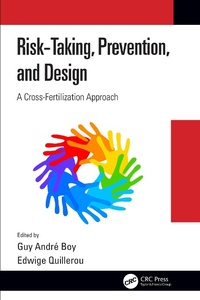
Risk-Taking, Prevention and Design
A Cross-Fertilization Approach
1st Edition
Published on 29. July 2022
267 pages
978-1-000-60627-0 (ISBN)
Description

Most approaches that contribute to the design of life-critical systems almost only consider nominal situations where procedures can be developed and used to achieve satisfactory operations. These kinds of approaches lead to rigid ways of doing things and poorly address the needs for flexibility, especially when things go wrong. It is not a matter of human adaptation but of human systems integration (HSI) flexibility. HSI flexibility requires cross-fertilization of appropriate experiences combined with creativity. This book provides risk-management approaches and methods for combining prevention and design.
Features:
Discusses risk-management approaches and methods for combining prevention and design
Examines a transdisciplinary approach to risk management in design and operations of safer life-critical systems
Proposes an approach of work analysis during design, which enables design teams to consider HSI issues early enough to fix organizational problems upstream
Teaches the combination of prevention and design for safety management
This book gathers and analyzes relevant field data to rationalize human and systems activity in various life-critical environments and workplaces, in a systemic manner, and in a variety of safety domains (e.g., aviation, road, navy, manufacturing, hospital, transportation, defense, sport). It further formalizes and analyzes risk-taking experience, expertise, stories about critical events, and scientific and professional literature data to help engineering designers, managers, and health and safety specialists.
The text is primarily written for graduate students and professionals working in the fields of occupational health and safety, ergonomics, human factors, cognitive engineering, and human-system integration.
Features:
Discusses risk-management approaches and methods for combining prevention and design
Examines a transdisciplinary approach to risk management in design and operations of safer life-critical systems
Proposes an approach of work analysis during design, which enables design teams to consider HSI issues early enough to fix organizational problems upstream
Teaches the combination of prevention and design for safety management
This book gathers and analyzes relevant field data to rationalize human and systems activity in various life-critical environments and workplaces, in a systemic manner, and in a variety of safety domains (e.g., aviation, road, navy, manufacturing, hospital, transportation, defense, sport). It further formalizes and analyzes risk-taking experience, expertise, stories about critical events, and scientific and professional literature data to help engineering designers, managers, and health and safety specialists.
The text is primarily written for graduate students and professionals working in the fields of occupational health and safety, ergonomics, human factors, cognitive engineering, and human-system integration.
More details
Edition
1. Auflage
Language
English
Place of publication
London
United Kingdom
Publishing group
Taylor & Francis Ltd
Target group
College/higher education
Professional and scholarly
Product notice
Reflowable
Illustrations
2 Tables, black and white; 15 Line drawings, black and white; 17 Halftones, black and white; 18 Illustrations, color; 14 Illustrations, black and white
ISBN-13
978-1-000-60627-0 (9781000606270)
Copyright in bibliographic data and cover images is held by Nielsen Book Services Limited or by the publishers or by their respective licensors: all rights reserved.
Schweitzer Classification
Other editions
Additional editions
Book
07/2022
1st Edition
CRC Press
€299.60
Shipment within 10-20 days
Book
07/2022
1st Edition
CRC Press
€121.70
Shipment within 10-20 days
Persons
Guy Andre Boy, Ph.D., is a Scientist and Engineer, Fellow of INCOSE and the Air and Space Academy. He is University Professor at CentraleSupelec (Paris Saclay University) and ESTIA Institute of Technology. He was Chief Scientist for Human-Centered Design at NASA Kennedy Space Center, University Professor and Dean at Florida Institute of Technology, where he created the Human-Centered Design Institute. He was Senior Research Scientist at Florida Institute for Human and Machine Cognition, and former President and CEO of the European Institute of Cognitive Sciences and Engineering (EURISCO), France
Edwige Quillerou, Ph.D., is an Occupational Psychologist and Health & Safety Scientist at INRS, the French National Research and Safety Institute for Prevention of Occupational Accidents and Diseases. She contributes to both research and field interventions in a variety of design and work organization projects. Edwige is involved in interdisciplinary collaborations with researchers in the human and social sciences as well as engineers with a view to improving the organization of prevention with respect to occupational risks through improved engineering design. She is a member of IEA (International Ergonomics Association) and INCOSE (International Council on Systems Engineering).
Edwige Quillerou, Ph.D., is an Occupational Psychologist and Health & Safety Scientist at INRS, the French National Research and Safety Institute for Prevention of Occupational Accidents and Diseases. She contributes to both research and field interventions in a variety of design and work organization projects. Edwige is involved in interdisciplinary collaborations with researchers in the human and social sciences as well as engineers with a view to improving the organization of prevention with respect to occupational risks through improved engineering design. She is a member of IEA (International Ergonomics Association) and INCOSE (International Council on Systems Engineering).
Content
Chapter 1 : Risk Taking, A Life-Critical Necessity
Chapter 2: From Praise Of Danger To "Reasoned" Risk-taking: A Psychological Approach To Risk-taking
Chapter 3: Decisions And Risks Manifesting Themselves Through Movements Performed By Workers
Chapter 4: The East 'broken-links' Method For Examining Risk In Sociotechnical Systems
Chapter 5: Worksite Risk Management As A Culturalissue:the Needs Of Risk Work And Regulation To Improve Safety Culture
Chapter 6: Risk-taking: An Opportunity To Win In Elite Sports
Chapter 7: Risk-taking: Submarine Experience
Chapter 8: Risk Mitigation Practices In Commercial Aviation
Chapter 9: Aging And Risk-taking:an Increasing Dimension Of Life-critical Systems
Chapter 10: Risk-seeking In Healthcare: A Life-critical Necessity
Chapter 11: Risk-seeking And The Paradox Of Variability For Safety
In Healthcare: Resonance With R.l. Wears Text
Chapter 12: Managing And Preventing Operational Risk-taking
At Design Time: Stories From A Human-centered Design Project
Chapter 13: Designing Sustainable 'plastic' Work Systems. A Resource For Work-related Prevention In France's Waste Management And Recycling Sector
Chapter 14: Conclusion
Chapter 2: From Praise Of Danger To "Reasoned" Risk-taking: A Psychological Approach To Risk-taking
Chapter 3: Decisions And Risks Manifesting Themselves Through Movements Performed By Workers
Chapter 4: The East 'broken-links' Method For Examining Risk In Sociotechnical Systems
Chapter 5: Worksite Risk Management As A Culturalissue:the Needs Of Risk Work And Regulation To Improve Safety Culture
Chapter 6: Risk-taking: An Opportunity To Win In Elite Sports
Chapter 7: Risk-taking: Submarine Experience
Chapter 8: Risk Mitigation Practices In Commercial Aviation
Chapter 9: Aging And Risk-taking:an Increasing Dimension Of Life-critical Systems
Chapter 10: Risk-seeking In Healthcare: A Life-critical Necessity
Chapter 11: Risk-seeking And The Paradox Of Variability For Safety
In Healthcare: Resonance With R.l. Wears Text
Chapter 12: Managing And Preventing Operational Risk-taking
At Design Time: Stories From A Human-centered Design Project
Chapter 13: Designing Sustainable 'plastic' Work Systems. A Resource For Work-related Prevention In France's Waste Management And Recycling Sector
Chapter 14: Conclusion
