

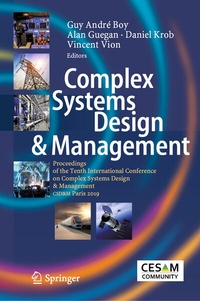
Complex Systems Design & Management
Description

This book contains all refereed papers accepted during the tenth edition of the conference that took place at the Cité Internationale Universitaire de Paris on December 12-13, 2019.
Mastering complex systems requires an integrated understanding of industrial practices as well as sophisticated theoretical techniques and tools. This explains the creation of an annual go-between forum in Paris dedicated to academic researchers & industrial actors working on complex industrial systems architecture, modeling & engineering.
These proceedings cover the most recent trends in the emerging field of Complex Systems, both from an academic and a professional perspective. A special focus is put on "Systems Engineering through the ages".
The CSD&M Paris 2019 conference is organized under the guidance of CESAM Community. It has been developed since 2010 by the non-profit organization CESAMES Association to organize the sharing of good practices in Enterprise and Systems Architecture and to certify the level of knowledge and proficiency in this field through CESAM certification.
More details
Other editions
Additional editions
Content
1.1 - Introduction [Seite 5]
1.2 - Why a CSD&M Conference? [Seite 5]
1.3 - Our Core Academic-Industrial Dimension [Seite 6]
1.4 - The 2019 Edition [Seite 6]
2 - Conference Organization [Seite 8]
2.1 - Conference Chairs [Seite 8]
2.2 - General Chair [Seite 8]
2.3 - Organizing Committee Chair [Seite 8]
2.4 - Program Committee Co-chairs [Seite 8]
2.5 - Program Committee [Seite 8]
2.6 - Academic Members [Seite 8]
2.7 - Sec11 [Seite 8]
2.8 - Sec12 [Seite 9]
2.9 - Industrial Members [Seite 9]
2.10 - Sec14 [Seite 9]
2.11 - Sec15 [Seite 9]
2.12 - Organizing Committee [Seite 9]
2.13 - Chair [Seite 9]
2.14 - Members [Seite 9]
2.15 - Invited Speakers [Seite 10]
2.16 - Plenary Sessions [Seite 10]
2.17 - "New Mobilities" Track [Seite 10]
2.18 - "Energy" Track [Seite 11]
2.19 - "Smart Cities" Track [Seite 11]
2.20 - "Modeling, Simulation, Visualization" Track [Seite 11]
2.21 - "Industry 4.0" Track [Seite 11]
2.22 - "Systems-of-Systems" Track [Seite 11]
2.23 - "Product Line Engineering" Track [Seite 11]
3 - Acknowledgements [Seite 12]
4 - Contents [Seite 14]
5 - Regular Papers [Seite 16]
6 - Gas Turbine Design at Rolls-Royce - Exploring the Limitations of a Systems Engineering Approach [Seite 17]
6.1 - 1 Introduction [Seite 17]
6.2 - 2 The Gas Turbine and Its Product Breakdown [Seite 18]
6.2.1 - 2.1 Subsystems [Seite 18]
6.2.2 - 2.2 Emergence and Integration [Seite 19]
6.3 - 3 Organizing to Do the Work Efficiently [Seite 20]
6.3.1 - 3.1 Organizational Breakdown Structure [Seite 20]
6.3.2 - 3.2 Designing Product Systems and Design Topics [Seite 21]
6.4 - 4 Product System and Design Topic Examples [Seite 22]
6.4.1 - 4.1 The Turbine Tip Clearance Control (TTCC) Product System [Seite 22]
6.4.2 - 4.2 The Shaft Order Vibration Design Topic [Seite 23]
6.5 - 5 Design Topic Systems Engineering [Seite 24]
6.5.1 - 5.1 Why Do Design Topics Exist? [Seite 24]
6.5.2 - 5.2 Developing a Design Topic [Seite 25]
6.5.3 - 5.3 Physical Constraints and Non-functional Interactions [Seite 25]
6.6 - 6 Conclusions and Discussion Points [Seite 26]
6.6.1 - 6.1 Conclusions [Seite 26]
6.6.2 - 6.2 Discussion Points [Seite 26]
6.7 - References [Seite 27]
7 - Managing the Complexity of Processing Financial Data at Scale - An Experience Report [Seite 28]
7.1 - 1 Introduction [Seite 28]
7.2 - 2 The Complexity of Processing Financial Data at Scale [Seite 29]
7.2.1 - 2.1 Background: Financial Data Feeds [Seite 30]
7.2.2 - 2.2 Challenges Processing Financial Data at vwd [Seite 31]
7.2.3 - 2.3 Challenges Regarding Compliance [Seite 34]
7.2.4 - 2.4 Challenges Regarding IT Governance [Seite 35]
7.3 - 3 How vwd Processes Financial Data at Scale [Seite 36]
7.3.1 - 3.1 Technology: Modular Platform and Hybrid Infrastructures [Seite 36]
7.3.2 - 3.2 Organization: Balance Agility with Regulatory Accountability [Seite 39]
7.4 - 4 Conclusion, Ongoing and Future Work [Seite 39]
7.5 - References [Seite 39]
8 - Verification of BPMN Models [Seite 41]
8.1 - 1 Introduction [Seite 41]
8.2 - 2 Motivation and Objectives [Seite 42]
8.3 - 3 Related Work [Seite 42]
8.4 - 4 Importing the Model [Seite 43]
8.5 - 5 Executing the Model [Seite 44]
8.6 - 6 Tracing the Model [Seite 48]
8.7 - 7 Conclusions [Seite 49]
8.8 - References [Seite 50]
9 - Synchronization of System Architecture, Multi-physics and Safety Models [Seite 51]
9.1 - 1 Introduction [Seite 51]
9.2 - 2 Case Study [Seite 52]
9.3 - 3 Model Synchronization [Seite 53]
9.3.1 - 3.1 Principle [Seite 53]
9.3.2 - 3.2 S2ML as a Pivot Language [Seite 53]
9.3.3 - 3.3 SmartSync Platform [Seite 56]
9.4 - 4 EMA Case Study: Model Synchronization [Seite 57]
9.4.1 - 4.1 Modeling [Seite 57]
9.4.2 - 4.2 Synchronization of System Architecture and Multi-physics Models [Seite 58]
9.4.3 - 4.3 Synchronization of System Architecture and Safety Models [Seite 60]
9.5 - 5 Conclusion and Perspectives [Seite 61]
9.6 - References [Seite 62]
10 - Managing Margins Under Uncertainties Surrogate Modelling and Uncertainty Quantification [Seite 63]
10.1 - 1 Introduction [Seite 63]
10.1.1 - 1.1 Context and Motivation [Seite 64]
10.1.2 - 1.2 Linking Product Strategy to Modelling & Simulation [Seite 66]
10.1.3 - 1.3 Architecture Cockpit [Seite 67]
10.2 - 2 Quantifying and Propagating Uncertainties for Setting Margins [Seite 68]
10.3 - 3 Illustrative Case Study [Seite 71]
10.3.1 - 3.1 Data Generation [Seite 72]
10.3.2 - 3.2 Building and Testing the Surrogate Model [Seite 73]
10.3.3 - 3.3 Exploring the Design Space Along Perpendicular Facets [Seite 73]
10.3.4 - 3.4 Uncertainty Analysis About One Design [Seite 74]
10.3.5 - 3.5 Uncertainty Analysis About Perpendicular Facets [Seite 75]
10.3.6 - 3.6 Reflections on the Case Study Results [Seite 76]
10.4 - 4 Summary and Conclusions [Seite 77]
10.5 - References [Seite 77]
11 - Implementing Organizational Cybernetics for the Next Generation of Digital Business Models [Seite 78]
11.1 - 1 Introduction [Seite 78]
11.2 - 2 Disruptive Technology [Seite 79]
11.2.1 - 2.1 VNF - Virtualized Network Function and SDN - Software Defined Networks [Seite 79]
11.2.2 - 2.2 MEC - Multi-access Edge Computing for IT Services [Seite 79]
11.2.3 - 2.3 IoT Authentication [Seite 81]
11.3 - 3 Organizational Change [Seite 81]
11.3.1 - 3.1 Organizational Cybernetics [Seite 81]
11.3.2 - 3.2 Transformation of Needs into Requirements [Seite 82]
11.4 - 4 The Next Generation of Digital Business Models [Seite 85]
11.5 - 5 Electronic Transactions Within the Finance Sector [Seite 88]
11.6 - 6 Conclusion [Seite 89]
11.7 - References [Seite 91]
12 - Identifying Focal Points in IT Project Governance Using a Synthetic and Systems Thinking Approach [Seite 93]
12.1 - 1 Introductions [Seite 93]
12.2 - 2 Background and Literature Review [Seite 94]
12.3 - 3 Research Method [Seite 96]
12.4 - 4 Research Findings [Seite 97]
12.5 - 5 Discussion and Conclusion [Seite 105]
12.6 - References [Seite 105]
13 - MAESTRIA: A New Tool to Support Collaborative Building and Sharing of an Integration, Verification, Validation, and Qualification Strategy [Seite 107]
13.1 - 1 Introduction [Seite 107]
13.2 - 2 The Genesis of MAESTRIA [Seite 108]
13.3 - 3 The Rationale of MAESTRIA [Seite 110]
13.4 - 4 Tool Chain for IVVQ Strategy Building [Seite 112]
13.5 - 5 Added Values [Seite 113]
13.6 - 6 Future Work and Perspectives [Seite 114]
13.7 - 7 Conclusion [Seite 115]
13.8 - References [Seite 116]
14 - School Shootings in the U.S. - Where to Begin [Seite 117]
14.1 - 1 Introduction [Seite 117]
14.2 - 2 Investigative Approach [Seite 117]
14.3 - 3 Background [Seite 118]
14.4 - 4 Causal Chain [Seite 120]
14.4.1 - 4.1 Desire to Act [Seite 120]
14.4.2 - 4.2 Authority to Act [Seite 121]
14.4.3 - 4.3 Shaping Forces [Seite 125]
14.5 - 5 Shifts in Law Enforcement Strategy [Seite 127]
14.6 - 6 Conclusion [Seite 128]
14.7 - References [Seite 128]
15 - Smart Component Modeling for Complex System Development [Seite 131]
15.1 - 1 Introduction [Seite 131]
15.1.1 - 1.1 Related Work [Seite 132]
15.2 - 2 Current Aircraft Development Process [Seite 133]
15.3 - 3 Out-of-Cycle Development Method [Seite 133]
15.4 - 4 Smart Component Modeling [Seite 134]
15.4.1 - 4.1 Models [Seite 135]
15.4.2 - 4.2 Parametric Elements and Relations [Seite 135]
15.4.3 - 4.3 Type System [Seite 136]
15.4.4 - 4.4 Ports and Connectors [Seite 137]
15.4.5 - 4.5 Constraints [Seite 137]
15.5 - 5 Implementation [Seite 138]
15.5.1 - 5.1 Supporting Tool Infrastructure [Seite 138]
15.6 - 6 Example and Evaluation [Seite 139]
15.7 - 7 Conclusion [Seite 141]
15.8 - References [Seite 141]
16 - Dynamic Disruption Simulation in Large-Scale Urban Rail Transit Systems [Seite 143]
16.1 - 1 Introduction [Seite 143]
16.2 - 2 Simulation-Based Disruption Analysis [Seite 144]
16.2.1 - 2.1 Urban Transit System Model [Seite 144]
16.2.2 - 2.2 The Objective Function - Minimization of Aggregated Delays [Seite 146]
16.2.3 - 2.3 The Simulation Inputs and Optimization Framework [Seite 147]
16.3 - 3 The Test Network and Test Cases [Seite 147]
16.4 - 4 Results and Discussion [Seite 149]
16.4.1 - 4.1 Case 1: The Undisrupted Network [Seite 149]
16.4.2 - 4.2 Case 2: Link Flow and Travel Delay Under Disruptions [Seite 150]
16.4.3 - 4.3 Case 3: Optimizing the Train Headway [Seite 151]
16.4.4 - 4.4 Case 4: Effects of Passenger Demand Uncertainty [Seite 152]
16.5 - 5 Conclusion [Seite 153]
16.6 - References [Seite 153]
17 - A Multiobjective Systems Architecture Model for Sensor Selection in Autonomous Vehicle Navigation [Seite 155]
17.1 - 1 Introduction [Seite 155]
17.2 - 2 Related Work [Seite 156]
17.2.1 - 2.1 Systems Approaches to Autonomous Vehicle Architecture [Seite 156]
17.2.2 - 2.2 Sensor Evaluation and Selection [Seite 156]
17.3 - 3 Methodology [Seite 158]
17.3.1 - 3.1 Sensor Library [Seite 158]
17.3.2 - 3.2 Evaluation [Seite 158]
17.3.3 - 3.3 Enumeration [Seite 160]
17.4 - 4 Results [Seite 162]
17.5 - 5 Conclusion [Seite 164]
17.6 - References [Seite 165]
18 - Simulation Architecture Definition for Complex Systems Design: A Tooled Methodology [Seite 167]
18.1 - 1 Introduction [Seite 167]
18.1.1 - 1.1 Context [Seite 167]
18.1.2 - 1.2 Industrial Problem [Seite 168]
18.2 - 2 Agility in Complex Conception Cycle [Seite 169]
18.3 - 3 Solicitation Package from the System Architect [Seite 171]
18.3.1 - 3.1 Current Practice and Alternative [Seite 171]
18.3.2 - 3.2 Content of the Solicitation Package [Seite 171]
18.3.3 - 3.3 Implementation of the Solicitation Package [Seite 172]
18.4 - 4 Proposed Methodology for the Simulation Architecture Definition [Seite 173]
18.4.1 - 4.1 Developed Components [Seite 174]
18.5 - 5 Conclusion [Seite 176]
18.6 - References [Seite 176]
19 - Towards a Cross-Domain Modeling Approach in System-of-Systems Architectures [Seite 178]
19.1 - 1 Introduction [Seite 178]
19.2 - 2 Related Work [Seite 179]
19.2.1 - 2.1 Software Platform Embedded Systems (SPES) [Seite 179]
19.2.2 - 2.2 Automotive Reference Architecture Model (ARAM) [Seite 180]
19.2.3 - 2.3 Reference Architecture Model Industrie 4.0 (RAMI 4.0) [Seite 180]
19.2.4 - 2.4 Smart Grid Architecture Model (SGAM) [Seite 181]
19.3 - 3 Approach [Seite 181]
19.3.1 - 3.1 Agile Design Science Research Methodology [Seite 181]
19.3.2 - 3.2 Case Study [Seite 182]
19.4 - 4 Implementation [Seite 183]
19.5 - 5 Application [Seite 185]
19.5.1 - 5.1 Findings [Seite 187]
19.6 - 6 Conclusions and Future Work [Seite 187]
19.7 - References [Seite 188]
20 - Safety Demonstration of Autonomous Vehicles: A Review and Future Research Questions [Seite 190]
20.1 - 1 Introduction [Seite 190]
20.2 - 2 Challenges in AV Safety Validation [Seite 191]
20.2.1 - 2.1 Specificities and Technological Issues [Seite 192]
20.2.2 - 2.2 Difficulty in Compensating for the Presence of Uncertainties [Seite 192]
20.2.3 - 2.3 Limitation of the ISO 26262 Standard [Seite 193]
20.3 - 3 Scenarios Generation for Simulation-Based Validation [Seite 193]
20.3.1 - 3.1 Scenarios Identification in the Industrial Domain [Seite 193]
20.3.2 - 3.2 Concepts Definition and Their Modeling [Seite 194]
20.3.3 - 3.3 Scenario Generation [Seite 194]
20.4 - 4 Quantification of Uncertainty - Probabilistic Evaluation of Scenarios and Their Coverage [Seite 195]
20.5 - 5 Simulation Framework [Seite 196]
20.5.1 - 5.1 Specification of an AV Safety Demonstration and Testing System [Seite 196]
20.5.2 - 5.2 Simulation Architecture for Safety Validation [Seite 197]
20.6 - 6 Conclusion and Future Research Questions [Seite 198]
20.7 - Appendix: Typology of Contents [Seite 199]
20.8 - References [Seite 200]
21 - Posters [Seite 203]
22 - Model-Based Specification for System Development with Suppliers [Seite 204]
23 - Applications of Systems Thinking for Scooter Sharing Transportation System [Seite 205]
24 - Collaborative Decision-Making Challenges in the Dutch Railway System [Seite 206]
25 - Understanding Stakeholder Interactions Impacting Human Spaceflight Funding Levels [Seite 207]
26 - Author Index [Seite 208]
