

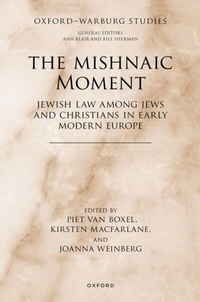
The Mishnaic Moment
Jewish Law among Jews and Christians in Early Modern Europe
1st Edition
Published on 12. May 2022
240 pages
978-0-19-265431-1 (ISBN)
Description

This collection of essays treats a topic that has scarcely been approached in the literature on Hebrew and Hebraism in the early modern period. In the seventeenth century, Christians, especially Protestants, studied the Mishnah alongside a host of Jewish commentaries in order to reconstruct Jewish culture, history, and ritual, shedding new light on the world of the Old and New Testaments. Their work was also inextricably dependent upon the vigorous Mishnaic studies of early modern Jewish communities. Both traditions, in a sense, culminated in the monumental production in six volumes of an edition and Latin translation of the Mishnah published by Guilielmus Surenhusius in Amsterdam between 1698 and 1703. Surenhusius gathered up more than a century's worth of Mishnaic studies by scholars from England, Germany, the Netherlands, and Sweden, as well as the commentaries of Maimonides and Obadiah of Bertinoro (c. 1455-c.1515), but this edition was also born out of the unique milieu of Amsterdam at the end of the seventeenth century, a place which offered possibilities for cross-cultural interactions between Jews and Christians. With Surenhusius's great volumes as an end point, the essays presented here discuss for the first time the multiple ways in which the canonical text of Jewish law, the Mishnah (c.200 CE), was studied by a variety of scholars, both Jewish and Christian, in early modern Europe. They tell the story of how the Mishnah generated an encounter between different cultures, faiths, and confessions that would prove to be enduringly influential for centuries to come.
More details
Other editions
Additional editions
Piet van Boxel | Kirsten Macfarlane | Joanna Weinberg
The Mishnaic Moment
Jewish Law among Jews and Christians in Early Modern Europe
Book
05/2022
Oxford University Press
€140.60
Shipment within 15-20 days
Persons
Piet van Boxel was Fellow librarian of the Oxford Centre for Hebrew and Jewish Studies and Curator of Hebraica at the Bodleian Libraries. He is Honorary Fellow of the Bodleian Centre for the History of the Book.
Kirsten Macfarlane is Associate Professor of Early Modern Christianities at the University of Oxford and an Official Fellow and Tutor at Keble College. Before this, she was a Title A Research Fellow at Trinity College, Cambridge University, and completed her BA (2012), MSt (2014), and DPhil (2017) at Lincoln College, University of Oxford. She has held visiting fellowships at the Oxford Centre for Hebrew and Jewish Studies, the Massachusetts Historical Society, the Houghton Library, Harvard, and the Netherlands Institute for Advanced Study in the Humanities and Social Sciences.
Joanna Weinberg was Professor of Early Modern Jewish History and Rabbinics at the University of Oxford and Fellow at the Oxford Centre for Hebrew and Jewish Studies. She is Hebrew lecturer at Exeter College, Oxford, and Honorary Fellow of the Bodleian Centre for the History of the Book.
Content
- Introduction: The Mishnah between Jews and Christians in Early Modern Europe
- Prelude
- Humanism and the Mishnah: Paulus Fagius Edits Avot
- Some Concepts of Mishnah among 16th-Century Safedian Kabbalists
- Translation and Pedagogy
- The First Complete Latin translation of the Mishnah (1663-1676): Isaac Abendana and Rabbinic Erudition in Restoration England
- Isaac Abendana's German Student Theodor Dassow, the Latin translation of the Mishnah and the conversion of the Jews
- 'El sabio Jacob Abendana' and the Spanish Translation of the Mishnah
- Commentary and Scholarship
- Bringing Maimonides to Oxford: Edward Pococke, the Mishnah, and the Porta Mosis
- William Guise: the application of Arabic to the interpretation of Mishnah Zera'im
- 'Ancient Rabbis Inspired by God': Robert Sheringham's Surprising Edition of Mishnah Tractate Yoma (1648)
- Johann Christoph Wagenseil: From Scholar to Missionary
- Communities and Curricula
- Between Law and Antiquarianism: The Christian Study of Maimonides's Mishneh Torah in Late Seventeenth-Century Europe
- The Significance of Historical Judaism and the Career of Humphrey Prideaux
- Cultivating Education and Piety: Menasseh ben Israel, Lay Readership, and the Printing of the Mishnah in the Seventeenth Century
- Guilielmus Surenhusius (1664-1729)
- The role of Jewish commentaries in Christian interpretation of the Mishnah in 17th century Northern Europe
- Imagining Visually the Mishnah - From Wagenseil to Surenhuis (1674-1703)
- 'To the advantage of the Republic of Letters'? Guilielmus Surenhusius's Projects, Plans, and Collaborations Beyond the Mishnah
- Christianity as Jewish Allegory? Guilielmus Surenhusius, Rabbinic Hermeneutics and the Reformed Study of the New Testament in the Early Eighteenth Century
