

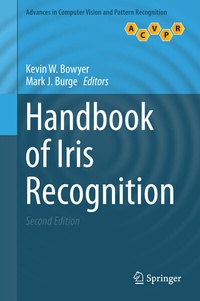
Handbook of Iris Recognition
Description

The definitive work on iris recognition technology, this comprehensive handbook presents a broad overview of the state of the art in this exciting and rapidly evolving field. Revised and updated from the highly-successful original, this second edition has also been considerably expanded in scope and content, featuring four completely new chapters. Features: provides authoritative insights from an international selection of preeminent researchers from government, industry, and academia; reviews issues covering the full spectrum of the iris recognition process, from acquisition to encoding; presents surveys of topical areas, and discusses the frontiers of iris research, including cross-wavelength matching, iris template aging, and anti-spoofing; describes open source software for the iris recognition pipeline and datasets of iris images; includes new content on liveness detection, correcting off-angle iris images, subjects with eye conditions, and implementing software systems for iris recognition.
More details
Other editions
Additional editions
Persons
Dr. Kevin W. Bowyer is the Schubmehl-Prein Professor and Chair of the Department of Computer Science and Engineering at the University of Notre Dame, IN, USA.
Dr. Mark J. Burge is a scientist at the non-profit organization Noblis in Falls Church, VA, USA. His other publications include the Springer textbook Digital Image Processing - An Algorithmic Introduction Using Java .
Content
Introduction to the Handbook of Iris Recognition.- A Survey of Iris Biometrics Research: 2008-2010.- Optics of Iris Imaging Systems.- Standard Iris Storage Formats.- Iris Quality Metrics for Adaptive Authentication.- Quality and Demographic Investigation of ICE 2006.- Methods for Iris Segmentation.- Iris Recognition with Taylor Expansion Features.- Application of Correlation Filters for Iris Recognition.- Introduction to the IrisCode Theory.- Robust and Secure Iris Recognition.- Multispectral Iris Fusion and Cross-Spectrum Matching.- Iris Segmentation for Challenging Periocular Images.- Periocular Recognition from Low Quality Iris Images.- Unconstrained Iris Recognition in Visible Wavelengths.- Design Decisions for an Iris Recognition SDK.- Fusion of Face and Iris Biometrics.- A Theoretical Model for Describing Iris Dynamics.- Iris Liveness Detection by Modeling Dynamic Pupil Features.- Iris Image Reconstruction from Binary Templates.- Off-Angle Iris Correction Methods.- Ophthalmic Disorder Menagerie and Iris Recognition.- Template Aging in Iris Biometrics.
