

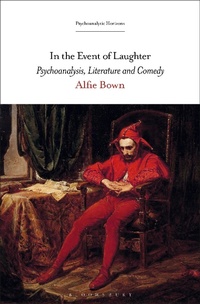
In the Event of Laughter
Psychoanalysis, Literature and Comedy
1st Edition
Published on 15. November 2018
168 pages
978-1-5013-4263-9 (ISBN)
Description

Using Lacanian psychoanalysis, as well as its pre-history and afterlives, In the Event of Laughter argues for a new framework for discussing laughter. Responding to a tradition of 'comedy studies' that has been interested only in the causes of laughter (in why we laugh), it proposes a different relationship between laughter and causality. Ultimately it argues that laughter is both cause and effect, troubling chronological time and asking for a more nuanced way of conceiving the relationship between subjects and their laughter than existing theories have accounted for.
Making this visible via psychoanalytic ideas of retroactivity, Alfie Bown explores how laughter - far from being a mere response to a stimulus - changes the relationship between the present, the past and the future. Bown investigates this hypothesis in relation to a range of comic texts from the 'history of laughter,' discussing Chaucer, Shakespeare, Kafka and Chaplin, as well as lesser-known but vital figures from the comic genre.
Making this visible via psychoanalytic ideas of retroactivity, Alfie Bown explores how laughter - far from being a mere response to a stimulus - changes the relationship between the present, the past and the future. Bown investigates this hypothesis in relation to a range of comic texts from the 'history of laughter,' discussing Chaucer, Shakespeare, Kafka and Chaplin, as well as lesser-known but vital figures from the comic genre.
Reviews / Votes
I read In the Event of Laughter with real pleasure. It is smart and confident, but also ruminative and genuinely philosophical, and balances a distinct central thesis with many diverse case studies. The notion that there is something penny-pinching and parsimonious about existing accounts of 'the event' ('a rare and unusual occurrence, something that occasionally interrupts the trajectory of things'), and that rather, wouldn't we be better off thinking about how it happens all the time?, is a very sympathetic one; and it's an inspired twist to locate it in the act of laughter. The book will certainly have readers in the growing area of comedy and laughter studies, as it is a combative (though courteous) shakeup of that field. * James Smith, Lecturer in English Literature, Royal Holloway, University of London, UK, and author of Samuel Richardson and the Theory of Tragedy: Clarissa's Caesuras (2016) * Alfie Bown's In the Event of Laughter is above all about taking laughter seriously, recognizing in it a force that erects and constructs ideologies and subjectivities, as well as calling these very things into question. A wonderful book, providing a fresh and pleasantly surprising conceptual framework for the discussion of laughter. * Alenka Zupancic, Professor of Philosophy and Psychoanalysis at The European Graduate School, Switzerland, Research Advisor at the Institute for Philosophy, Slovene Academy of Sciences, Slovenia, and author of The Odd One In: On Comedy (2008) * Fans of philosophy and literature alike will truly enjoy Alfie Bown's In the Event of Laughter for the way it draws together Hegel, Freud, Lacan, and Badiou with readings of Chaucer, Shakespeare, Dickens, Gogol, Baudelaire, and Kafka, to tell a compelling story about the meaning of laughter. Bown shows that when we divide laughter into its common types (radical vs. reactionary, canned vs. spontaneous, liberatory vs. enthralling), we obscure the fact that laughter is, in toto, our experience in ideology. Every laugh resets our connection to ideology right at the moment ideology itself, intermittent as ever, releases us into laughter. Every guffaw is an event that refashions us for a society constantly remaking itself. Every chortle, a world reimagined but reaffirmed. As Bown nicely demonstrates, laughter as ideology comprehends social and biological, political and natural, and ideal and material domains, all the way up to the angels and all the way down to the turtles. * Andrew Cole, Professor of English, Princeton University, USA, and author of The Birth of Theory (2014) *More details
Series
Edition
1. Auflage
Language
English
Place of publication
New York
United States
Publishing group
Bloomsbury Publishing PLC (Digital)
Target group
Professional and scholarly
ISBN-13
978-1-5013-4263-9 (9781501342639)
Copyright in bibliographic data and cover images is held by Nielsen Book Services Limited or by the publishers or by their respective licensors: all rights reserved.
Schweitzer Classification
Other editions
Additional editions
Book
05/2020
Bloomsbury Academic USA
€60.84
Shipment within 15-20 days
Person
Alfie Bown is author of The Playstation Dreamworld (2017) and Enjoying It: Candy Crush and Capitalism (2015). He is editor of Everyday Analysis and writes for The Guardian and The Paris Review, among other publications.
Content
List of Figures
Preface and Acknowledgments
Note on the Text
Introduction: Laughter's Doubleness
1. Laughter as Liberation
2. Laughter and Control
3. Laughter as Event
4. Laughter and Anxiety
Conclusion
Bibliography
Index
Preface and Acknowledgments
Note on the Text
Introduction: Laughter's Doubleness
1. Laughter as Liberation
2. Laughter and Control
3. Laughter as Event
4. Laughter and Anxiety
Conclusion
Bibliography
Index
