

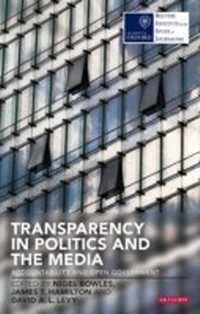
Transparency in Politics and the Media
Accountability and Open Government
Published on 28. October 2013
264 pages
978-0-85773-459-4 (ISBN)
Description

Increasingly governments around the world are experimenting with initiatives in transparency or 'open government'. These involve a variety of measures including the announcement of more user-friendly government websites, greater access to government data, the extension of freedom of information legislation and broader attempts to involve the public in government decision making. However, the role of the media in these initiatives has not hitherto been examined. This volume analyses the challenges and opportunities presented to journalists as they attempt to hold governments accountable in an era of professed transparency. In examining how transparency and open government initiatives have affected the accountability role of the press in the US and the UK, it also explores how policies in these two countries could change in the future to help journalists hold governments more accountable. This volume will be essential reading for all practising journalists, for students of journalism or politics, and for policymakers.
More details
Series
Edition
Digital original
Language
English
Place of publication
London
United Kingdom
Publishing group
Bloomsbury Publishing PLC
Target group
College/higher education
Professional and scholarly
Edition type
Digital original
ISBN-13
978-0-85773-459-4 (9780857734594)
Copyright in bibliographic data and cover images is held by Nielsen Book Services Limited or by the publishers or by their respective licensors: all rights reserved.
Schweitzer Classification
Other editions
Additional editions
Nigel Bowles | James T. Hamilton | David A. L. Levy
Transparency in Politics and the Media
Accountability and Open Government
Book
11/2013
I.B. Tauris
€163.42
Shipment within 10-20 days
Persons
Nigel Bowles is Director of the Rothermere American Institute, and Professorial Fellow, at Corpus Christi College, University of Oxford, UK.
Content
Introduction James T. Hamilton, Nigel Bowles and David Levy
Part I: Defining Transparency and Open Government
Before Transparency: Disclosure as Political and Cultural Practice 1960s-1980s Michael Schudson (Columbia University Graduate School of Journalism
The Impact of the Freedom of Information Act in the UK (co-author: Robert Hazell) Ben Worthy, and Robert Hazell, University College London
Part II: Impact of Transparency on Accountability
3. Impact of Transparency on Accountability Peter Riddell, The Institute for Government
4. Transparency and Public Policy: Where Open Government Fails Accountability Sarah Cohen, New York Times
Part III: Media Transparency and Accountability
5. Transparency John Lloyd, Reuters Institute for the Study of Journalism
6. 'Truth Vigilantes': On Journalism and Transparency Phil Bennett, Duke University
Part IV: Making Sense of Records and Data
7. The transparency opportunity: holding power to account - or making power accountable? Paul Bradshaw, Birmingham City University
8. Making Sense of Records and Data Jennifer LaFleur, ProPublica
Part V: Valuing Transparency in Government and the Media
9. Valuing Transparency in Government and Media Patrick Birkinshaw, University of Hull
10. Corporations and Transparency: Improving Consumer Markets and Increasing Public Accountability Joel Gurin, Federal Communications Commission (with Beth Simone Noveck)
Part VI: Rise of NGOs and Nonprofit Media
11. The Rise of NGOs and Nonprofit Media Charles Lewis, American University
Part VII: Policy Hurdles to Transparency
12. Keeping American Accountability Journalism Alive Len Downie, Walter Cronkite School of Journalism, Arizona State University and Washington Post
13. Data, Data Everywhere: Open Data versus Big Data in the Quest for Transparency Helen Margetts, Oxford Internet Institute
Part I: Defining Transparency and Open Government
Before Transparency: Disclosure as Political and Cultural Practice 1960s-1980s Michael Schudson (Columbia University Graduate School of Journalism
The Impact of the Freedom of Information Act in the UK (co-author: Robert Hazell) Ben Worthy, and Robert Hazell, University College London
Part II: Impact of Transparency on Accountability
3. Impact of Transparency on Accountability Peter Riddell, The Institute for Government
4. Transparency and Public Policy: Where Open Government Fails Accountability Sarah Cohen, New York Times
Part III: Media Transparency and Accountability
5. Transparency John Lloyd, Reuters Institute for the Study of Journalism
6. 'Truth Vigilantes': On Journalism and Transparency Phil Bennett, Duke University
Part IV: Making Sense of Records and Data
7. The transparency opportunity: holding power to account - or making power accountable? Paul Bradshaw, Birmingham City University
8. Making Sense of Records and Data Jennifer LaFleur, ProPublica
Part V: Valuing Transparency in Government and the Media
9. Valuing Transparency in Government and Media Patrick Birkinshaw, University of Hull
10. Corporations and Transparency: Improving Consumer Markets and Increasing Public Accountability Joel Gurin, Federal Communications Commission (with Beth Simone Noveck)
Part VI: Rise of NGOs and Nonprofit Media
11. The Rise of NGOs and Nonprofit Media Charles Lewis, American University
Part VII: Policy Hurdles to Transparency
12. Keeping American Accountability Journalism Alive Len Downie, Walter Cronkite School of Journalism, Arizona State University and Washington Post
13. Data, Data Everywhere: Open Data versus Big Data in the Quest for Transparency Helen Margetts, Oxford Internet Institute
