

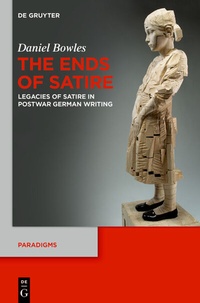
The Ends of Satire
Legacies of Satire in Postwar German Writing
1st Edition
Published on 24. February 2015
VII, 231 pages
978-3-11-035953-4 (ISBN)
Description

How are we to think of satire if it has ceased to exist as a discrete genre? This study proposes a novel solution, understanding the satiric in the postwar era as a set of writing practices: figures of inversion, myth-making, and citation. By showing how writers and theorists alike deploy these devices in new contexts, this book reexamines the link between German postwar writing and the history of satire, and between literature and theory.
Reviews / Votes
"Admirably structured, genorously researched, and written in sophisticated prose, The Ends of Satire is highly recommended reading for those interested in analyses of selected works by prominent authors like Elfriede Jelinek, Thomas Bernhard, and Thomas Meinecke. lt is further recommended to those invested in thought-provoking explomtions of intertextuality, authorship, and the meaning of writing and reading. For those specifically interested in what happened to "satire after satire" (207), it is quite simply a must."Lars Richter in: Seminar LIII, 416-418
More details
Other editions
Additional editions
Book
07/2019
1st Edition
De Gruyter
€34.95
Shipment within 7-9 days
E-Book
02/2015
1st Edition
De Gruyter
€139.95
Available for download
Book
01/2015
1st Edition
De Gruyter
€139.95
Shipment within 7-9 days
Person
Daniel Bowles, Boston College, Massachusetts, USA.
Content
- Intro
- Table of Contents
- Acknowledgments
- Introduction. Satire around 1800: Jean Paul
- 1. Prolegomena
- 2. The Case of Jean Paul: Unreadable Writing, Unwritable Readings
- Part One. Inversion
- 3. The Carnivalesque in Mikhail Bakhtin's Rabelais and His World (1965)
- 4. Perspective and Repetition in Thomas Bernhard's Woodcutters (1984)
- 5. Destructive Negativity: Thomas Bernhard and Extinction (1986)
- Part Two. Mythification
- 6. Between Theory and Literature: Roland Barthes' Mythologies (1957)
- 7. Elfriede Jelinek's Mythic Lust (1989)
- 8. Viennese Paradigms in Elfriede Jelinek's The Piano Teacher (1983)
- Part Three. Citation
- 9. From Stage to Page: Judith Butler and Gender Trouble (1990)
- 10. Performing Theory in Literature: Thomas Meinecke's Tomboy (1998)
- 11. Infinite Paradise of the Infinite Text: Thomas Meinecke's Music (2004)
- Conclusion. Satire after Satire
- Bibliography
- Index
