
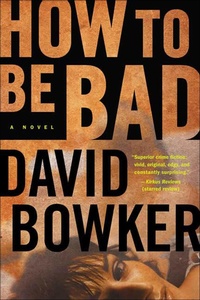
How to Be Bad
Description
Alles über E-Books | Antworten auf Fragen rund um E-Books, Kopierschutz und Dateiformate finden Sie in unserem Info- & Hilfebereich.
Mark is a mild-mannered twenty-three-year-old bookseller who makes endless lists about stupid things. His life changes when he reestablishes contact with his old girlfriend, Caro. At seventeen, Caro was an implausibly sexy, promiscuous, druggy big-mouth. Six years later, she's exactly the same and Mark falls in love with her all over again. Caro, who has nothing but contempt for Mark's list and his choirboy attitude, asks him to prove his love by giving him a list of her own: a list of people she wants him to kill for her. As things begin to spiral out of control and the bodies pile up, Mark himself becomes a target and realizes that to survive, he needs to be as ruthless and decisive as his enemy. Violent, edgy and with a wicked sense of humor, How to Be Bad establishes David Bowker as one of the premier crime writers working today.
More details
Other editions
Additional editions

Person
System requirements
File format: ePUB
Copy protection: Watermark-DRM (Digital Rights Management)
System requirements:
- Computer (Windows; MacOS X; Linux): Use a reading software that can process the file format ePUB: e.g., Adobe Digital Editions or FBReader – both free (see eBook Help).
- Tablet/Smartphone (Android; iOS): Before downloading, install the free app Adobe Digital Editions (see eBook Help).
- E-reader: Bookeen, Kobo, Pocketbook, Sony, Tolino and many more (not Kindle).
The file format ePUB works well for novels and non-fiction books – i.e., „flowing” text without complex layout. On an e-reader or smartphone, line and page breaks automatically adjust to fit the small displays.
This eBook uses Watermark-DRM, a „soft” copy protection. This means that there are no technical restrictions to prevent illegal distribution. However, there is a personalised watermark embedded in the eBook that can be used to identify the purchaser of the eBook in the event of misuse and to provide evidence for legal purposes.
For more information, see our eBook Help page.
