

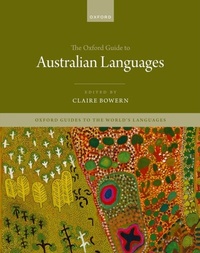
The Oxford Guide to Australian Languages
1st Edition
Published on 19. June 2023
1184 pages
978-0-19-255849-7 (ISBN)
Description

The Oxford Guide to Australian Languages is a wide-ranging reference work that explores the more than 550 traditional and new Indigenous languages of Australia. Australian languages have long played an important role in diachronic and synchronic linguistics and are a vital testing ground for linguistic theory. Until now, however, there has been no comprehensive and accessible guide to the their vast linguistic diversity. This volume fills that gap, bringing together leading scholars and junior researchers to provide an up-to-date guide to all aspects of the languages of Australia. The chapters in the book explore typology, documentation, and classification; linguistic structures from phonology to pragmatics and discourse; sociolinguistics and language variation; and language in the community. The final part offers grammatical sketches of a selection of languages, sub-groups, and families. At a time when the number of living Australian languages is significantly reduced even compared to twenty year ago, this volume establishes priorities for future linguistic research and contributes to the language expansion and revitalization efforts that are underway.
More details
Other editions
Additional editions
Claire Bowern
The Oxford Guide to Australian Languages
Book
06/2023
Oxford University Press
€204.50
Shipment within 15-20 days
Content
- Detailed contents
- Series preface
- Abbreviations and conventions
- The contributors
- Language maps
- Australian language families and linguistic classifications
- Foreword
- 1: Claire Bowern: Introduction
- Part I: Background
- 2: Clara Stockigt: A history of the early description of Australian languages
- 3: Nicholas Thieberger: Documentation of Australian languages
- 4: Rachel Nordlinger: Australian languages and syntactic theory
- 5: Luisa Miceli and Claire Bowern: Australian languages and interdisciplinary approaches to the past
- 6: Clara Stockigt: Nineteenth-century classifications of Australian languages
- 7: Claire Bowern: How many languages are and were spoken in Australia?
- 8: John Giacon and Harold Koch: Philological methods for Australian languages
- Part II: Structures
- A: Phonetics and phonology
- 9: Marija Tabain: Articulatory and acoustic phonetics
- 10: Erich R. Round: Segment inventories
- 11: Erich R. Round: Phonotactics
- 12: Erich R. Round: Morphophonology: Lenition and assimilation
- 13: Erich R. Round: Nasal cluster dissimilation
- 14: Kathleen Jepson and Thomas Ennever: Lexical stress
- 15: Janet Fletcher: Intonation
- 16: Barry Alpher: Sound change
- B: Morphosyntax
- 17: Oliver Shoulson: Word classes
- 18: Dana Louagie: The noun phrase
- 19: Amalia Skilton: Noun classes
- 20: Vivien Dunn and Felicity Meakins: Ergativity
- 21: Jane Simpson: Semantic case
- 22: Maïa Ponsonnet: Possession
- 23: Dana Louagie: Demonstratives
- 24: Alice Gaby and Oliver Shoulson: Pronouns
- 25: Juhyae Kim: Adjectives and adverbs
- 26: David Osgarby and Claire Bowern: Complex predication and serialization
- 27: Harold Koch: Conjugation classes
- 28: Parker Brody: Agreement morphology
- 29: Erich R. Round and Xavier Bach: Suppletion
- 30: Stef Spronck: Valency change and causation
- 31: Alice Gaby: Reflexives and reciprocals
- 32: James Bednall: Tense and aspect
- 33: James Bednall: Modality and mood
- 34: Josh Phillips: Negation
- 35: Magda Andrews-Hoke and Parker Brody: Word order
- 36: Juhyae Kim and Claire Bowern: Questions
- 37: Marie-Elaine van Egmond: Subordination
- 38: Rachel Hendery: Relative clauses
- 39: Jessica Denniss: Antipassives
- 40: Barry Alpher and Claire Bowern: Morphological change
- C: Semantics, pragmatics, and discourse
- 41: Margit Bowler and Ivan Kapitonov: Quantification
- 42: Dorothea Hoffmann: Direction and location
- 43: Patrick McConvell: Kinship, marriage, and skins
- 44: Katherine Rosenberg, Jane Simpson, and Claire Bowern: Toponyms
- 45: Joe Blythe and Ilana Mushin: Discourse and social interaction
- 46: Francesca Merlan: Narrative
- 47: Maïa Ponsonnet: Interjections
- 48: Michael Walsh: Insults and compliments
- 49: Katherine Rosenberg and Claire Bowern: Language names
- Part III: Sociolinguistics and language variation
- 50: Jennifer Green, Inge Kral, and Sally Treloyn: The verbal arts in Indigenous Australia
- 51: John Mansfield: Sociolinguistic variation
- 52: Jennifer Green: Australian Indigenous sign languages
- 53: John Bradley and Alice Gaby: Gender-based dialects
- 54: Jill Vaughan: Multilingualism
- 55: Amanda Hamilton-Hollaway: Code-switching
- 56: Denise Angelo: Language contact
- 57: Greg Dickson: Kriol
- 58: Carmel O'Shannessy: Young people's varieties
- 59: Michael Walsh: Restricted respect registers and auxiliary languages
- 60: Lucinda Davidson, Barbara Kelly, Gillian Wigglesworth, and Rachel Nordlinger: Language input and child-directed speech
- Part IV: Language in the Community
- 61: Rob Amery: Language policy, planning, and standardization
- 62: Gillian Wigglesworth and Samantha Disbray: Indigenous children's language practices in Australia
- 63: Catherine Bow: Technology for Australian languages
- 64: Maryanne Gale: Language revival
- 65: Rob Amery and Maryanne Gale: Language, land, identity, and well-being
- Part V: Structural sketches of languages, subgroups, and families
- 66: Denise Angelo: Contact language case studies
- 67: Nicholas Evans and Alexandra Marley: The Gunwinyguan languages
- 68: Marie-Elaine van Egmond: Anindilyakwa
- 69: Stef Spronck: Languages of the Kimberley region
- 70: Margaret Carew and David Felipe Guerrero Beltran: The Maningrida languages
- 71: K. Eira: Living languages of Victoria
- 72: Jean-Christophe Verstraete: Lamalamic (Paman)
- 73: Margaret Sharpe: The Bandialangic languages and dialects
- 74: Denise Smith-Ali, Sue Hanson, George Hayden, Claire Bowern, Akshay Aitha, Lydia Ding, and Sarah Mihuc: Noongar
- 75: Sarah Babinski, Luis-Miguel Rojas-Berscia, and Claire Bowern: The Wati (Western Desert) subgroup of Pama-Nyungan
- 76: Felicity Meakins, Thomas Ennever, David Osgarby, Mitchell Browne, and Amanda Hamilton-Hollaway: Ngumpin-Yapa languages
- 77: Doug Marmion: Wajarri
- 78: Annie Reynolds and Theresa Sainty: The revitalization of the sleeping Tasmanian Aboriginal languages: palawa kani
- References
- Index
