

A History Book for Scots
Selections from the Scotichronicon
Published on 19. September 2019
536 pages
978-1-78885-326-2 (ISBN)
Description

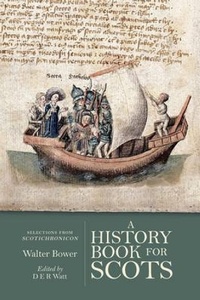
Writing on a small island in the Firth of Forth in the 1440s, Walter Bower set out to tell the whole story of the Scottish nation in a single huge book, the Scotichronicon - 'a history book for Scots'. It begins with the mythical voyage of Scota, the Pharaoh's daughter, from Egypt with the Stone of Destiny. The land that her sons discovered in the Western Ocean was named after her: Scotland. It goes on to describe the turbulent events that followed, among them the wars of the Scots and the Picts (begun by a quarrel over a dog); the poisoning of King Fergus by his wife; Macbeth's usurpation and uneasy reign; the good deeds of Margaret, queen and saint; Bruce's murder of the Red Comyn; the founding of Scotland's first university at St Andrews; the 'Burnt Candlemas'; and the endless troubles between Scotland and England.
Weaving in and out of the events of Bower's factual history, like a wonderful pageant, are other subjects that fascinated him: harrowing visions of hell and purgatory, extraordinary miracles; the exploits of knights and beggars, merchants and monks; the ravages of flood and fire; the terrors of the plague; and the answers to such puzzling questions as what makes a good king, and why Englishmen have tails. In 1998 Donald Watt and his team of scholars completed the first modern edition and translation of Scotichronicon in nine volumes. It has been described as 'a massive achievement for Scottish cultural history' (Sally Mapstone) and 'an open invitation to join a voyage of discovery' (Books in Scotland). This selection from the whole of Scotichronicon puts Bower's epic of Scotland into the hands of the general reader. It is a marvellous and unforgettable story. Perhaps its importance is best summed up by Bower himself, who wrote at the end of it: Non Scotus est Christe cui liber non placet iste - Christ! He is not a Scot who is not pleased with this book!
A History Book for Scots is selected from the complete edition of Scotichronicon by Walter Bower, edited by D E R Watt and a team of scholars, in nine volumes. This monumental work of scholarship, in which the original Latin text appears side by side with a translation in modern English, was completed in 1998. Extensive introductory material and notes guide the reader through the complexities of Bower's history and its background.
Weaving in and out of the events of Bower's factual history, like a wonderful pageant, are other subjects that fascinated him: harrowing visions of hell and purgatory, extraordinary miracles; the exploits of knights and beggars, merchants and monks; the ravages of flood and fire; the terrors of the plague; and the answers to such puzzling questions as what makes a good king, and why Englishmen have tails. In 1998 Donald Watt and his team of scholars completed the first modern edition and translation of Scotichronicon in nine volumes. It has been described as 'a massive achievement for Scottish cultural history' (Sally Mapstone) and 'an open invitation to join a voyage of discovery' (Books in Scotland). This selection from the whole of Scotichronicon puts Bower's epic of Scotland into the hands of the general reader. It is a marvellous and unforgettable story. Perhaps its importance is best summed up by Bower himself, who wrote at the end of it: Non Scotus est Christe cui liber non placet iste - Christ! He is not a Scot who is not pleased with this book!
A History Book for Scots is selected from the complete edition of Scotichronicon by Walter Bower, edited by D E R Watt and a team of scholars, in nine volumes. This monumental work of scholarship, in which the original Latin text appears side by side with a translation in modern English, was completed in 1998. Extensive introductory material and notes guide the reader through the complexities of Bower's history and its background.
Reviews / Votes
'A superlatively good edition' - G W S Barrow, Books in ScotlandMore details
Language
English
Place of publication
Edinburgh
United Kingdom
Publishing group
Birlinn General
Target group
College/higher education
Professional and scholarly
File size
1,04 MB
ISBN-13
978-1-78885-326-2 (9781788853262)
Copyright in bibliographic data and cover images is held by Nielsen Book Services Limited or by the publishers or by their respective licensors: all rights reserved.
Schweitzer Classification
Other editions
Additional editions
Book
06/2012
John Donald Short Run Press
€21.50
Shipment within 3-4 weeks
Persons
Walter Bower was born in Haddington, Scotland in 1385. He had occupations including author, religious leader, historian and abbot. He died in December 1449 at the age of 64 years old.
Content
- Intro
- Title
- Copyright
- Contents
- Preface
- Introduction
- Prologue
- The beginning of the book called Scotichronicon
- Preface to the work
- Book I
- The legend of Gaythelos and Scota
- The islands north-west of Europe
- Simon Brecc and the Stone of Destiny
- The origins of the Picts
- The arrival of the Scots in Albion
- King Fergus I of the Scots
- Book II
- War between the Britons and the Scots and Picts
- 'Fulgentius', the Emperor Severus and the Wall
- A quarrel over a dog
- St Regulus and the relics of St Andrew
- Book III
- King Fergus son of Erc
- St Columba and St Kentigern
- Why the English have tails
- The proper cure of souls
- The murder of King Fergus by his wife
- Charlemagne
- St Bridget's rules about fighting pagans
- The Pictish royal succession
- Book IV
- The Scottish royal succession
- The stratagem of King Kenneth son of Alpin
- The church at Abernethy
- King Hungus and the battle at Athelstaneford
- King Indulf and the Danes and Norwegians
- King Kenneth II and the succession
- The assassination of Kenneth II by Finuele
- A satire on the dress of the English
- Kingly right
- The vice of treachery
- The prodigality of King Malcolm II
- The life and death of King Duncan I
- The duties of a king
- The rule of Macbeth and the exile of Malcolm
- The exile of MacDuff
- Book V
- Malcolm III defeats Macbeth
- The marriage of Malcolm and Margaret
- The virtuous works of Malcolm and Margaret
- A judicial duel involving Edgar the Ætheling
- King Alexander I and Alexander Scrimgeour
- Alexander I and Scone
- The last days of King David I
- The saintly King David I
- Book VI
- The young St Waltheof
- St Waltheof's vision of a baby
- Fordun's address to the Scottish kings
- Maurice bishop of Le Mans
- St Waltheof at Melrose
- Bower's abhorrence of perjury
- The division of the see of Dunkeld
- Bishop Walter Trayl of St Andrews
- Prior Robert de Montrose of St Andrews
- Prior James Biset of St Andrews
- Book VII
- The vision of Dryhthelm of Melrose
- The vision of the Emperor Charles the Fat
- Two beggars and the body of St Martin
- William Rufus and new shoes
- King William's dream and death
- The conversion of a Cistercian monk
- How parents should be honoured
- Thunder at Dunfermline
- Book VIII
- Malcolm IV and Henry II
- Pope Adrian IV on the misery of power
- Epitaph on Malcolm IV
- The sin of pluralism
- The captivity of King William I
- The council at Northampton 1176
- King William and Donald MacWilliam
- Philip II and the Jews
- Philip II and the abbacy of St Denis
- More examples of simony
- Fighting in Galloway
- Peace in England and Scotland 1193-99
- Philip II and a vineyard
- A bishop of Paris and his mother
- William I and Harald earl of Caithness
- Diplomatic relations with England 1209
- Flooding at Perth in 1209
- William I and Guthred MacWilliam
- King William's problems with King John
- Book IX
- King William's death
- inauguration of King Alexander II
- King Philip II and virtuous recreation
- Scottish churchmen and legates 1217-18
- Cistercian monks and the eating of meat
- The murder of Adam bishop of Caithness
- More stories about King Philip II
- King Alexander II attacks Galloway
- King Louis IX and the Jews
- The Bissets
- Epitaph on Alexander II
- Book X
- Inauguration of King Alexander III
- The translation of the mortal remains of St Margaret
- Good and bad counsellors
- The Comyns seize Alexander III
- The battle of Largs
- End of Norse rule in the Western Isles
- Robin Hood and Little John
- The right regard of prelates for royal authority
- Gamelin and William Wischard bishops of St Andrews
- Wischard and the canonical offence of pluralism
- The Bruces earls of Carrick
- Bagimond the papal collector, and stories about papal legates
- Second marriage and death of Alexander III
- The merits of Alexander III: the prophecy of Thomas the Rhymer
- Book XI
- The Interregnum and Great Cause
- The humiliation of John Balliol
- The Siege of Berwick
- Battle of Dunbar
- Balliol and Bruce
- King John's abdication
- William Wallace
- Book XII
- More on William Wallace
- Stirrings of Bruce
- Bruce and Comyn
- Bruce's inauguration and desperate deeds
- Reflections on Bruce's hardships
- The ups and downs of worldly honour
- The capture of Perth
- The Battle of Bannockburn
- James de Douglas and William de Sinclair
- Edward de Bruce
- Celebrations at St Andrews
- Book XIII
- Tit for tat 1322
- Death of Robert I
- The Guardian Thomas Randolph
- James de Douglas and King Robert's heart
- The perfidious English
- Siege of Loch Leven castle
- Inchcolm and English raiders
- Black Agnes of Dunbar
- Robert Prenderguest and sanctuary at Holyrood
- Alan Steersman and Guardian Andrew de Moray
- William de Douglas and William Bullock
- A Bruce imposter and a Seton heiress
- Book XIV
- The battle of Neville's Cross
- The Black Death: first and second occurrences
- A papal appointment to Dunfermline Abbey
- The battle of the Thirty
- The Burnt Candlemas
- Sons of Lindsay and Kirkpatrick
- Floods at Haddington
- A revolt against David II
- plans for his succession
- Choice of a wife
- Good wives
- Queen Margaret Logie
- Robert II and his family
- The Peasants' Revolt in England
- An English invasion 1384
- Invasion of Scotland by Richard II 1385
- The prowess of William Douglas
- The battle of Otterburn
- Book XV
- Aftermath of the coronation at Scone 1390
- Clan fight at Perth
- The pseudo-Richard II
- Death of the duke of Rothesay
- The character of Robert III
- Founding of the University of St Andrews
- Storks at St Giles in Edinburgh
- Scottish forces in France
- 'Le qwhew'
- The battle of Verneuil
- Joan of Arc
- Robert duke of Albany
- The merits of the mass
- Book XVI
- Address to King James II
- The marriage of Princess Margaret
- Reflections on taxation
- Reflections on legislation
- Reflections on a battle in Strathnaver
- The burning of Paul Kravar
- A debate over foreign policy
- The assassination of James I
- The merits of James I
- A poetic epitaph on King James I
- Epilogue
- Index
