

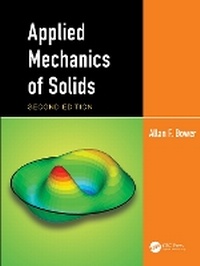
Applied Mechanics of Solids
2nd Edition
Published on 28. November 2025
774 pages
978-1-040-34426-2 (ISBN)
Description

The second edition of Applied Mechanics of Solids provides a concise description of all the concepts needed to predict how solid materials deform and fail under stress. With its companion volume of solved example problems, it is an invaluable class textbook or reference for personal study or review.
With the aid of computer simulations, design engineers can predict stresses, deformation, and failure in structural, mechanical, and bio-mechanical components with a few keystrokes. But simulations are built on sophisticated mathematics, physics, and numerical methods, and always involve some judicious approximations. Engineers need a thorough grasp of these concepts to know how to set up their simulations correctly and to interpret their predictions. This book contains all the theory they need to make the best use of their simulations.
Beginning with a description of the physical and mathematical laws that govern deformation in solids, the text presents models of material behavior; solutions to important boundary value problems using classical methods of analysis; a detailed description of the finite element method; fracture mechanics and failure analysis; as well as structural theories of rods, plates and shells.
All chapters in this new edition contain additional material, but the most substantial changes are to Chapter 8: "Finite Element Analysis: Theory and Implementation," which now covers topics such as locking-resistant finite elements for simulations of solids subjected to large deformations; structural elements (trusses, beams, and plates); as well as methods for enforcing constraints in finite element simulations, cohesive zone models of interface fracture, and contact elements. In addition, a new companion volume provides over 400 example problems with their solutions. The text is supplemented by example finite element codes posted on GitHub, which demonstrate all the finite element algorithms described in the text.
With the aid of computer simulations, design engineers can predict stresses, deformation, and failure in structural, mechanical, and bio-mechanical components with a few keystrokes. But simulations are built on sophisticated mathematics, physics, and numerical methods, and always involve some judicious approximations. Engineers need a thorough grasp of these concepts to know how to set up their simulations correctly and to interpret their predictions. This book contains all the theory they need to make the best use of their simulations.
Beginning with a description of the physical and mathematical laws that govern deformation in solids, the text presents models of material behavior; solutions to important boundary value problems using classical methods of analysis; a detailed description of the finite element method; fracture mechanics and failure analysis; as well as structural theories of rods, plates and shells.
All chapters in this new edition contain additional material, but the most substantial changes are to Chapter 8: "Finite Element Analysis: Theory and Implementation," which now covers topics such as locking-resistant finite elements for simulations of solids subjected to large deformations; structural elements (trusses, beams, and plates); as well as methods for enforcing constraints in finite element simulations, cohesive zone models of interface fracture, and contact elements. In addition, a new companion volume provides over 400 example problems with their solutions. The text is supplemented by example finite element codes posted on GitHub, which demonstrate all the finite element algorithms described in the text.
More details
Edition
2nd edition
Language
English
Place of publication
London
United Kingdom
Publishing group
Taylor & Francis Ltd
Target group
College/higher education
Professional and scholarly
Illustrations
36 Tables, black and white; 515 Line drawings, black and white; 515 Illustrations, black and white
File size
26,41 MB
ISBN-13
978-1-040-34426-2 (9781040344262)
Copyright in bibliographic data and cover images is held by Nielsen Book Services Limited or by the publishers or by their respective licensors: all rights reserved.
Schweitzer Classification
Other editions
Additional editions
Allan F. Bower
Applied Mechanics of Solids
Book
11/2025
2nd Edition
CRC Press
€119.50
Shipment within 15-20 days

Allan F. Bower
Applied Mechanics of Solids
Book
06/2025
CRC Press
Unfortunately, price unknown
Available (delivery time upon request)
Person
Allan F. Bower is emeritus professor of engineering at Brown University, where he taught in the undergraduate mechanical engineering programme and the graduate programme in mechanics of solids. His research interests were in solid mechanics, and included topics such as the strength of contacting surfaces; thin films for microelectronics; metal forming; and the mechanical behaviour of energy storage materials. He also enjoyed working with Brown's talented students in a broad range of engineering courses, and was the recipient of various teaching awards, including Brown's Royce family professorship in teaching excellence.
Content
1 Overview of Solid Mechanics
2 Governing Equations
3 Constitutive Models: Relations between Stress and Strain
4 Solutions to simple boundary and initial value problems for elastic solids
5 Solutions for linear elastic solids
6 Solutions for plastic solids
7 Finite Element Analysis: An Introduction
8 Finite Element Analysis: Theory and Implementation
9 Modelling Material Failure
10 Solutions for Rods, Beams, Membranes, Plates and Shells
Appendix A Review of Vectors and Matrices
Appendix B Introduction to Tensors and their properties
Appendix C Index Notation for Vector and Tensor Operations
Appendix D Vectors and Tensor Operations in Polar Coordinates
Appendix E Miscellaneous derivations
2 Governing Equations
3 Constitutive Models: Relations between Stress and Strain
4 Solutions to simple boundary and initial value problems for elastic solids
5 Solutions for linear elastic solids
6 Solutions for plastic solids
7 Finite Element Analysis: An Introduction
8 Finite Element Analysis: Theory and Implementation
9 Modelling Material Failure
10 Solutions for Rods, Beams, Membranes, Plates and Shells
Appendix A Review of Vectors and Matrices
Appendix B Introduction to Tensors and their properties
Appendix C Index Notation for Vector and Tensor Operations
Appendix D Vectors and Tensor Operations in Polar Coordinates
Appendix E Miscellaneous derivations
