

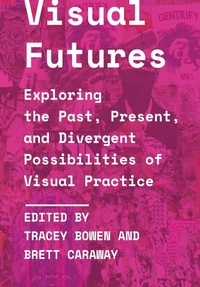
Visual Futures
Exploring the Past, Present, and Divergent Possibilities of Visual Practice
Published on 26. July 2021
978-1-78938-448-2 (ISBN)
Description

The overall subject of the book is visual culture. What sets it apart and gives it such an original emphasis is its multi-disciplinarity and the range of critical voices, ranging through film studies, architecture, creative practice, biology, pedagogy and media theory, which are brought to bear upon the question of visuality and its relationship to futurity.
In our everyday lives, we navigate across a vast sea of visual imagery. Yet, we rarely pause to question how or why we derive meaning from this sea. Nor do we typically contemplate the impact that it has on our motivations, our assumptions about science and about other people, and our actions as individuals and collectives. This book is a collection of interdisciplinary perspectives, from science to film, from graffiti and virtual environments to architecture and education that examines the ways in which we interact and engage with the visual elements of our environments.
Visual Futures provides an interdisciplinary examination of how we visualize and use visuals to make meaning within our environment. A diverse range of contributions and perspectives from biology, film, virtual reality, urban graffiti, architecture, critical pedagogy and education challenge our current attitudes, norms and practices of looking and seeing, opening up questions about the future. The future is a concept with significant political stakes and the work of rethinking and reimagining possible worlds requires a host of practices, which include the work of seeing, of image-making and of representation - all of which is political work taken up by the book contributors.
Primary readership will be among scholars and students of visual culture, media studies, digital cultures, fine art, architecture, education, science communication and sociology. Clearly aimed at an academic readership, it will also appeal to practising artists, architects, software developers and educators.
In our everyday lives, we navigate across a vast sea of visual imagery. Yet, we rarely pause to question how or why we derive meaning from this sea. Nor do we typically contemplate the impact that it has on our motivations, our assumptions about science and about other people, and our actions as individuals and collectives. This book is a collection of interdisciplinary perspectives, from science to film, from graffiti and virtual environments to architecture and education that examines the ways in which we interact and engage with the visual elements of our environments.
Visual Futures provides an interdisciplinary examination of how we visualize and use visuals to make meaning within our environment. A diverse range of contributions and perspectives from biology, film, virtual reality, urban graffiti, architecture, critical pedagogy and education challenge our current attitudes, norms and practices of looking and seeing, opening up questions about the future. The future is a concept with significant political stakes and the work of rethinking and reimagining possible worlds requires a host of practices, which include the work of seeing, of image-making and of representation - all of which is political work taken up by the book contributors.
Primary readership will be among scholars and students of visual culture, media studies, digital cultures, fine art, architecture, education, science communication and sociology. Clearly aimed at an academic readership, it will also appeal to practising artists, architects, software developers and educators.
More details
Language
English
Place of publication
United Kingdom
Publishing group
Intellect
Target group
Professional and scholarly
Illustrations
31 Halftones, color
ISBN-13
978-1-78938-448-2 (9781789384482)
Copyright in bibliographic data and cover images is held by Nielsen Book Services Limited or by the publishers or by their respective licensors: all rights reserved.
Schweitzer Classification
Other editions
Additional editions
Tracey Bowen | Brett Caraway
Visual Futures
Exploring the Past, Present, and Divergent Possibilities of Visual Practice
Book
02/2022
Intellect Books
€38.90
Shipment within 3-4 weeks
Persons
Tracey Bowen has a Ph.D. from the University of Toronto. Her research is situated at the intersection of contemporary hieroglyphics, social justice and visual communications. She teaches in the areas of visual rhetoric as well as experiential education and her research has been published in Visual Communications, Studies in Art Education, Metaphor and Symbol, Studies in Higher Education and Higher Education Research and Development.
Brett Caraway obtained his Ph.D. from the University of Texas at Austin before coming to the University of Toronto where he teaches and researches economics, Marxian theory and sustainability. His research has been published in Environmental Communication, Communication Theory, Information, Communication & Society, Media, Culture & Society and the International Journal of Communication.
Brett Caraway obtained his Ph.D. from the University of Texas at Austin before coming to the University of Toronto where he teaches and researches economics, Marxian theory and sustainability. His research has been published in Environmental Communication, Communication Theory, Information, Communication & Society, Media, Culture & Society and the International Journal of Communication.
Content
Chapter 1 - See and see again: mapping the fractures in visual culture
Brett Caraway and Penny Kinnear
Chapter 2 - In between Whiteness: Pierre Bourdieu and Rudolph Valentino, an unlikely pairing
Elizabeth Peden
Chapter 3 - Ink to inkling: Artful messages in the visuals of biology
Charudatta Navare
Chapter 4 - Visualizing gentrification: Resistance and reclamation through the writing on the walls
Tracey Bowen
Chapter 5 - Intentional viewing: Decoding, learning, and creating culturally relevant architecture
Matthew Dudzik & Marilyn Corsen Whitney
Chapter 6 - Visualizing art-science entanglements for more habitable futures
Kylie Caraway
Chapter 7 - Seeing, sensing and surrendering the inside: Expressions of the adolescent self in a 'structured illustrative disclosure'
Edie Lanphar and Phil Fitzsimmons
Chapter 8 - Picturing the state of visual literacy initiatives today
Dana Statton Thompson
Chapter 9 - Afterforward: To visualize the future is political work
Danielle Taschereau Mamers
Brett Caraway and Penny Kinnear
Chapter 2 - In between Whiteness: Pierre Bourdieu and Rudolph Valentino, an unlikely pairing
Elizabeth Peden
Chapter 3 - Ink to inkling: Artful messages in the visuals of biology
Charudatta Navare
Chapter 4 - Visualizing gentrification: Resistance and reclamation through the writing on the walls
Tracey Bowen
Chapter 5 - Intentional viewing: Decoding, learning, and creating culturally relevant architecture
Matthew Dudzik & Marilyn Corsen Whitney
Chapter 6 - Visualizing art-science entanglements for more habitable futures
Kylie Caraway
Chapter 7 - Seeing, sensing and surrendering the inside: Expressions of the adolescent self in a 'structured illustrative disclosure'
Edie Lanphar and Phil Fitzsimmons
Chapter 8 - Picturing the state of visual literacy initiatives today
Dana Statton Thompson
Chapter 9 - Afterforward: To visualize the future is political work
Danielle Taschereau Mamers
