

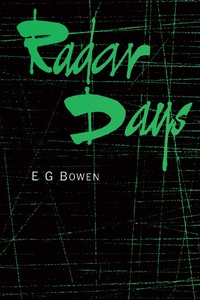
Radar Days
1st Edition
Published on 2. March 2022
231 pages
978-1-000-11212-2 (ISBN)
Description

It is now more than sixty years since radar began in Britain. In the intervening years, airborne radar has become one of the most important branches of civilian and military radar. In Radar Days, "the father of airborne radar," Dr. "Taffy" Bowen recounts his personal story of how the first airborne radars were built and brought into use in the Royal Air Force, and of the Tizard mission to the USA in 1940, of which he was a member.
Written from the point of view of the individuals who worked at the laboratory bench, the story begins with the building of the first ground air-warning radar at Orfordness in June 1935. The book proceeds to describe how this equipment was miniaturized to make it suitable for use in aircraft and the lengthy, sometimes hazardous flight trials conducted before radar went into service with the RAF. The author also details the activities of the Tizard mission, which was instrumental in installing the first airborne radars in US aircraft. The greatest achievement of the mission was to pass on the secret of the resonant magnetron to the US only a few months after its invention at Birmingham University. This was the device that brought about a revolution in Allied radar, putting it far ahead of the corresponding German technology for the remainder of the war.
Written from the point of view of the individuals who worked at the laboratory bench, the story begins with the building of the first ground air-warning radar at Orfordness in June 1935. The book proceeds to describe how this equipment was miniaturized to make it suitable for use in aircraft and the lengthy, sometimes hazardous flight trials conducted before radar went into service with the RAF. The author also details the activities of the Tizard mission, which was instrumental in installing the first airborne radars in US aircraft. The greatest achievement of the mission was to pass on the secret of the resonant magnetron to the US only a few months after its invention at Birmingham University. This was the device that brought about a revolution in Allied radar, putting it far ahead of the corresponding German technology for the remainder of the war.
More details
Edition
1. Auflage
Language
English
Place of publication
London
United Kingdom
Publishing group
Taylor & Francis Ltd
Target group
Professional and scholarly
File size
20,29 MB
ISBN-13
978-1-000-11212-2 (9781000112122)
Copyright in bibliographic data and cover images is held by Nielsen Book Services Limited or by the publishers or by their respective licensors: all rights reserved.
Schweitzer Classification
Other editions
Additional editions
E. G. Bowen
Radar Days
Book
01/1998
1st Edition
Institute of Physics Publishing
€156.24
Article exhausted; check different version

Bowen E G
Radar Days
Book
01/1987
1st Edition
Institute of Physics Publishing
€52.23
Article exhausted; check different version
Person
E.G. Bowen
Content
The beginning of radar in Britain. The early development of airborne radar. Sea search and some tales of "D" Flight. Air-interception trials in Battles and Blenheims. The outbreak of war and the move from Bawdsey. Air to surface vessel radar against ships and submarines. Introduction of air-interception radar into service. The move from St Athan to Swanage. The transition from metre to centimetre waves. The Tizard mission to the USA and Canada. The resonant magnetron and Bell Laboratory. Formation of the radiation laboratory.
