

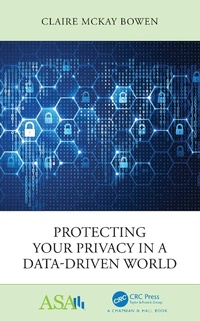
Protecting Your Privacy in a Data-Driven World
1st Edition
Published on 21. November 2021
148 pages
978-1-000-48181-5 (ISBN)
Description

At what point does the sacrifice to our personal information outweigh the public good?
If public policymakers had access to our personal and confidential data, they could make more evidence-based, data-informed decisions that could accelerate economic recovery and improve COVID-19 vaccine distribution. However, access to personal data comes at a steep privacy cost for contributors, especially underrepresented groups.
Protecting Your Privacy in a Data-Driven World is a practical, nontechnical guide that explains the importance of balancing these competing needs and calls for careful consideration of how data are collected and disseminated by our government and the private sector. Not addressing these concerns can harm the same communities policymakers are trying to protect through data privacy and confidentiality legislation.
If public policymakers had access to our personal and confidential data, they could make more evidence-based, data-informed decisions that could accelerate economic recovery and improve COVID-19 vaccine distribution. However, access to personal data comes at a steep privacy cost for contributors, especially underrepresented groups.
Protecting Your Privacy in a Data-Driven World is a practical, nontechnical guide that explains the importance of balancing these competing needs and calls for careful consideration of how data are collected and disseminated by our government and the private sector. Not addressing these concerns can harm the same communities policymakers are trying to protect through data privacy and confidentiality legislation.
Reviews / Votes
"Staffers and non-technical policy/think-tank researchers need this book. Also data users, like state demographers or public health officials, who need to understand how their data are affected by privacy preserving approaches, but who do not need to know the technical details."-Amy O'Hara, Georgetown University
"I worked in the Federal Statistical system for several years on the analysis and dissemination of household survey data, preparation of public uses files, and the submission of requests to the Disclosure Review Board. Even with my experience, I found the book fascinating, comprehensive, and valuable for developing a foundation to understand traditional and emerging data privacy issues."
-Stephanie Shipp, Biocomplexity Institute, University of Virginia
"The author introduces traditional data privacy techniques, such as data suppression, top-and bottom-coding and categorical thresholding, as well as modern approaches, most notably differential privacy, at a high, non-technical level. This is done in a clear and accessible way, making the book a good resource for the layperson or as a first glimpse into the complex world of data privacy. Readers with technical backgrounds may still find some of the chapters quite enlightening. I especially appreciated the discussion of issues surrounding the process of releasing personal data in the real world. ... In conclusion, Claire McKay Bowen has written a valuable introduction to the increasingly important area of data privacy."
-Stefan Stein, in Journal of the Royal Statistical Society Series A (Statistics in Society), April 2022
More details
Series
Edition
1. Auflage
Language
English
Place of publication
London
United Kingdom
Publishing group
Taylor & Francis Ltd
Target group
Professional and scholarly
Illustrations
1 Line drawings, color; 11 Line drawings, black and white; 11 Halftones, color; 12 Illustrations, color; 11 Illustrations, black and white
ISBN-13
978-1-000-48181-5 (9781000481815)
Copyright in bibliographic data and cover images is held by Nielsen Book Services Limited or by the publishers or by their respective licensors: all rights reserved.
Schweitzer Classification
Other editions
Additional editions
Claire McKay Bowen
Protecting Your Privacy in a Data-Driven World
Book
11/2021
1st Edition
Chapman & Hall/CRC
€100.40
Shipment within 15-20 days
Claire McKay Bowen
Protecting Your Privacy in a Data-Driven World
Book
11/2021
1st Edition
Chapman & Hall/CRC
€33.47
Shipment within 15-20 days
Claire McKay Bowen
Protecting Your Privacy in a Data-Driven World
Book
11/2021
CRC Press
Unfortunately, price unknown
Available (delivery time upon request)
Person
Dr. Claire McKay Bowen is the Lead Data Scientist for Privacy and Data Security at the Urban Institute. Her research focuses on developing and assessing the quality of di erentially private data synthesis methods and science communication. She holds a BS in mathematics and physics from Idaho State University and an MS and PhD in statistics from the University of Notre Dame. After completing her PhD, she worked at Los Alamos National Laboratory, where she investigated cosmic ray effects on supercomputers.
In 2021, the Committee of Presidents of Statistical Societies identified her as an emerging leader in statistics for her "contributions to the development and broad dissemination of Statistics and Data Science methods and concepts, particularly in the emerging field of Data Privacy, and for leadership of technical initiatives, professional development activities, and educational programs."
In 2021, the Committee of Presidents of Statistical Societies identified her as an emerging leader in statistics for her "contributions to the development and broad dissemination of Statistics and Data Science methods and concepts, particularly in the emerging field of Data Privacy, and for leadership of technical initiatives, professional development activities, and educational programs."
Content
1. Why Is Data Privacy Important? 2. How Did Data Privacy Change Over Time? 3. How Do Data Privacy Methods Expand Access to Data? 4. How Do Data Privacy Methods Avoid Invalidating Results? 5. What Makes Datasets Difficult for Data Privacy? 6. What Data Privacy Laws Exist? 7. What Is the Future of Data Privacy?
