

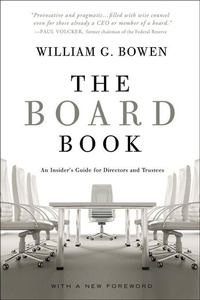
The Board Book
An Insider's Guide for Directors and Trustees
Published on 18. April 2012
256 pages
978-0-393-06841-2 (ISBN)
Description

"By far the best book on corporate and institutional governance." —Nicholas Katzenbach, former attorney general of the United States
In his new foreword to The Board Book, former Mellon Foundation and Princeton University president William G. Bowen brings his immense experience to bear on the most pressing questions facing boards of directors and trustees today: seeking collaborative relationships and placing a renewed emphasis on sustainable initiatives. The strategies Bowen relates throughout the book foster the collegiality and sense of purpose—more important in today's turbulent times than ever before—that are integral to any effective board.More details
Other editions
Additional editions
Book
06/2012
WW Norton & Co
€22.00
Article not available at the moment
Book
04/2008
WW Norton & Co
€46.03
Article exhausted; check different version
Person
William G. Bowen (1933?2016) was an influential educator and the author of more than twenty books, including Lessons Learned: Reflections of a University President, The Shape of the River, and Equity and Excellence in American Higher Education.
Content
- Cover
- ALSO BY WILLIAM G. BOWEN
- Title Page
- Dedication
- Contents
- Foreword
- Preface
- Approach Taken
- Commentators
- Organization
- Acknowledgments
- 1. Roles of Boards-and the Constraints They Face
- Why Are Boards Needed?
- What Do Boards Do?
- Return on Mission
- Changing Contexts and Constraints
- Scandals and Their Consequences
- Regulatory and Media Constraints
- Market Constraints and "Owners"
- 2. Board Leadership
- A Separate Chairman? The Conceptual Arguments for and against Splitting the Roles
- Practical Considerations: The Need to Take a Situational Perspective
- The Lead Director Model
- Summing Up: Prospects for Organizational Change in the For-Profit Sector
- Postscript: Characteristic Differences in Board Structure between Nonprofits and For-Profits
- 3. Compensating the CEO
- A Hot-Button Issue in the For-Profit Sector
- Actions to Consider
- Analogous Issues in the Nonprofit Sector
- Appendix to Chapter 3BOARD EVALUATION OF CEOS IN A NONPROFIT SETTING
- 4. Evaluating and Replacing the CEO
- The Obligation to Decide When New Leadership Is Needed
- The Role of a Careful Evaluation Process
- The Proper Length of the Leash: Different in the Two Sectors?
- Establishing a Set Retirement Date
- 5. CEO Transitions
- Improving the Succession-Planning Process
- Recruiting a New Leader: Job Specifications
- The Search Process
- Personal/Professional Qualifications of Candidates
- Graceful Transitions: What Should Be the Ongoing Role of the Former CEO/President?
- 6. Building the Board
- The Size of the Board
- Recruiting Board Members: The Context and Process
- Recruiting the Right Individuals
- Diversity
- Independence of Board Members
- 7. Board Machinery
- Committees
- Board Deliberations and Dynamics
- Executive Sessions
- Managing Conflicts of Interest
- Confidentiality and the Handling of Leaks
- When Resigning Is (and Is Not) the Right Thing to Do
- Dysfunctional Board Members, Term Limits, and Mandatory Retirement
- Compensation of Directors and Trustees
- Board Evaluation
- 8. Themes
- The CEO-Board Partnership
- Courage and the Will to Act
- Investing in Governance
- Are For-Profit and Nonprofit Board Practices Converging?
- Rewards for Service on Boards
- Notes
- Praise
- Copyright
