

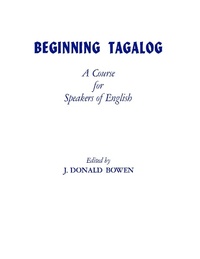
Beginning Tagalog
A Course for Speakers of English
1st Edition
Published on 3. November 2023
542 pages
978-0-520-34289-7 (ISBN)
Description

A comprehensive, one-year introductory textbook for Tagalog, the language spoken in the Philippines.
Beginning Tagalog has been designed to meet the specific needs of adult native speakers of English who wish to learn spoken Tagalog, though students with other language backgrounds may be able to follow the course with profit. With fairly intensive class scheduling, and assuming laboratory assignments and home study, the text can be covered in one academic year.
The text is designed to accomplish two aims. The first is to impart oral control of Tagalog and, by means of an acquaintance with the major patterns of the language, to provide the means for additional independent study that will lead to a full mastery of the structures and a vocabulary that is sufficiently broad to meet the needs of most students. The second aim is to provide accurate, up-to-date information about the patterns of Filipino culture that will enable a student to understand the social customs, standards, values, and aspirations of the Filipino people, in order to prepare him for sympathetic, enlightened, and useful participation in the context of Filipino society. . . .
The text consists of 25 units and appendices. In the first half of the text, the student plays the part of hearer and speaker, with only incidental reading of oral dialogs and drills. From Unit XIII on there is a reading section designated for each unit, correlated with the primarily spoken materials, but designed to promote facility in the orthography and distinctive patterns of the written language. . .
The basic format is as follows:
A. Basic Dialog
B. Cultural and Structural Notes
C. Pronunciation Exercises (to Unit XIII)
D. Drills and Grammar
E. Cumulative Drills
F. Visual-Cue Drills
G. Comprehension-Response Drills
H. Readings (from Unit XIII)"
This title is part of UC Press's Voices Revived program, which commemorates University of California Press's mission to seek out and cultivate the brightest minds and give them voice, reach, and impact. Drawing on a backlist dating to 1893, Voices Revived makes high-quality, peer-reviewed scholarship accessible once again using print-on-demand technology. This title was originally published in 1965.
A comprehensive, one-year introductory textbook for Tagalog, the language spoken in the Philippines.
Beginning Tagalog has been designed to meet the specific needs of adult native speakers of English who wish to learn spoken Tagalog, tho
Beginning Tagalog has been designed to meet the specific needs of adult native speakers of English who wish to learn spoken Tagalog, though students with other language backgrounds may be able to follow the course with profit. With fairly intensive class scheduling, and assuming laboratory assignments and home study, the text can be covered in one academic year.
The text is designed to accomplish two aims. The first is to impart oral control of Tagalog and, by means of an acquaintance with the major patterns of the language, to provide the means for additional independent study that will lead to a full mastery of the structures and a vocabulary that is sufficiently broad to meet the needs of most students. The second aim is to provide accurate, up-to-date information about the patterns of Filipino culture that will enable a student to understand the social customs, standards, values, and aspirations of the Filipino people, in order to prepare him for sympathetic, enlightened, and useful participation in the context of Filipino society. . . .
The text consists of 25 units and appendices. In the first half of the text, the student plays the part of hearer and speaker, with only incidental reading of oral dialogs and drills. From Unit XIII on there is a reading section designated for each unit, correlated with the primarily spoken materials, but designed to promote facility in the orthography and distinctive patterns of the written language. . .
The basic format is as follows:
A. Basic Dialog
B. Cultural and Structural Notes
C. Pronunciation Exercises (to Unit XIII)
D. Drills and Grammar
E. Cumulative Drills
F. Visual-Cue Drills
G. Comprehension-Response Drills
H. Readings (from Unit XIII)"
This title is part of UC Press's Voices Revived program, which commemorates University of California Press's mission to seek out and cultivate the brightest minds and give them voice, reach, and impact. Drawing on a backlist dating to 1893, Voices Revived makes high-quality, peer-reviewed scholarship accessible once again using print-on-demand technology. This title was originally published in 1965.
A comprehensive, one-year introductory textbook for Tagalog, the language spoken in the Philippines.
Beginning Tagalog has been designed to meet the specific needs of adult native speakers of English who wish to learn spoken Tagalog, tho
More details
Other editions
Additional editions
Book
06/1965
1st Edition
University of California Press
€56.95
Article not available at the moment
Content
The Tagalog Language
Introduction
1. Mapan ng Pilipinas
2. Bago Magklase
3. Kaisahan ng Pamilya
4. Araw ng Pista
5. Bayanihan
6. Ang Dobol Istandard
7. Ang Pamilya ni Fidel
8. Idealismo
9. Ang Pilipina
10. Ang Ninong
11. Ang Pulitika
12. Madaling Araw
13. Kagandahang-loob
14. Si Tagpe
15. Uuwi sa Nanay
16. Balot
17. Babasahing Pambayan
18. Sa Central Market
19. Ang Sabungero
20. Luksang Lamayan
21. Kaarawan ni Cely
22. Mahal na Araw
23. Santa Krus de Mayo
24. Mga Kaugaliang Pilipino at Amerikano
25. Sa Linggo ang Bola
Appendix 1. Useful Expressions
Appendix 2. Answer Keys
Appendix 3. Verbal Affix-Focus Charts
Appendix 4. Cardinal Numerals
Vocabulary
Index
Introduction
1. Mapan ng Pilipinas
2. Bago Magklase
3. Kaisahan ng Pamilya
4. Araw ng Pista
5. Bayanihan
6. Ang Dobol Istandard
7. Ang Pamilya ni Fidel
8. Idealismo
9. Ang Pilipina
10. Ang Ninong
11. Ang Pulitika
12. Madaling Araw
13. Kagandahang-loob
14. Si Tagpe
15. Uuwi sa Nanay
16. Balot
17. Babasahing Pambayan
18. Sa Central Market
19. Ang Sabungero
20. Luksang Lamayan
21. Kaarawan ni Cely
22. Mahal na Araw
23. Santa Krus de Mayo
24. Mga Kaugaliang Pilipino at Amerikano
25. Sa Linggo ang Bola
Appendix 1. Useful Expressions
Appendix 2. Answer Keys
Appendix 3. Verbal Affix-Focus Charts
Appendix 4. Cardinal Numerals
Vocabulary
Index
