

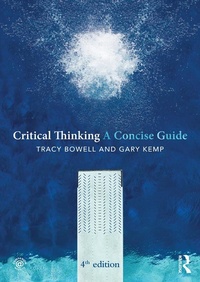
Critical Thinking
A Concise Guide
4th Edition
Published on 24. October 2014
318 pages
978-1-317-67718-5 (ISBN)
Description

We are frequently confronted with arguments. Arguments are attempts to persuade us - to influence our beliefs and actions - by giving us reasons to believe this or that. Critical Thinking: A Concise Guide will equip students with the concepts and techniques used in the identification, analysis and assessment of arguments. Through precise and accessible discussion, this book provides the tools to become a successful critical thinker, one who can act and believe in accordance with good reasons, and who can articulate and make explicit those reasons.
Key topics discussed include:
core concepts in argumentation
how language can serve to obscure or conceal the real content of arguments; how to distinguish argumentation from rhetoric
how to avoid common confusions surrounding words such as 'truth', 'knowledge' and 'opinion'
how to identify and evaluate the most common types of argument
how to distinguish good reasoning from bad in terms of deductive validly and induction.
This fourth edition has been revised and updated throughout, with a new introduction for each chapter and up-to-date topical examples. Particular revisions include: practical reasoning; understanding quantitative data, statistics, and the rhetoric used about them; scientific reasoning; the connection to formal logic and the logic of probability; conditionals; ambiguity; vagueness; slippery slope arguments; and arguments by analogy.
The dynamic Routledge Critical Thinking companion website provides thoroughly updated resources for both instructors and students including new examples and case studies, flashcards, sample questions, practice questions and answers, student activities and a testbank of questions for use in the classroom.
Key topics discussed include:
core concepts in argumentation
how language can serve to obscure or conceal the real content of arguments; how to distinguish argumentation from rhetoric
how to avoid common confusions surrounding words such as 'truth', 'knowledge' and 'opinion'
how to identify and evaluate the most common types of argument
how to distinguish good reasoning from bad in terms of deductive validly and induction.
This fourth edition has been revised and updated throughout, with a new introduction for each chapter and up-to-date topical examples. Particular revisions include: practical reasoning; understanding quantitative data, statistics, and the rhetoric used about them; scientific reasoning; the connection to formal logic and the logic of probability; conditionals; ambiguity; vagueness; slippery slope arguments; and arguments by analogy.
The dynamic Routledge Critical Thinking companion website provides thoroughly updated resources for both instructors and students including new examples and case studies, flashcards, sample questions, practice questions and answers, student activities and a testbank of questions for use in the classroom.
Reviews / Votes
'The way in which this text combines clear and detailed explanations of technical concepts with a comprehensive set of contemporary and relevant examples is excellent. Whilst the focus is largely on developing the practical skills of argument reconstruction and analysis, the authors never lose sight of the larger philosophical picture, and this makes the book a joy both to teach with, and to learn from.' - Joel Walmsley, University College Cork, Ireland'Bowell & Kemp's Critical Thinking: A Concise Guide is, in my view, the best textbook by some distance for undergraduate students approaching the subject for the first time. It is clearly written and introduces the fundamental concepts of the subject in an accessible and systematic way which equips students with the essential skills needed for the construction and analysis of arguments. The exercises are carefully selected to really embed the concepts in examples that will be relevant and interesting to students, and provide an excellent teaching resource. The book will be of great value to students of philosophy, providing them with an analytical framework within which they can properly understand and assess the texts they study. Furthermore, students of any academic discipline will benefit greatly from the book as a guide to organising their thoughts into rigorous arguments. The fourth edition contains welcome new material on probabilistic reasoning, as well as continued improvements throughout the book. It remains the clear first-choice textbook for my course.' - Graham Stevens, University of Manchester, UK
Praise for previous editions:
'This concise guide offers relevant, rigorous and approachable methods...The authors focus on analysing and assessing arguments in a thoughtfully structured series of chapters, with clear definitions, a glossary, plenty of examples and some useful exercises.' - Will Ord, Times Educational Supplement
'In my view this book is the most useful textbook on the market for its stated audience. It provides exceptionally clear explanations, with sufficient technical detail, but without over-complication. It is my first-choice text for teaching critical thinking to first-year undergraduate students.' - Dawn Phillips, University of Southampton, UK
'...written with actual undergraduates, and the standard mistakes and confusions that they tend to be subject to, clearly borne in mind...' - Helen Beebee, University of Manchester, UK
'This is the best single text I have seen for addressing the level, presumptions, and interests of the non-specialist.' - Charles Ess, Drury University, USA 'Critical Thinking is the best textbook by some distance for undergraduate students approaching the subject for the first time. It is clearly written and introduces the fundamental concepts of the subject in an accessible and systematic way. The fourth edition contains welcome new material on probabilistic reasoning, as well as continued improvements throughout the book. It remains the clear first-choice textbook for my course.' - Graham Stevens, University of Manchester, UK
'The way in which this text combines clear and detailed explanations of technical concepts with a comprehensive set of contemporary and relevant examples is excellent. Whilst the focus is largely on developing the practical skills of argument reconstruction and analysis, the authors never lose sight of the larger philosophical picture, and this makes the book a joy both to teach with, and to learn from.' - Joel Walmsley, University College Cork, Ireland
Praise for previous editions:
'This concise guide offers relevant, rigorous and approachable methods...The authors focus on analysing and assessing arguments in a thoughtfully structured series of chapters, with clear definitions, a glossary, plenty of examples and some useful exercises.' - Will Ord, Times Educational Supplement
'In my view this book is the most useful textbook on the market for its stated audience. It provides exceptionally clear explanations, with sufficient technical detail, but without over-complication. It is my first-choice text for teaching critical thinking to first-year undergraduate students.' - Dawn Phillips, University of Southampton, UK
'...written with actual undergraduates, and the standard mistakes and confusions that they tend to be subject to, clearly borne in mind...' - Helen Beebee, University of Manchester, UK
'This is the best single text I have seen for addressing the level, presumptions, and interests of the non-specialist.' - Charles Ess, Drury University, USA
More details
Edition
4th edition
Language
English
Place of publication
London
United Kingdom
Publishing group
Taylor & Francis Ltd
Target group
College/higher education
Edition type
Revised edition
Illustrations
12 s/w Abbildungen, 12 s/w Zeichnungen
12 Line drawings, black and white; 12 Illustrations, black and white
File size
2,82 MB
ISBN-13
978-1-317-67718-5 (9781317677185)
Copyright in bibliographic data and cover images is held by Nielsen Book Services Limited or by the publishers or by their respective licensors: all rights reserved.
Schweitzer Classification
Other editions
Additional editions
Book
09/2015
4th Edition
Routledge
€62.08
Article exhausted; check for reprint
Book
11/2014
4th Edition
Routledge
€163.42
Article exhausted; check for reprint
Persons
Tracy Bowell is Senior Lecturer in Philosophy at the University of Waikato, New Zealand.
Gary Kemp is Senior Lecturer in Philosophy at the University of Glasgow, UK.
Gary Kemp is Senior Lecturer in Philosophy at the University of Glasgow, UK.
Content
Preface to the fourth edition Introduction and Preview 1. Introducing Arguments 2. Language and Rhetoric 3. Logic: Deductive Validity 4. Logic: Inductive force 5. The Practice of Argument-Reconstruction 6. Issues in Argument-Assessment 7. Pseudo-Reasoning 8. Truth, Knowledge and Belief Glossary Answers and hints to selected exercises. Index
