

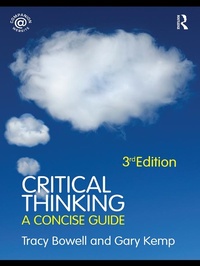
Critical Thinking
A Concise Guide
3rd Edition
Published on 11. September 2009
294 pages
978-1-135-28415-2 (ISBN)
Description

Critical Thinking: A Concise Guide is a much-needed guide to argument analysis and a clear introduction to thinking clearly and rationally for oneself. Through precise and accessible discussion this book equips students with the essential skills required to tell a good argument from a bad one.
Key features of the book are:
clear, jargon-free discussion of key concepts in argumentation
how to avoid common confusions surrounding words such as 'truth', 'knowledge' and 'opinion'
how to identify and evaluate the most common types of argument
how to spot fallacies in arguments and tell good reasoning from bad
chapter summaries, glossaries and useful exercises.
This third edition has been revised and updated throughout, with new exercises, and up-to-date topical examples, including: 'real-world' arguments; practical reasoning; understanding quantitative data, statistics, and the rhetoric used about them; scientific reasoning; and expanded discussion of conditionals, ambiguity, vagueness, slippery slope arguments, and arguments by analogy.
The Routledge Critical Thinking companion website, features a wealth of further resources, including examples and case studies, sample questions, practice questions and answers, and student activities.
Critical Thinking: A Concise Guide is essential reading for anyone, student or professional, at work or in the classroom, seeking to improve their reasoning and arguing skills.
Key features of the book are:
clear, jargon-free discussion of key concepts in argumentation
how to avoid common confusions surrounding words such as 'truth', 'knowledge' and 'opinion'
how to identify and evaluate the most common types of argument
how to spot fallacies in arguments and tell good reasoning from bad
chapter summaries, glossaries and useful exercises.
This third edition has been revised and updated throughout, with new exercises, and up-to-date topical examples, including: 'real-world' arguments; practical reasoning; understanding quantitative data, statistics, and the rhetoric used about them; scientific reasoning; and expanded discussion of conditionals, ambiguity, vagueness, slippery slope arguments, and arguments by analogy.
The Routledge Critical Thinking companion website, features a wealth of further resources, including examples and case studies, sample questions, practice questions and answers, and student activities.
Critical Thinking: A Concise Guide is essential reading for anyone, student or professional, at work or in the classroom, seeking to improve their reasoning and arguing skills.
Reviews / Votes
Reviews of earlier editions:'This concise guide offers relevant, rigorous and approachable methods...The authors focus on analysing and assessing arguments in a thoughtfully structured series of chapters, with clear definitions, a glossary, plenty of examples and some useful exercises.'
Will Ord, Times Educational Supplement
'In my view this book is the most useful textbook on the market for its stated audience. It provides exceptionally clear explanations, with sufficient technical detail, but without over-complication. It is my first-choice text for teaching critical thinking to first-year undergraduate students.'
Dawn Phillips, University of Southampton
'...written with actual undergraduates, and the standard mistakes and confusions that they tend to be subject to, clearly borne in mind...'
Helen Beebee, University of Manchester
'This is the best single text I have seen for addressing the level, presumptions, and interests of the non-specialist.'
Charles Ess, Drury University
More details
Edition
3rd edition
Language
English
Place of publication
London
United Kingdom
Publishing group
Taylor & Francis Ltd
Target group
College/higher education
Edition type
Revised edition
Illustrations
15 s/w Zeichnungen
15 Line drawings, black and white
File size
2,00 MB
ISBN-13
978-1-135-28415-2 (9781135284152)
Copyright in bibliographic data and cover images is held by Nielsen Book Services Limited or by the publishers or by their respective licensors: all rights reserved.
Schweitzer Classification
Other editions
Additional editions
Book
07/2009
3rd Edition
Routledge
€119.04
Article exhausted; check for reprint
Book
07/2009
3rd Edition
Routledge
€48.46
Article exhausted; check for reprint
Persons
Tracy Bowell is Senior Lecturer in Philosophy at the University of Waikato, New Zealand. Gary Kemp is Senior Lecturer in Philosophy at the University of Glasgow, UK.
Content
Chapter 1: Introducing Arguments
Chapter 2: Language and Rhetoric
Chapter 3: Logic: Deductive Validity
Chapter 4 : Logic: Inductive force
Chapter 5: The practice of argument-reconstruction
Chapter 6: Issues in argument assessment
Chapter 7: Pseudo-Reasoning
Chapter 8 :Truth Knowledge and Belief
Chapter 2: Language and Rhetoric
Chapter 3: Logic: Deductive Validity
Chapter 4 : Logic: Inductive force
Chapter 5: The practice of argument-reconstruction
Chapter 6: Issues in argument assessment
Chapter 7: Pseudo-Reasoning
Chapter 8 :Truth Knowledge and Belief
