

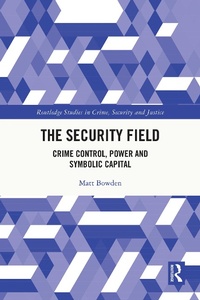
The Security Field
Crime Control, Power and Symbolic Capital
1st Edition
Published on 3. June 2024
212 pages
978-1-040-04204-5 (ISBN)
Description

How crime and security are governed has become a critical issue in criminology over the first quarter of the twenty-first century. Today, we see a broader landscape of regulatory players who are involved in the control and management of crime, whether in crime prevention, safety in the community or in providing private security services. The Security Field: Crime Control, Power and Symbolic Capital gets to grips with these changes and argues that this forms an emerging field in which different players appear to compete and co-operate but are ultimately vying to shape and order the field. This book draws on new thinking in the social sciences on questions of crime, fear and security and contributes to the expanding interest on the sociology and criminology of security by offering a Bourdieusian approach to plural policing and the everyday political economy of security.
Drawing from Bourdieu's concept of field, this book builds a theory of the security field based upon a series of in-depth interviews with security actors such as senior police officers, NGOs, private security professionals, government officials and community safety workers in Ireland. It demonstrates how security producers compete for cultural capital in its many forms - as data, information and relationships - and ultimately as a way of cementing their positions in this emerging field. It shows the dominant power of the formal police and central government in shaping and ordering this relational space. In doing so, The Security Field: Crime Control, Power and Symbolic Capital builds an empirical case from three distinct areas of security production: urban security, community safety and the connections between regulated private security and public crime prevention. It explores the challenges of securitisation in respect of public safety, security and rights and the way in which social problems such as drug use, homelessness and urban marginality are recast as 'security' concerns.
An accessible and compelling read, this book will appeal to students and scholars of criminology, sociology, urban studies and security studies.
Drawing from Bourdieu's concept of field, this book builds a theory of the security field based upon a series of in-depth interviews with security actors such as senior police officers, NGOs, private security professionals, government officials and community safety workers in Ireland. It demonstrates how security producers compete for cultural capital in its many forms - as data, information and relationships - and ultimately as a way of cementing their positions in this emerging field. It shows the dominant power of the formal police and central government in shaping and ordering this relational space. In doing so, The Security Field: Crime Control, Power and Symbolic Capital builds an empirical case from three distinct areas of security production: urban security, community safety and the connections between regulated private security and public crime prevention. It explores the challenges of securitisation in respect of public safety, security and rights and the way in which social problems such as drug use, homelessness and urban marginality are recast as 'security' concerns.
An accessible and compelling read, this book will appeal to students and scholars of criminology, sociology, urban studies and security studies.
Reviews / Votes
'Studies on the governance of security and safety in society is a growing area of importance to criminologists. Matt Bowden provides us with not only a deep empirical dive into how security actors collaborate and form networks and assemblages but also a thorough exposition and application of Bourdieu's concepts and tools. This excellent book on complex relations between the actors in the security field, is an exemplary model of theory-building while remaining relevant for policymakers and practitioners. It is also invaluable study material for graduate students.'Gorazd Mesko, Professor of Criminology, Faculty of Criminal Justice and Security, University of Maribor, Slovenia
'Analysis of how crime prevention and security operate in society are always enhanced by delving into how this is a contentious and deeply fought-for territory. This book goes further by proposing a conceptual framework for thinking about the security field using ideas from Bourdieu that many criminologists have heard of, but rarely use - and does this in a remarkably accessible way. This truly is essential reading for anyone interested in security and crime prevention.'
Amanda Kramer, Senior Lecturer, School of Law, Queen's University Belfast
'After a long slow drip, Bourdieusian criminology has gathered into a steady stream and Matt Bowden's new book might just flood the gates. This is a work of serious scholarship that combines flinty analysis of plural policing practices with a forceful case for a comprehensive sociology of securitisation in the twenty-first century. You may never feel secure again.'
Alistair Fraser, Professor of Criminology and Sociology, University of Glasgow
More details
Series
Edition
1. Auflage
Language
English
Place of publication
London
United Kingdom
Publishing group
Taylor & Francis Ltd
Target group
College/higher education
Illustrations
12 Tables, black and white; 1 Halftones, black and white; 1 Illustrations, black and white
ISBN-13
978-1-040-04204-5 (9781040042045)
Copyright in bibliographic data and cover images is held by Nielsen Book Services Limited or by the publishers or by their respective licensors: all rights reserved.
Schweitzer Classification
Other editions
Additional editions
Book
10/2025
1st Edition
Routledge
€63.30
Shipment within 15-20 days
Book
06/2024
1st Edition
Routledge
€193.60
Shipment within 15-20 days
Person
Matt Bowden is the Academic Lead at the Culture and Society Research Hub and Senior Lecturer in Sociology, Technological University Dublin, Ireland.
Content
1.The Security Field? An Introduction 2.From Plural Policing to the Security Field 3.The Theoretical and Empirical Challenge: Towards a Relational Approach 4.The Case in Context: Introduction to Crime, Policing and Security Governance in Ireland 5.'Everything's built on knowing each other' - The Construction of Safety in the Consumer City: Policing, Business and the Politics of Urban Marginality 6.Conversation as Security Capital: Community Safety and Local Security 7.Policy Networks and Security Networks: The Case of the Private Security Industry and the National Crime Prevention Office 8.The Security Field: Crime Control, Power, and Symbolic Capital
