

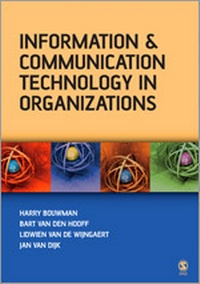
Information and Communication Technology in Organizations
Adoption, Implementation, Use and Effects
1st Edition
Published on 4. August 2008
240 pages
978-1-84860-480-3 (ISBN)
Description

How best can we understand why the application of information and communication technology in organizations succeeds or fails? Calling on technical, organisational, social, psychological and economic perspectives, this book provides a fresh and comprehensive framework for answering this question. Consideration is given to how ICT is adopted, implemented and used within organizations. Throughout special features will help readers clarify their understanding. These features include: - Case studies and vignettes that chart the opportunities and pitfalls created by ICT - Useful chapter introductions - An up to date glossary of concepts and abbreviations
All prices
More details
Other editions
Additional editions
Harry Bouwman | Bart van den Hooff | Lidwien van de Wijngaert
Information and Communication Technology in Organizations
Adoption, Implementation, Use and Effects
Book
03/2005
1st Edition
SAGE Publications Inc
€231.10
Shipment within 10-20 days
Harry Bouwman | Bart van den Hooff | Lidwien van de Wijngaert
Information and Communication Technology in Organizations
Adoption, Implementation, Use and Effects
Book
03/2005
1st Edition
SAGE Publications Inc
€120.60
Shipment within 10-20 days
Persons
Author
Delft University of Technology, Netherlands
Harry Bouwman is the Finnish Distinguished Professor at the Institute for Advanced Management Systems Research, Åbo Akademi University, Turku Finland, and the Associate professor at Delft University of Technology, Information and Communication Technology, Faculty Technology, Policy and Management, Delft, The Netherlands. He served as an interim chair of the ICT-section in the period 2000-2002, in 2004 and from 2007- 2009. He studied political science at the Free University of Amsterdam (1979). He is specialized in research methods and techniques, statistic and communication sciences. He followed courses in the domain of Computer Science at the Open University (1985-86). He received his PhD at Catholic University Nijmegen in 1986 at the Faculty of Social Science.
Harry Bouwman is the Finnish Distinguished Professor at the Institute for Advanced Management Systems Research, Åbo Akademi University, Turku Finland, and the Associate professor at Delft University of Technology, Information and Communication Technology, Faculty Technology, Policy and Management, Delft, The Netherlands. He served as an interim chair of the ICT-section in the period 2000-2002, in 2004 and from 2007- 2009. He studied political science at the Free University of Amsterdam (1979). He is specialized in research methods and techniques, statistic and communication sciences. He followed courses in the domain of Computer Science at the Open University (1985-86). He received his PhD at Catholic University Nijmegen in 1986 at the Faculty of Social Science.
VU University Amsterdam, Netherlands
Bart van den Hooff is Professor of Organizational Communication and Information Systems. He has a PhD (with honors) in Communication from the University of Amsterdam. Before coming to the VU University, he worked in consultancy (M&I/Partners), at the Delft University of Technology and the University of Amsterdam. His research interests include the interaction between ICT, organization and individuals, knowledge sharing, distributed collaboration and online interaction. His work has been presented at international conferences and published in (among others) Journal of Management Studies, Organization Studies, Journal of Information Technology, Information & Management, Communication Research, European Journal of Information Systems and Information Processing & Management
Bart van den Hooff is Professor of Organizational Communication and Information Systems. He has a PhD (with honors) in Communication from the University of Amsterdam. Before coming to the VU University, he worked in consultancy (M&I/Partners), at the Delft University of Technology and the University of Amsterdam. His research interests include the interaction between ICT, organization and individuals, knowledge sharing, distributed collaboration and online interaction. His work has been presented at international conferences and published in (among others) Journal of Management Studies, Organization Studies, Journal of Information Technology, Information & Management, Communication Research, European Journal of Information Systems and Information Processing & Management
University of Utrecht, Netherlands
University of Twente, Netherlands
Jan A.G.M. van Dijk (1952) is emeritus professor of communication science and sociology of the information society and still working at the University of Twente, the Netherlands. His main domains of research are the social aspects of the digital media, digital democracy and the digital divide. His best known English books are The Network Society (Four Editions, Sage Publications), Digital Democracy (2000, Sage Publications), The Deepening Divide (2005, Sage Publications), Digital Skills (2014, Palgrave Macmillan), Internet and Democracy (2018, Routledge) and The Digital Divide (2020, Polity Press). Since the year 2020 he is working on an overall work called Power & Technology, combining theories of social and natural power explaining the use of technology in human history. During his long career he was an advisory of many governments and departments as well as the European Commission.
Jan A.G.M. van Dijk (1952) is emeritus professor of communication science and sociology of the information society and still working at the University of Twente, the Netherlands. His main domains of research are the social aspects of the digital media, digital democracy and the digital divide. His best known English books are The Network Society (Four Editions, Sage Publications), Digital Democracy (2000, Sage Publications), The Deepening Divide (2005, Sage Publications), Digital Skills (2014, Palgrave Macmillan), Internet and Democracy (2018, Routledge) and The Digital Divide (2020, Polity Press). Since the year 2020 he is working on an overall work called Power & Technology, combining theories of social and natural power explaining the use of technology in human history. During his long career he was an advisory of many governments and departments as well as the European Commission.
Content
PART ONE
ICT and Organization
Process and Factors
Technology
Organizations
PART TWO
Adoption
From Exploration to Decision-Making
Implementation
Use
Individual, Group and Organization
Effects
Tasks, Processes and Structures
PART THREE
E-commerce and E-business
E-government
Some Concluding Remarks and Research Agenda
ICT and Organization
Process and Factors
Technology
Organizations
PART TWO
Adoption
From Exploration to Decision-Making
Implementation
Use
Individual, Group and Organization
Effects
Tasks, Processes and Structures
PART THREE
E-commerce and E-business
E-government
Some Concluding Remarks and Research Agenda
