

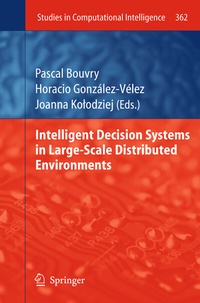
Intelligent Decision Systems in Large-Scale Distributed Environments
Description

One of the most challenging issues for the intelligent decision systems is to effectively manage the large-scale complex distributed environments such as computational clouds, grids, ad hoc and P2P networks, under the different types of users, their relations, and real-world uncertainties. In this context the IT resources and services usually belong to different owners (institutions, enterprises, or individuals) and are managed by different administrators. These administrators conform to different sets of rules and configuration directives, and can impose different usage policies on the system users. Additionally, uncertainties are presented in various types of information that are incomplete, imprecise, fragmentary or overloading, which hinders the full and precise determination of the evaluation criteria, their subsequent and selection, the assignment scores, and eventually the final integrated decision result.
This book presents new ideas, analysis, implementations and evaluation of the next generation intelligent techniques for solving complex decision problems in large-scale distributed systems. In 15 chapters several important formulations of the decision problems in heterogeneous environments are identified and a review of the recent approaches, from game theoretical models and computational intelligent techniques, such as genetic, memetic and evolutionary algorithms, to intelligent multi-agent systems and networking are presented. We believe that this volume will serve as a reference for the students, researchers and industry practitioners working in or are interested in joining interdisciplinary works in the areas of intelligent decision systems using emergent distributed computing paradigms. It will also allow newcomers to grasp key concerns and potential solutions on the selected topics.
More details
Other editions
Additional editions
Content
Task Allocation Oriented Users Decisions in Computational Grid.- Efficient Hierarchical Task Scheduling on GRIDS Accounting for Computation and Communications.- Multi-objective Cooperative Coevolutionary Evolutionary Algorithms for Continuous and Combinatorial Optimization.- Parallel Evolutionary Algorithms for Energy Aware Scheduling.- Biologically-inspired Methods and Game Theory in Multi-criterion.- Decision Processes.- Advanced Planning in Vertically Integrated Supply Chains .- Efficient Data Sharing over Large-Scale Distributed Communities.- Hierarchical Multi-Agent System for Heterogeneous Data Integration.- Emerging Cooperation in the Spatial IPD with Reinforcement Learning and Coalitions.- Evolutionary and Economic Agents in Complex Decision Systems.- On Reconfiguring Embedded Application Placement on Smart Sensing and Actuating Environments.- Market-oriented Resource Providing Networks.- Distributed Evolutionary Algorithm Using the MapReduce Paradigm - a Case Study for Data Compaction Problem.- Virtual Accelerated Life Testing of Complex Systems.- Alvis - Modelling Language for Concurrent Systems.
