

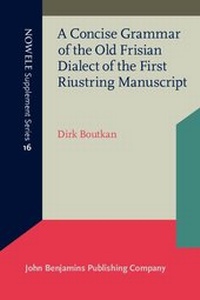
A Concise Grammar of the Old Frisian Dialect of the First Riustring Manuscript
1st Edition
Published on 1. January 1996
203 pages
978-90-272-7280-5 (ISBN)
Description

The language of the First Riustring Manuscript, dating from ca. 1300 AD, represents the most archaic stage of Old Frisian. The mainly legal texts are famous for their historical value. However, a grammatical treatise of this important codex is still lacking. This book is meant to meet this need. It contains an inventory of the linguistic evidence as well as a synchronic study of the grammar. Moreover, historical linguistic problems are discussed wherever relevant. The book is intended for all students of Old Frisian, not just linguists but also legal historians, philologists, historians, and others.
More details
Other editions
Additional editions
Book
01/1996
University Press of Southern Denmark
€31.80
Shipment within 10-20 days
Content
- Intro
- A CONCISE GRAMMAR OF THE OLD FRISIAN DIALECT OF THE FIRST RIUSTRING MANUSCRIPT
- Editorial page
- Title page
- Copyright page
- PREFACE
- Table of contents
- SYMBOLS AND ABBREVIATIONS
- 1. INTRODUCTION
- 1.1 PRELIMINARY REMARKS
- 1.2 LINGUISTIC REMARKS
- 2. PHONOLOGY
- 2.1 INTRODUCTION
- 2.2 ORTHOGRAPHY
- 2.3 VOWELS
- 2.3.1 ACCENT
- 2.3.2 STRESSED SYLLABLES
- 2.3.3 UNSTRESSED SYLLABLES
- 2.4 CONSONANTS
- 2.4.1 CONSONANT CHART
- 2.4.2 DISTRIBUTION
- 2.4.3 ASSIMILATION RULES
- 2.4.4 OTHER PROCESSES AND PROBLEMATIC CONSONANTS
- 2.5 CLITICISATION
- 3. MORPHOLOGY
- 3.1 NOUNS
- 3.1.1 STRONG MASCULINES
- 3.1.2 WEAK MASCULINES
- 3.1.3 STRONG NEUTERS
- 3.1.4 WEAK NEUTERS
- 3.1.5 STRONG FEMININES
- 3.1.6 WEAK FEMININES
- 3.1.7 REMAINING FORMS
- 3.2 ADJECTIVES
- 3.2.1 STRONG FORMS
- 3.2.2 WEAK FORMS
- 3.2.3 THE DEGREES OF COMPARISON
- 3.2.3.1Comparative
- 3.2.3.2 Superlative
- 3.2.4 PREDICATIVE FORMS
- 3.2.5 SUBSTANTIVAL USE
- 3.3 PRONOUNS
- 3.3.1 PERSONAL PRONOUN
- 3.3.2 POSSESSIVE PRONOUN
- 3.3.3 DEMONSTRATIVE PRONOUN/DEFINITE ARTICLE
- 3.3.3.1 Attributive use
- 3.3.3.2 Substantival use
- 3.3.3.3 The enclitic forms of the definite article
- 3.3.4 DEMONSTRATIVE PRONOUN FOR NEARBY REFERENCE: 'THIS, THESE'
- 3.3.5 'SELF'
- 3.3.6 RELATIVE PRONOUN
- 3.3.7 INDEFINITE ARTICLE, NUMERAL 'ONE': EN
- 3.3.8 INDEFINITE PRONOUNS
- 3.4 ADVERBS
- 3.5 PREPOSITIONS
- 3.6 PREFIXES
- 3.7 CONJUNCTIONS
- 3.8 NUMERALS
- 3.8.1 CARDINALS
- 3.8.2 ORDINALS
- 3.8.3 INDEFINITE NUMERALS
- 3.9 VERBS
- 3.9.1 WEAK I
- 3.9.1.1 Present indicative
- 3.9.1.2 Present subjunctive
- 3.9.1.3 Preterite indicative
- 3.9.1.4 Preterite subjunctive
- 3.9.1.5 Nominal forms
- 3.9.2 WEAK II
- 3.9.2.1 Present indicative
- 3.9.2.2 Present subjunctive
- 3.9.2.3 Preterite indicative
- 3.9.2.4 Preterite subjunctive
- 3.9.2.5 Nominal forms
- 3.9.3 STRONG VERBS
- 3.9.3.1 Class I
- 3.9.3.2 Class II
- 3.9.3.3 Class III
- 3.9.3.4 Class IV
- 3.9.3.5 Class V
- 3.9.3.6 Class VI
- 3.9.3.7 Class VII
- 3.9.4 PRETERITE-PRESENTS
- 3.9.5 IRREGULAR VERBS
- 3.9.5.1 'To be' = wesa
- 3.9.5.2 'Will' = *willa
- 3.9.5.3 'Do' = dwa
- 3.9.5.4 'Contract verbs'
- 3.10 PERSONAL NAMES
- BIBLIOGRAPHY
- INDEX
