

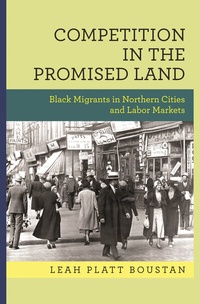
Competition in the Promised Land
Black Migrants in Northern Cities and Labor Markets
1st Edition
Published on 11. January 2017
216 pages
978-1-4008-8297-7 (ISBN)
Description

From 1940 to 1970, nearly four million black migrants left the American rural South to settle in the industrial cities of the North and West. Competition in the Promised Land provides a comprehensive account of the long-lasting effects of the influx of black workers on labor markets and urban space in receiving areas.
Traditionally, the Great Black Migration has been lauded as a path to general black economic progress. Leah Boustan challenges this view, arguing instead that the migration produced winners and losers within the black community. Boustan shows that migrants themselves gained tremendously, more than doubling their earnings by moving North. But these new arrivals competed with existing black workers, limiting black-white wage convergence in Northern labor markets and slowing black economic growth. Furthermore, many white households responded to the black migration by relocating to the suburbs. White flight was motivated not only by neighborhood racial change but also by the desire on the part of white residents to avoid participating in the local public services and fiscal obligations of increasingly diverse cities.
Employing historical census data and state-of-the-art econometric methods, Competition in the Promised Land revises our understanding of the Great Black Migration and its role in the transformation of American society.
Traditionally, the Great Black Migration has been lauded as a path to general black economic progress. Leah Boustan challenges this view, arguing instead that the migration produced winners and losers within the black community. Boustan shows that migrants themselves gained tremendously, more than doubling their earnings by moving North. But these new arrivals competed with existing black workers, limiting black-white wage convergence in Northern labor markets and slowing black economic growth. Furthermore, many white households responded to the black migration by relocating to the suburbs. White flight was motivated not only by neighborhood racial change but also by the desire on the part of white residents to avoid participating in the local public services and fiscal obligations of increasingly diverse cities.
Employing historical census data and state-of-the-art econometric methods, Competition in the Promised Land revises our understanding of the Great Black Migration and its role in the transformation of American society.
All prices
More details
Language
English
Place of publication
Princeton, NJ
United States
Publishing group
De Gruyter
Target group
Professional and scholarly
Edition type
Digital original
Product notice
Reflowable
Illustrations
15 line illus. 14 tables.
File size
1,23 MB
ISBN-13
978-1-4008-8297-7 (9781400882977)
Schweitzer Classification
Other editions
Additional editions
Leah Platt Boustan
Competition in the Promised Land
Black Migrants in Northern Cities and Labor Markets
Book
06/2020
Princeton University Press
€30.50
Shipment within 10-20 days
Leah Platt Boustan
Competition in the Promised Land
Black Migrants in Northern Cities and Labor Markets
Book
11/2016
Princeton University Press
€42.50
Article not available at the moment
Person
Leah Platt Boustan is professor of economics at the University of California, Los Angeles, and a research associate at the National Bureau of Economic Research.
Content
Acknowledgments xiii
Introduction 1
1 Black Migration from the South in Historical Context 14
2 Who Left the South and How Did They Fare? 39
3 Competition in Northern Labor Markets 65
4 Black Migration, White Flight 93
5 Motivations for White Flight: The Role of Fiscal/Political Interactions 122
Epilogue: Black Migration, Northern Cities, and Labor Markets after 1970 154
References 165
Index 187
Introduction 1
1 Black Migration from the South in Historical Context 14
2 Who Left the South and How Did They Fare? 39
3 Competition in Northern Labor Markets 65
4 Black Migration, White Flight 93
5 Motivations for White Flight: The Role of Fiscal/Political Interactions 122
Epilogue: Black Migration, Northern Cities, and Labor Markets after 1970 154
References 165
Index 187

