

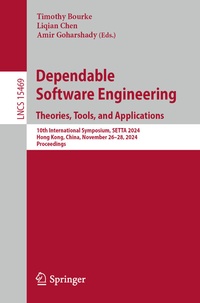
Dependable Software Engineering. Theories, Tools, and Applications
Description

This book constitutes the refereed proceedings of the 10th International Symposium on Dependable Software Engineering. Theories, Tools, and Applications, SETTA 2024, held in Hong Kong, China, during November 26-28, 2024.
The 21 full papers included in this book were carefully reviewed and selected from 47 submissions. The purpose of the SETTA symposium series is to bring international researchers together to exchange research results and ideas on bridging the gap between formal methods and software engineering.
More details
Other editions
Additional editions
Content
.- Invited Talks.
.- Synthesis from LTL with Reward Optimization in Sampled Oblivious Environments.
.- Regular Papers.
.- An Assertion-Based Separation Logic for Probabilistic Programs with Unbounded Loops.
.- Extending Symbolic Heap to Support Shared Ownership.
.- Constraint Based Invariant Generation with Modular Operations.
.- Data-Dependent WAR Analysis for Efficient Task-Based Intermittent Computing.
.- Can Language Models Pretend Solvers? Logic Code Simulation with LLM.
.- Enhancing Multi-modal Regular Expression Synthesis via Large Language Models and Semantic Manipulations of Sub-Expressions.
.- Formal Verification of RISC-V Processor Chisel Designs.
.- The Principle of Staking: Formal Verification of Staking Smart Contract.
.- A Contract-based Framework for Formal Verification of Embedded Software.
.- Formalizing x86-64 ISA in Isabelle/HOL: A Binary Semantics for eBPF JIT Correctness.
.- The Design of Intelligent Temperature Control System of Smart House with MARS.
.- Universal Construction for Linearizable but Not Strongly Linearizable Concurrent Objects.
.- Cache Behavior Analysis with SP-relative Addressing for WCET Estimation.
.- Timing Analysis of Cause-Effect Chains for External Events with Finite Validity Intervals.
.- Runtime Verification of Neural-Symbolic Systems.
.- Eidos: Efficient, Imperceptible Adversarial 3D Point Clouds.
.- MILE: A Mutation Testing Framework of In-Context Learning System.
.- A Derivative-based Membership Algorithm for Enhanced Regular Expressions.
.- NanoHook: An Efficient System Call Hooking Technique with One-Byte Invasive.
.- Faster Lifetime-optimal Speculative Partial Redundancy Elimination for Goto-free Program.
.- EDSLog: Efficient Log Anomaly Detection Method Based on Dataset Partitioning.
