

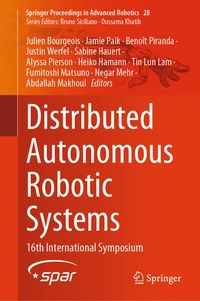
Distributed Autonomous Robotic Systems
16th International Symposium
1st Edition
Published on 31. January 2024
XII, 564 pages
978-3-031-51497-5 (ISBN)
Description

This book of the SPAR series contains 39 scientific articles presented in the Distributed Autonomous Robotic Systems conference organized in November 28-30, 2022, in Montbéliard, France.
More details
Series
Language
English
Place of publication
Cham
Switzerland
Publishing group
Springer International Publishing
Target group
Professional and scholarly
Product notice
Reflowable
Illustrations
XII, 564 p. 244 illus., 227 illus. in color.
File size
72,64 MB
ISBN-13
978-3-031-51497-5 (9783031514975)
DOI
10.1007/978-3-031-51497-5
Schweitzer Classification
Other editions
Additional editions
Julien Bourgeois | Jamie Paik | Benoît Piranda
Distributed Autonomous Robotic Systems
16th International Symposium
Book
02/2024
Springer
€235.39
Shipment within 15-20 days
Persons
Content
- Intro
- Foreword
- Preface
- Contents
- How Can We Understand Multi-Robot Systems? a User Study to Compare Implicit and Explicit Communication Modalities
- 1 Introduction
- 2 Methods
- 2.1 Communication Modalities
- 2.2 Experimental Task
- 2.3 Experimental Setup
- 2.4 Participants
- 2.5 Data Collection and Analysis
- 3 Results
- 3.1 Correctness of Responses
- 3.2 Response Time
- 3.3 Subjective Reporting
- 4 Conclusion
- References
- The Benefits of Interaction Constraints in Distributed Autonomous Systems
- 1 Introduction
- 2 Collective Learning in Multi-agent Systems
- 3 A Three-Valued Model for Collective Learning
- 4 Simulation Environment
- 5 The Networks Underlying Agent Interactions
- 6 Multi-agent Simulation Experiments
- 6.1 Convergence Results for Physical Networks
- 7 Constraining the Interaction Network
- 7.1 Convergence Results for Constrained Interaction Networks
- 8 Conclusion and Future Work
- References
- Outlining the Design Space of eXplainable Swarm (xSwarm): Experts' Perspective
- 1 Introduction
- 2 Background and Related Work
- 3 Background and Related Work
- 3.1 Participants
- 3.2 Study Procedure and Design
- 3.3 Analysis
- 4 Results
- 4.1 Explanation Categories
- 4.2 Challenges Faced by Swarm Experts
- 5 Conclusion
- References
- VMAS: A Vectorized Multi-agent Simulator for Collective Robot Learning
- 1 Introduction
- 2 Related Work
- 3 The VMAS Platform
- 4 Multi-robot Scenarios
- 5 Comparison with MPE
- 6 Experiments and Benchmarks
- 7 Conclusion
- References
- FLAM: Fault Localization and Mapping
- 1 Introduction
- 2 Related Work and Background
- 2.1 Fault Detection
- 2.2 Risk Awareness
- 2.3 Distributed Storage
- 3 System Model
- 3.1 Risk Modelling
- 3.2 Feature Vectors
- 3.3 Fault Detection
- 3.4 Distributed Belief Map
- 3.5 Implementation
- 4 Simulations
- 4.1 Experimental Setup
- 4.2 Results
- 5 Conclusion
- References
- Social Exploration in Robot Swarms
- 1 Introduction
- 2 Related Work
- 3 Methodology
- 3.1 Simulation and Local Swarm Behaviours
- 3.2 Generating Random Environments
- 3.3 Agents with ``Happiness''
- 3.4 Social Exploration Algorithm
- 4 Results
- 4.1 Performance in Randomly Generated Environments
- 5 Conclusions and Future Work
- References
- Stochastic Nonlinear Ensemble Modeling and Control for Robot Team Environmental Monitoring
- 1 Introduction
- 2 Problem Formulation
- 2.1 Task Topology
- 2.2 Ensemble Model
- 3 Ensemble Model Control
- 3.1 Feedback Controller
- 3.2 Distributed Microscopic Algorithm
- 4 Simulation and Experimental Setup
- 5 Results
- 6 Discussion
- 7 Conclusion
- References
- A Decentralized Cooperative Approach to Gentle Human Transportation with Mobile Robots Based on Tactile Feedback
- 1 Introduction
- 2 Methodology
- 2.1 Flexible Tactile Sensors and Methods of Acquiring Force Information
- 2.2 Design of Control Law
- 3 Modeling and Simulation
- 3.1 Modeling
- 3.2 Simulation
- 4 Experiments
- 4.1 Experiment Setup
- 4.2 Experiment Result
- 5 Conclusion and Future Work
- References
- Sparse Sensing in Ergodic Optimization
- 1 Introduction
- 2 Prior Work
- 3 Sparse Sensing in Ergodic Optimization
- 3.1 Sparse Ergodic Optimization
- 3.2 Multi-agent Sparse Ergodic Optimization
- 4 Results and Discussion
- 4.1 Experimental Details
- 4.2 Single Agent Sensing Distribution
- 4.3 Multi-agent Sparse Ergodic Optimization
- 5 Conclusion
- References
- Distributed Multi-robot Tracking of Unknown Clustered Targets with Noisy Measurements
- 1 Introduction
- 2 Problem Formulation
- 2.1 Lloyd's Algorithm
- 3 Distributed Multi-target Tracking
- 3.1 Instantaneous State Estimation
- 3.2 Cumulative State Estimation
- 3.3 Environment Approximation
- 3.4 Distributed Control
- 3.5 Algorithm Outline
- 4 Simulations
- 4.1 Qualitative Comparison
- 4.2 Quantitative Comparison
- 5 Conclusions
- References
- A Force-Mediated Controller for Cooperative Object Manipulation with Independent Autonomous Robots
- 1 Background
- 2 Related Work
- 3 Challenges and Assumptions
- 4 Control Methodology
- 4.1 Closed Loop Control Dynamics
- 4.2 Inertial Estimation and Error Compensation
- 4.3 Controller Stability
- 4.4 Task-Frame Switching
- 5 Experimental Validation
- 5.1 Implementation in Hardware
- 5.2 Implementation in Simulation
- 6 Results
- 6.1 Controller Performance Within Static Task Domain
- 6.2 Controller Performance with a Changing Task Domain
- 6.3 Multi-robot Performance with Changing Task Domain
- 7 Discussion
- References
- A Distributed Architecture for Onboard Tightly-Coupled Estimation and Predictive Control of Micro Aerial Vehicle Formations
- 1 Introduction
- 2 Problem Formulation
- 3 Methodology
- 3.1 Follower Estimation Scheme
- 3.2 Follower Controller Scheme
- 4 Experiments and Results
- 4.1 Formation Navigation
- 4.2 Formation Reconfiguration
- 4.3 Discussion
- 5 Conclusion
- References
- Search Space Illumination of Robot Swarm Parameters for Trustworthy Interaction
- 1 Introduction
- 2 Methodology
- 2.1 Scenario
- 2.2 Swarm Metrics
- 2.3 Map-Elites Illumination Algorithm Methodology
- 3 Results
- 3.1 Qualitative Analysis: Case Study
- 4 Conclusion and Future Work
- References
- Collective Gradient Following with Sensory Heterogeneous UAV Swarm
- 1 Introduction
- 2 Methodology
- 3 Experimental Setup
- 4 Results and Discussion
- 5 Conclusion
- References
- DAN: Decentralized Attention-Based Neural Network for the MinMax Multiple Traveling Salesman Problem
- 1 Introduction
- 2 Prior Works
- 3 Problem Formulation
- 4 mTSP as an RL PROBLEM
- 5 DAN: Decentralized Attention-Based Network
- 6 Training
- 7 Experiments
- 7.1 Results
- 7.2 Discussion
- 8 Conclusion
- References
- Receding Horizon Control on the Broadcast of Information in Stochastic Networks
- 1 Introduction
- 2 Background and Problem Formulation
- 2.1 Graph Theory
- 2.2 Information Propagation Model
- 3 Methodology
- 3.1 Control Strategy
- 3.2 Expected Time to Broadcast Information
- 3.3 Robust Moment Closure
- 4 Numerical Evaluation and Discussions
- 5 Conclusions and Future Work
- References
- Adaptation Strategy for a Distributed Autonomous UAV Formation in Case of Aircraft Loss
- 1 Introduction
- 2 Adaptation Algorithm for a Decentralized UAV Formation
- 2.1 Distributed Autonomous System Model
- 2.2 Adaptation Strategy for a Distributed Autonomous System
- 3 Simulation Results and Discussion
- 4 Conclusions
- References
- DGORL: Distributed Graph Optimization Based Relative Localization of Multi-robot Systems
- 1 Introduction
- 2 Related Work
- 3 Problem Formulation and the Proposed DGORL Solution
- 3.1 Graph Formation
- 3.2 Expansion Through Transition
- 3.3 Optimization
- 4 Theoretical Analysis
- 5 Simulation Experiments and Results
- 6 Conclusion
- References
- Characterization of the Design Space of Collective Braitenberg Vehicles
- 1 Introduction
- 1.1 Related Work
- 2 Model and Simulation
- 2.1 Agent Model
- 2.2 World
- 2.3 Metrics
- 3 Emergent Behaviors
- 3.1 Behavior Characterization
- 3.2 General Observations
- 3.3 Love
- 3.4 Aggression
- 3.5 Fear
- 3.6 Curiosity
- 4 Conclusion and Outlook
- References
- Decision-Making Among Bounded Rational Agents
- 1 Introduction
- 2 Related Work
- 3 Problem Formulation
- 3.1 Multi-agent Markov Decision Process
- 3.2 Iterative Best Response for MMDPs
- 4 Methodology
- 4.1 Bounded Rational Agents in Game-Theoretic Framework
- 4.2 Importance Sampling for Computing Bounded-Rational Strategies
- 5 Simulated Experiments
- 5.1 Simulation Setup
- 5.2 Results
- 6 Physical Experiments
- 7 Conclusion
- References
- Distributed Multi-robot Information Gathering Using Path-Based Sensors in Entropy-Weighted Voronoi Regions
- 1 Introduction
- 2 Problem Formulation
- 3 Distributed Information Gathering
- 3.1 Distributed Entropy Voronoi Partition and Planner (DEVPP)
- 3.2 Multi-agent Distributed Information-Theoretic Planner (MA-DITP)
- 3.3 Multi-agent Global Information-Theoretic Planner (MA-GITP)
- 4 Experiments and Results
- 5 Conclusion
- References
- Distributed Multiple Hypothesis Tracker for Mobile Sensor Networks
- 1 Introduction
- 2 Background
- 2.1 MHT Definition
- 2.2 Lloyd's Algorithm
- 3 Distributed Multiple Hypothesis Tracker
- 3.1 Assumptions
- 3.2 Track Exchange and Fusion
- 3.3 Importance Weighting Function
- 4 Results
- 4.1 Performance Metric
- 4.2 Stationary Targets
- 4.3 Dynamic Targets
- 4.4 Discussion
- 5 Conclusion
- References
- Distributed Multirobot Control for Non-cooperative Herding
- 1 Introduction
- 2 Prior Work
- 3 Problem Formulation
- 4 Controller Design
- 4.1 Approach 1: One Dog to One Sheep Allocation Based Approach
- 4.2 Approach 2: Iterative Distributed Reformulation of (12)
- 5 Results
- 5.1 Simulation Results
- 5.2 Robot Experiments
- 6 Conclusions
- 7 Appendix: Proof of Feasibility for Approach 1
- References
- On Limited-Range Coverage Control for Large-Scale Teams of Aerial Drones: Deployment and Study
- 1 Introduction
- 2 Methods
- 2.1 Coverage Control Strategy
- 2.2 Simulation Protocol
- 2.3 Field Test Protocol
- 2.4 Metrics
- 3 Results and Discussion
- 3.1 Simulation Results
- 3.2 Results of Field Tests
- 4 Conclusions
- References
- MARLAS: Multi Agent Reinforcement Learning for Cooperated Adaptive Sampling
- 1 Introduction
- 2 Problem Formulation
- 3 Approach
- 4 Experiments and Results
- 4.1 Analyzing Scalability of Learned Policy
- 4.2 Analyzing Robustness of the Learned Policy
- 4.3 Online Adaptations to the Changing Field
- 4.4 Robot Experiments
- 5 Conclusion and Future Work
- References
- Proportional Control for Stochastic Regulation on Allocation of Multi-robots
- 1 Introduction
- 2 Problem Formulation
- 2.1 Graph Theory
- 2.2 Ensemble Model
- 3 Methodology
- 3.1 Control Strategy
- 3.2 Control Analysis
- 4 Results
- 4.1 Numerical Simulations
- 4.2 Experimental Results
- 5 Discussion
- 6 Conclusions and Future Work
- References
- Comparing Stochastic Optimization Methods for Multi-robot, Multi-target Tracking
- 1 Introduction
- 1.1 Related Work
- 1.2 Contributions
- 2 Problem Formulation
- 2.1 PHD Filter
- 2.2 Lloyd's Algorithm
- 2.3 Distributed PHD Filter
- 2.4 Assumptions
- 3 Distributed Control
- 3.1 Simulated Annealing
- 3.2 Particle Swarm Optimization
- 3.3 Communication and Complexity
- 4 Experimental Results
- 4.1 Evaluation Metric
- 4.2 Stationary Targets
- 4.3 Dynamic Targets
- 5 Conclusion
- References
- Multi-agent Deep Reinforcement Learning for Countering Uncrewed Aerial Systems
- 1 Introduction
- 1.1 Related Work
- 2 Problem Formulation
- 3 Multi-agent Deep Reinforcement Learning for C-UAS
- 3.1 Proximal Policy Optimization Based Advantage Actor Critic
- 3.2 Parameter Sharing
- 4 Simulation Results
- 5 Conclusion
- References
- Decentralized Risk-Aware Tracking of Multiple Targets
- 1 Introduction
- 2 Related Work
- 3 Problem Formulation
- 3.1 Notation
- 3.2 Robot and Target Modeling
- 3.3 Problem Definition
- 4 Approach
- 4.1 Decentralized Goal Position Generation
- 4.2 Decentralized Motion Synthesis
- 4.3 Decentralized Target Position Estimation
- 5 Experiments
- 5.1 Decentralized Tracking
- 5.2 Comparison to Centralized Target Tracking
- 6 Conclusion and Future Work
- References
- Application of 3D Printed Vacuum-Actuated Module with Multi-soft Material to Support Handwork Rehabilitation
- 1 Introduction
- 2 MORI-A FleX: The Vacuum-Actuated Module with 3D Printed Flexible Connectors
- 2.1 Creation Procedure of MORI-A FleX
- 2.2 TPU Internal Construction
- 2.3 3D Printed Flexible Connector
- 3 MORI-A Flex Mechanical Properties
- 3.1 Load Displacement Performance
- 3.2 Coefficient of Friction with Texture Change Connector
- 4 Applications
- 5 Conclusion
- References
- Combining Hierarchical MILP-MPC and Artificial Potential Fields for Multi-robot Priority-Based Sanitization of Railway Stations
- 1 Introduction and Related Works
- 2 Architecture
- 3 Experiments and Comparison with MARL Technique
- 4 Conclusions
- References
- Exploration System for Distributed Swarm Robots Using Probabilistic Action Decisions
- 1 Introduction
- 2 The Proposed Exploration Swarm Robot System and Area Control Algorithm
- 2.1 Distributed Robot System for Wide-Area Exploration by Swarm Robots
- 2.2 Overview of the Region Control Algorithm with Probabilistic Action Decision
- 2.3 Algorithm for Probabilistic Action Decision Making
- 3 Evaluation by Simulation
- 3.1 Algorithm Verification by Simulator and Comparison of Search Efficiency by Changing Control Parameters
- 4 Development and Implementation of Exploration Systems
- 4.1 Hardware Development of the Robot for Actual Equipment Verification
- 4.2 Software and Exploration System Configuration
- 5 Exploration Field Tests and Results
- 5.1 Description of Experimental Environment/conditions and Data Collected
- 5.2 Examination of Collected Data
- 6 Conclusion
- References
- Distributed Estimation of Scalar Fields with Implicit Coordination
- 1 Introduction
- 2 Related Work
- 3 Problem Statement
- 4 Methods
- 4.1 Gaussian Process Regression
- 4.2 Spatial Prior
- 4.3 Exploration
- 4.4 Vertex Quality Computation
- 5 Experimental Evaluation and Discussion
- 6 Conclusion
- References
- A Constrained-Optimization Approach to the Execution of Prioritized Stacks of Learned Multi-robot Tasks
- 1 Introduction
- 2 Background and Related Work
- 2.1 Multi-task Learning, Composition, and Execution
- 2.2 Constraint-Based Task Execution
- 2.3 From Dynamic Programming to Constraint-Driven Control
- 3 Prioritized Multi-task Execution
- 4 Experimental Results
- 4.1 Multi-robot Tasks
- 4.2 Discussion
- 5 Conclusion
- A Comparison Between Optimal Control, Optimization-Based Control, and RL Policy
- B Implementation Details
- References
- A Comparison of Two Decoupled Methods for Simultaneous Multiple Robots Path Planning
- 1 Introduction
- 2 Related Work
- 3 Planning Algorithms
- 3.1 Problem Formulation
- 3.2 Decoupled Prioritized Planning (PP)
- 3.3 Decoupled Fixed-Path Coordination (FPC)
- 4 Numerical Experiments
- 4.1 Illustrative Test Cases
- 4.2 Monte Carlo Simulations
- 5 Conclusion
- References
- Smarticle 2.0: Design of Scalable, Entangled Smart Matter
- 1 Introduction
- 2 Background and Related Work
- 3 Electro-mechanical Design
- 4 Fabrication
- 5 Characterization
- 6 Multi-robot Demonstrations
- 7 Summary
- References
- Hybrid Flock - Formation Control Algorithms
- 1 Introduction
- 2 Methodology
- 2.1 Pot2Lapl
- 2.2 Flock2Lapl
- 3 Experimental Evaluation
- 3.1 Robotic Platform
- 3.2 Evaluation Metrics
- 3.3 Experimental Setup
- 3.4 Characterization Experiment
- 3.5 Narrow Passage Experiment
- 4 Results and Discussion
- 5 Conclusion
- References
- Multi-Robot Systems Research: A Data-Driven Trend Analysis
- 1 Introduction
- 2 Exhaustive Search
- 2.1 Methodology
- 2.2 Findings from Journal-Specific Analysis
- 2.3 Findings from Trend Analysis
- 3 Expert Survey
- 3.1 Methodology
- 3.2 Findings
- 4 Conclusions
- References
- Coverage Control for Exploration of Unknown Non-convex Environments with Limited Range Multi-robot Systems
- 1 Introduction
- 2 Problem Statement
- 3 Distributed Control Algorithm for Exploration
- 4 Time-Varying Probability Density Function for Exploration
- 5 Simulations and Experiments
- 5.1 Implementation
- 5.2 Results and Discussion
- 6 Conclusions
- References
- Author Index
