

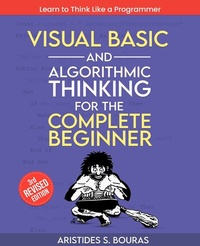
Visual Basic and Algorithmic Thinking for the Complete Beginner
Master Visual Basic and Algorithmic Thinking: From Fundamentals to Advanced Concepts
1st Edition
Published on 23. September 2024
976 pages
978-1-83620-594-4 (ISBN)
Description

No detailed description available for "Visual Basic and Algorithmic Thinking for the Complete Beginner".
More details
Person
Bouras Aristides :
Aristides S. Bouras holds a degree in Computer Engineering from the Technological Educational Institute of Piraeus, and a Dipl. Eng. degree in Electrical and Computer Engineering from the Democritus University of Thrace. He worked as a software developer at a company that specialized in industrial data flow and labelling of products. He has developed many applications such as warehouse managing systems and websites for companies and other organizations. He works as a high school teacher. He mainly teaches computer networks, programming tools for the Internet/intranets, and databases. He has written many books, mainly about algorithmic and computational thinking through Python, C#, C++, Java, PHP, and Visual Basic programming languages.
Aristides S. Bouras holds a degree in Computer Engineering from the Technological Educational Institute of Piraeus, and a Dipl. Eng. degree in Electrical and Computer Engineering from the Democritus University of Thrace. He worked as a software developer at a company that specialized in industrial data flow and labelling of products. He has developed many applications such as warehouse managing systems and websites for companies and other organizations. He works as a high school teacher. He mainly teaches computer networks, programming tools for the Internet/intranets, and databases. He has written many books, mainly about algorithmic and computational thinking through Python, C#, C++, Java, PHP, and Visual Basic programming languages.
Content
Table of Contents - How a Computer Works
- Visual Basic and Integrated Development Environments
- Software Packages to Install
- Introduction to Basic Algorithmic Concepts
- Variables and Constants
- Handling Input and Output
- Operators
- Trace Tables
- Using Visual Studio Community
- Introduction to Sequence Control Structures
- Manipulating Numbers
- Complex Mathematical Expressions
- Exercises With a Quotient and a Remainder
- Manipulating Strings
- Making Questions
- The Single-Alternative Decision Structure
- The Dual-Alternative Decision Structure
- The Multiple-Alternative Decision Structure
- The Case Decision Structure
- Nested Decision Control Structures
- More about Flowcharts with Decision Control Structures
- Tips and Tricks with Decision Control Structures
- More with Decision Control Structures
- Introduction to Loop Control Structures
- Pre-Test, Mid-Test and Post-Test Loop Structures
- Definite Loops
- Nested Loop Control Structures
- Flowcharts with Loop Control Structures
- Tips and Tricks with Loop Control Structures
- More with Loop Control Structures
- One-Dimensional Arrays and Dictionaries
- Two-Dimensional Arrays
- Tips and Tricks with Data Structures
- More with Data Structures
- Introduction to Subprograms
- User-Defined Subprograms
- Tips and Tricks with Subprograms
- More with Subprograms
- Introduction to Object-Oriented Programming
- Introduction to Files
- More with Files
- Visual Basic and Integrated Development Environments
- Software Packages to Install
- Introduction to Basic Algorithmic Concepts
- Variables and Constants
- Handling Input and Output
- Operators
- Trace Tables
- Using Visual Studio Community
- Introduction to Sequence Control Structures
- Manipulating Numbers
- Complex Mathematical Expressions
- Exercises With a Quotient and a Remainder
- Manipulating Strings
- Making Questions
- The Single-Alternative Decision Structure
- The Dual-Alternative Decision Structure
- The Multiple-Alternative Decision Structure
- The Case Decision Structure
- Nested Decision Control Structures
- More about Flowcharts with Decision Control Structures
- Tips and Tricks with Decision Control Structures
- More with Decision Control Structures
- Introduction to Loop Control Structures
- Pre-Test, Mid-Test and Post-Test Loop Structures
- Definite Loops
- Nested Loop Control Structures
- Flowcharts with Loop Control Structures
- Tips and Tricks with Loop Control Structures
- More with Loop Control Structures
- One-Dimensional Arrays and Dictionaries
- Two-Dimensional Arrays
- Tips and Tricks with Data Structures
- More with Data Structures
- Introduction to Subprograms
- User-Defined Subprograms
- Tips and Tricks with Subprograms
- More with Subprograms
- Introduction to Object-Oriented Programming
- Introduction to Files
- More with Files
