

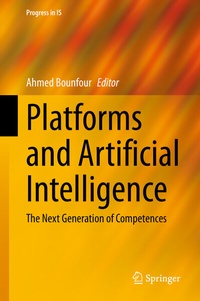
Platforms and Artificial Intelligence
Description

Artificial intelligence (AI) and platforms are closely related. Most investments in AI, especially in critical technologies, are provided by large platforms. This book describes how platforms invest in AI and how AI will impact the next generation of competences, following a twofold approach to do so: on the one hand, the book seeks to understand how platforms for investment in intangibles and AI are organized, but on the other hand, it provides a framework to describe how AI will change jobs and competences in the future.
Moreover, the book addresses five main themes: 1. platforms, platformization, and the foundations of their business models; 2. artificial intelligence, technological tendencies, and the policy agenda; 3. artificial intelligence, productivity, and the next generation of competences; 4. artificial intelligence, productivity, and the digital divide; 5. artificial intelligence, ethics, and the post-truth society.
The book's content is mostly based on papers presented at the last two installments of the World Conference on Intellectual Capital for Communities. It brings together the views of leading scholars and experts on how artificial intelligence and platformization will impact competences in the near future.
More details
Other editions
Additional editions
Person
Professor Ahmed Bounfour is holder and coordinator of the European Chair on Intangibles at Université Paris-Saclay and Research Director with RITM research group. He is a leading researcher in digital transformation and intangibles. Professor Bounfour is the scientific director of the World Conference on Intellectual Capital, co-organized by the UNESCO and the European Chair on Intangibles. He is series editor of Springer Briefs in Digital Spaces and author of several books and papers on intangible assets valuation and innovation policy and strategies.
Content
Part I: Platforms, Platformisation and the Foundations of Their Business Models.- Digital Platform Modelling: Delineating the Foundations of Their Business Models.- Growth of Internet Digital Platforms in China: Stages, Trends, and Research Opportunities.- Platforms, AI and the Spillover Effect.- Part II: Artificial Intelligence, Technological Tendencies and the Policy Agenda.- Artificial Intelligence: A Review of the Economic Context and Policy Agenda.- Patents and the Fourth Industrial Revolution: The Global Technology Trends Enabling the Data Economy.- Comparing the Methodology for the Development and Project Management of Artificial Intelligence Systems.- Part III Artificial Intelligence, Productivity and the Next Generation of Competences.- Artificial Intelligence: Productivity Growth and the Transformation of Capitalism.- What Artificial Intelligence Can Do and What It Cannot Do.- AI, Platformization and the Next Generation of Competences.- Part IV: Artificial Intelligence, Productivity and the Digital Divide.- Are We Pretender of Digitalization?-Towards a New Management Using Telework and Digital Transformation.- Real-Time Management: When AI Goes Fast and Flow.- Artificial Intelligence and the Digital Divide: From an Innovation Perspective.- Part V: AI, Ethics and the Post-Truth Society.- Post-Truth: Organisational Social Responsibility in an AI-Driven Society.- Co-constructing Shared Values and Ethical Practice for the Next Generation: Lessons Learned from a Curriculum on Information Ethics.-
