

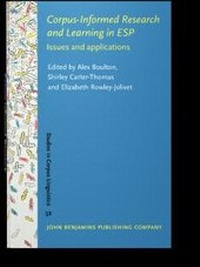
Corpus-Informed Research and Learning in ESP
Issues and applications
1st Edition
Published on 15. May 2012
IX, 306 pages
978-90-272-7394-9 (ISBN)
Description

These specially-commissioned studies cover corpus-informed approaches to researching, teaching and learning English for Specific Purposes (ESP). The corpora used range from very large published corpora to small tailor-made collections of written and spoken text, as well as parallel and contrastive corpora, in both the hard and softer sciences. Designed to tackle the problems faced by a variety of first- and second-language ESP users (specialised translators, undergraduates, junior and experienced researchers, and language trainers), the breadth of approaches enables treatment of issues central to ESP and corpus research, from corpus compilation and analysis to new applications and data-driven learning. The first full-length book on applied corpus use in France, Corpus-Informed Research and Learning in ESP will be of interest not only to those working in the French context, but to a wide variety of language professionals - teachers, researchers or course designers - in many countries looking at ESP from different linguistic, cultural and educational perspectives.
More details
Other editions
Additional editions
Alex Boulton | Shirley Carter-Thomas | Elizabeth Rowley-Jolivet
Corpus-Informed Research and Learning in ESP
Issues and applications
Book
05/2012
John Benjamins Publishing Co
€100.70
Shipment within 10-15 days
Persons
Content
- Corpus-Informed Research and Learning in ESP
- Editorial page
- Title page
- LCC data
- Table of contents
- Preface
- References
- Issues in Corpus-Informed Research and Learning in ESP
- 1. Introduction
- 2. Overview of the volume
- 3. ESP corpora for language research
- 4. ESP corpora for genre-based approaches
- 5. ESP corpora for language teaching and learning
- 6. Perspectives
- References
- Part I ESP corpora for language research
- From text to corpus
- 1. Introduction
- 2. Academic corpora and language learning: Combining quantitative and qualitative approaches
- 3. Corpus and methodology
- 3.1 Methodology: From individual RAs.
- 3.2 .to corpus examples
- 4. The author's voice: Author roles and the CARS model
- 4.1 Learning from a single article
- 4.2 'Multicontextual learning': The contribution of corpus data
- 4.2.1 Quantitative data
- 4.2.2 Verbs and moves: Three author roles
- 4.3 First person singular and plural in the English and French single-authored articles
- 5. Pedagogical applications
- 6. Conclusion
- References
- Appendix A. French model introduction
- Appendix B. English model introduction
- Appendix C. Studying author roles using a concordance
- Phraseological patterns in a large corpus of biomedical articles
- 1. Introduction
- 1.1 Biomedical articles and phraseology
- 1.2 Objectives
- 1.3 Article structure and phraseological patterns
- 2. Methodology
- 2.1 Corpus compilation
- 2.2 Analysis of the LBC
- 2.3 Distributional analysis of salient nouns and verbs
- 3. Phraseological patterns in the LBC
- 3.1 Preferred wordings
- 3.2 Phraseological patterns in sub-corpus I
- 3.3 Phraseological patterns in sub-corpus M
- 3.3.1 Describing patient enrollment
- 3.3.2 Presenting exclusion and inclusion criteria
- 3.3.3 Describing randomization methods
- 3.3.4 Introducing definitions
- 3.3.5 Identifying end points
- 3.3.6 Describing treatment or drug administration
- 3.3.7 Describing ethical precautions
- 3.3.8 Describing statistical methods
- 3.4 Phraseological patterns in sub-corpus R
- 3.4.1 Referring the reader to tables and figures
- 3.4.2 Reporting observations
- 3.4.3. Signaling changes from baseline situation
- 3.4.4 Making comparisons
- 3.4.5 Describing events in the follow-up period
- 3.5 Phraseological patterns in sub-corpus D
- 3.5.1 Checking consistency with previous studies
- 3.5.2 Signaling improvements in patients' health
- 3.5.3 Mentioning the need for further research
- 3.5.4 Describing limitations
- 3.5.5 Hedging conclusions
- 4. Conclusion
- References
- Appendix A. Keyword relative frequencies in subcorpora I, M, R & D
- Appendix B. Section-specific salient words (SSSWs) in sub-corpora I, M, R & D
- A corpus-based study of adjectival vs nominal modification in medical English
- 1. Introduction
- 2. Relational adjectives or denominal adjectives?
- 2.1 Morphological features
- 2.2 Syntactic features
- 2.2.1 Non-attributiveness
- 2.2.2 Non-gradability
- 2.3 Semantic features
- 3. Terminological uses of denominal adjectives in medicine
- 3.1 Noun phrase modification: a pitfall for ESL learners
- 3.2 A corpus-based study of denominal adjective/noun modification in specialized language using the EMEA corpus
- 3.3 A comparison of modification by nouns and adjectives in specialized and non-specialized literature through interrogation of the Corpus of Contemporary American English (CoCA)
- 4. Conclusion
- References
- Semantic prosody and specialised translation, or how a lexico-grammatical theory of language can help with specialised translation
- 1. Introduction
- 2. Semantic prosody
- 2.1 Semantic prosody in languages for specific purposes
- 2.2 Semantic prosody in translation or contrastive studies
- 3. The problem with collecting comparable corpora in different languages
- 4. French and english items in general language
- 4.1 'Commit': an English verb with negative semantic prosody
- 4.2 'Commettre': The (approximate) French equivalent of 'commit'
- 5. French and English items in earth science
- 5.1 'Cause' in earth science
- 5.2 The French verb 'causer' in earth sciences
- 5.3 Equivalents in earth sciences
- 6. What about semantic prosody in the translation process?
- 7. Conclusion
- References
- Part II ESP corpora for genre-based approaches
- Oralising text slides in scientific conference presentations
- 1. Introduction
- 2. Corpus: Macro-scale features
- 2.1 Redundancy between the written and spoken texts
- 3. Quantitative Findings
- 3.1 Distribution of text slides
- 3.2 Lexical density
- 3.3 Keywords Comparison
- 4. Grammatical metaphor
- 4.1 Speaker options
- 5. Specific functions and linguistic resources of the spoken commentary
- 5.1 Textual metafunction
- 5.2 Ideational metafunction
- 5.3 Interpersonal metafunction
- 6. Conclusions
- References
- Appendix A: Conferences Filmed
- Corpora and academic writing
- 1. Introduction
- 2. Tools and methodology
- 3. Corpus description
- 4. Results: Domain and genre variations
- 4.1 Domain variation
- 4.2 Genre variation
- 5. Results: Textual organizers in the two disciplines
- 5.1 Introduction features
- 5.1.1 Importance
- 5.1.2 Gap
- 5.2 Statement of results and interpretation
- 6. Conclusion
- References
- Measuring the construction of discoursal expertise through corpus-based genre analysis
- 1. Introduction
- 2. Measuring genre norms using standard deviation
- 3. Methods
- 4. Results
- 4.1 Measuring standard deviation in the field account (Corpus 1)
- 4.2 Individual writers' use of the variables over time (Corpus 2)
- 4.3 Measuring the development of discoursal expertise?
- 5. Discussion and conclusions
- References
- Part III ESP corpora for language teaching and learning
- Bringing data and dictionary together
- 1. Introduction
- 2. Dictionaries and their users
- 3. Science in the learner's dictionary
- 4. Tweaking the dictionary
- 5. The BMC corpus
- 6. Moving on: The organic dictionary
- 7. DicSci: A dictionary of science verbs
- 8. Lengthening the verb list: compare
- 9. Refining the verb list: ask
- 10. Conclusion
- References
- Dictionaries
- Raising collective awareness of rhetorical strategies
- 1. Introduction
- 1.1 Novice writers: The pressure to publish
- 1.2 Novice writers: The classic scenario
- 1.3 The classic scenario: Any solutions?
- 2. Drafting introductions
- 3. A corpus-based tool
- 4. Writing introductions: a course plan
- 4.1 Focusing on discourse variation
- 4.1.1 Widening horizons
- 4.1.2 Raising awareness about bricks and cement
- 4.1.3 Applying knowledge about bricks and cement
- 4.2 Introducing and demonstrating move analysis
- 4.2.1 Illustrating inter-disciplinary differences
- 4.2.2 Presenting a typical introduction
- 4.2.3 Presenting TYOS breakdown of a typical introduction
- 4.3 Marking up discourse moves
- 4.4 Gathering resources to apply move analysis
- 4.5 Controlled drafting of an introduction
- 4.6 Searching for concordances: TYOS and the Internet
- 5. Conclusion
- References
- Corpus consultation for ESP
- 1. Corpora for ESP learners
- 1.1 Empirical research in data-driven learning
- 1.2 From DDL to ESP
- 2. Quantitative overview of 20 studies
- 2.1 Background context
- 2.2 Research design
- 3. Qualitative discussion of individual studies
- 3.1 Vocabulary studies
- 3.2 Writing studies
- 4. Discussion
- 4.1 Short-term and long-term benefits
- 4.2 Learner profiles
- 5. Conclusion
- References
- Appendix A: 20 empirical DDL studies in ESP
- Notes on contributors
- Author index
- Subject index
