

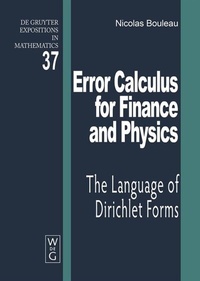
Error Calculus for Finance and Physics
Description

Many recent advances in modelling within the applied sciences and engineering have focused on the increasing importance of sensitivity analyses. For a given physical, financial or environmental model, increased emphasis is now placed on assessing the consequences of changes in model outputs that result from small changes or errors in both the hypotheses and parameters. The approach proposed in this book is entirely new and features two main characteristics. Even when extremely small, errors possess biases and variances. The methods presented here are able, thanks to a specific differential calculus, to provide information about the correlation between errors in different parameters of the model, as well as information about the biases introduced by non-linearity. The approach makes use of very powerful mathematical tools (Dirichlet forms), which allow one to deal with errors in infinite dimensional spaces, such as spaces of functions or stochastic processes. The method is therefore applicable to non-elementary models along the lines of those encountered in modern physics and finance. This text has been drawn from presentations of research done over the past ten years and that is still ongoing. The work was presented in conjunction with a course taught jointly at the Universities of Paris 1 and Paris 6. The book is intended for students, researchers and engineers with good knowledge in probability theory.
Reviews / Votes
"[...] interesting book [...]"Alexander Schied in: Zentralblatt MATH 12/2007More details
Other editions
Additional editions
Person
Content
Strongly-continuous semigroups and Dirichlet forms ? Strongly-continuous contraction semigroups on a Banach space ? The Ornstein-Uhlenbeck semigroup on R and the associated Dirichlet form ? Appendix. Determination of D for the Ornstein-Uhlenbeck semigroup ? Bibliography for Chapter II
Error structures ? Main definition and initial examples ? Performing calculations in error structures ? Lipschitz functional calculus and existence of densities ? Closability of pre-structures and other examples ? Bibliography for Chapter III
Images and products of error structures ? Images ? Finite products ? Infinite products ? Appendix. Comments on projective limits ? Bibliography for Chapter IV
Sensitivity analysis and error calculus ? Simple examples and comments ? The gradient and the sharp ? Integration by parts formulae ? Sensitivity of the solution of an ODE to a functional coefficient ? Substructures and projections ? Bibliography for Chapter V
Error structures on fundamental spaces ? Error structures on the Monte Carlo space ? Error structures on the Wiener space ? Error structures on the Poisson space ? Bibliography for Chapter VI
Application to financial models ? Instantaneous error structure of a financial asset ? From an instantaneous error structure to a pricing model ? Error calculations on the Black-Scholes model ? Error calculations for a diffusion model ? Bibliography for Chapter VII
Applications in the field of physics ? Drawing an ellipse (exercise) ? Repeated samples: Discussion ? Calculation of lengths using the Cauchy-Favard method (exercise) ? Temperature equilibrium of a homogeneous solid (exercise) ? Nonlinear oscillator subject to thermal interaction: The Grueneisen parameter ? Natural error structures on dynamic systems ? Bibliography for Chapter VIII
