

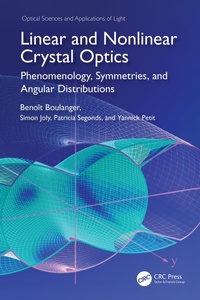
Linear and Nonlinear Crystal Optics
Phenomenology, Symmetries, and Angular Distributions
Published on 22. December 2025
388 pages
978-1-4987-7457-4 (ISBN)
Description

This book provides both theoretical foundations and practical insights into linear and nonlinear crystal optics. It bridges the fundamental principles of light-crystal interactions with advanced applications in optics.
Linear and Nonlinear Crystal Optics offers a thorough exploration of electric susceptibility-the cornerstone of optical properties through electric constitutive relations and Maxwell's equations. Key features include comprehensive tensor representations, detailed angular distributions of optical parameters, complete mathematical demonstrations, and original research insights developed over decades. The book covers essential topics including phenomenological introduction to light-matter coupling, mathematical background in orientation and thermodynamic symmetries, electric susceptibility and field tensors, polarization calculations, linear optical effects linked to the real and imaginary parts of the refractive index, and both second-order and third-order interactions. Each chapter concludes with a summary and references, providing readers with clear learning pathways and resources for further exploration.
This book is ideal for advanced undergraduate students, graduate students, and researchers in physics, optical engineering, materials science, and crystallography. It serves as an essential reference for professionals working in fields requiring deep understanding of crystal optics, including photonics, laser technology, telecommunications, and materials characterization.
Linear and Nonlinear Crystal Optics offers a thorough exploration of electric susceptibility-the cornerstone of optical properties through electric constitutive relations and Maxwell's equations. Key features include comprehensive tensor representations, detailed angular distributions of optical parameters, complete mathematical demonstrations, and original research insights developed over decades. The book covers essential topics including phenomenological introduction to light-matter coupling, mathematical background in orientation and thermodynamic symmetries, electric susceptibility and field tensors, polarization calculations, linear optical effects linked to the real and imaginary parts of the refractive index, and both second-order and third-order interactions. Each chapter concludes with a summary and references, providing readers with clear learning pathways and resources for further exploration.
This book is ideal for advanced undergraduate students, graduate students, and researchers in physics, optical engineering, materials science, and crystallography. It serves as an essential reference for professionals working in fields requiring deep understanding of crystal optics, including photonics, laser technology, telecommunications, and materials characterization.
More details
Series
Language
English
Place of publication
London
United Kingdom
Publishing group
Taylor & Francis Ltd
Target group
Professional and scholarly
Illustrations
1 Tables, black and white; 52 Line drawings, color; 195 Line drawings, black and white; 52 Illustrations, color; 195 Illustrations, black and white
File size
49,52 MB
ISBN-13
978-1-4987-7457-4 (9781498774574)
Copyright in bibliographic data and cover images is held by Nielsen Book Services Limited or by the publishers or by their respective licensors: all rights reserved.
Schweitzer Classification
Other editions
Additional editions
Benoit Boulanger | Simon Joly | Patricia Segonds
Linear and Nonlinear Crystal Optics
Phenomenology, Symmetries, and Angular Distributions
Book
approx. 12/2025
1st Edition
CRC Press
€195.60
Not yet published
Persons
Benoit Boulanger received the Ph.D. degree in material sciences from the University of Nancy in 1989. He was researcher at the National Center for Scientific Research (CNRS) from 1989 to 2000 at the University of Nancy, Stanford University, and the University of Bourgogne. In 2000, he joined the University of Grenoble-Alpes as Professor. He does his research at Institut Neel CNRS where he is a group leader. He held a position of Distinguished Professor at Tianjin University of Technology from 2018 to 2021. His work is at the frontiers between nonlinear crystal optics, quantum optics, and material engineering with achievements in frequency conversion and generation of new quantum states of light. He has authored over 350 papers in international peer-reviewed journals and conference proceedings. He teaches laser physics, nonlinear optics, crystallography, and tensors, and he also regularly gives tutorials on crystal parametric nonlinear optics in international conferences and summer schools. He served as associate editor for Optics Letters from 2014 to 2020. He was general co-chair of the international conferences Non Linear Optics (Hawaii) in 2013 and Advanced Solid State Lasers (Boston) in 2018, and will be general co-chair of the French-Israel Symposium on Non Linear & Quantum Optics from 2026.
Simon Joly is an associate professor at the University of Bordeaux in the IMS laboratory (Talence, France) since 2013 and is on delegation at the CEA of Pessac. He received his Ph.D. in Physics from the University of Grenoble in 2009. From 2010 to 2013, he undertook three postdoctoral positions at the Institute of Molecular Science in Okazaki, Japan, at the CROMA laboratory in Chambery, and then at CEA LETI in Grenoble. He has been involved in research activities in nonlinear optics, micro-lasers, terahertz spectroscopy, and infrared imaging. His current research focuses on two main areas: the development of photonic components for sensing applications and reliability concerns within the ONDES Research Group at the IMS Laboratory, and powerful and tunable sources for multispectral terahertz imaging at CEA Tech in Pessac.
Patricia Segonds received her PhD in physics from the University of Grenoble in 1989. During her postdoctoral fellowship at Ohio State University, she was appointed associate professor at the University of Bordeaux. She conducted research on ultrafast all-optical switching in glasses at the Centre de Physique Moleculaire et d'Optique Hertzienne (CPMOH) until joining the University of Grenoble-Alpes in 1998. She is currently a professor at the NEEL Institute, where her research deals with optics and frequency conversion in nonlinear crystals and their characterization and implementation in optical parametric oscillators. She has authored over 230 papers in peer-reviewed journals and conference proceedings. She teaches practical courses in linear and nonlinear optics and has recorded tutorials in various areas of physics. Since 2013, she has served the European Optical Society (EOS), 2022-2024 as President, 2024-2026 as responsible for the JEOS-RP journal. She has organized several EOS and OPTICA conferences.
Yannick Petit received the Ph.D. degree in physics of condensed matter and radiations from the University of Grenoble in 2007. He was a postdoctoral researcher in terawatt femtosecond laser applications at University of Geneva, Switzerland, from 2007 to 2010. In 2010, he joined the University of Bordeaux as associate professor. He does his research as a physicist at the Institute of Chemistry and Condensed Matter of Bordeaux (ICMCB). His work deals with femtosecond laser material structuring and 3D-printing for the development of photonic functionalities and integrated photonic circuits. He has authored over 100 papers in refereed journals and conference proceedings. He is teaching wave optics, nonlinear optics, and optics of solids in University of Bordeaux.
Simon Joly is an associate professor at the University of Bordeaux in the IMS laboratory (Talence, France) since 2013 and is on delegation at the CEA of Pessac. He received his Ph.D. in Physics from the University of Grenoble in 2009. From 2010 to 2013, he undertook three postdoctoral positions at the Institute of Molecular Science in Okazaki, Japan, at the CROMA laboratory in Chambery, and then at CEA LETI in Grenoble. He has been involved in research activities in nonlinear optics, micro-lasers, terahertz spectroscopy, and infrared imaging. His current research focuses on two main areas: the development of photonic components for sensing applications and reliability concerns within the ONDES Research Group at the IMS Laboratory, and powerful and tunable sources for multispectral terahertz imaging at CEA Tech in Pessac.
Patricia Segonds received her PhD in physics from the University of Grenoble in 1989. During her postdoctoral fellowship at Ohio State University, she was appointed associate professor at the University of Bordeaux. She conducted research on ultrafast all-optical switching in glasses at the Centre de Physique Moleculaire et d'Optique Hertzienne (CPMOH) until joining the University of Grenoble-Alpes in 1998. She is currently a professor at the NEEL Institute, where her research deals with optics and frequency conversion in nonlinear crystals and their characterization and implementation in optical parametric oscillators. She has authored over 230 papers in peer-reviewed journals and conference proceedings. She teaches practical courses in linear and nonlinear optics and has recorded tutorials in various areas of physics. Since 2013, she has served the European Optical Society (EOS), 2022-2024 as President, 2024-2026 as responsible for the JEOS-RP journal. She has organized several EOS and OPTICA conferences.
Yannick Petit received the Ph.D. degree in physics of condensed matter and radiations from the University of Grenoble in 2007. He was a postdoctoral researcher in terawatt femtosecond laser applications at University of Geneva, Switzerland, from 2007 to 2010. In 2010, he joined the University of Bordeaux as associate professor. He does his research as a physicist at the Institute of Chemistry and Condensed Matter of Bordeaux (ICMCB). His work deals with femtosecond laser material structuring and 3D-printing for the development of photonic functionalities and integrated photonic circuits. He has authored over 100 papers in refereed journals and conference proceedings. He is teaching wave optics, nonlinear optics, and optics of solids in University of Bordeaux.
Content
Chapter 1 Phenomenological Introduction Chapter 2 Mathematical Backgrounds in Orientation Symmetry and Tensors Chapter 3 Symmetries of the Electric Susceptibility Chapter 4 Calculation of the Induced Polarization Chapter 5 Linear Optical Effects Associated with the Real Part of the First-Order Electric Susceptibility Chapter 6 Effects Based on the Imaginary Part of the First-Order Electric Susceptibility Chapter 7 Second-Order Interactions Chapter 8 Third-Order Interactions
