

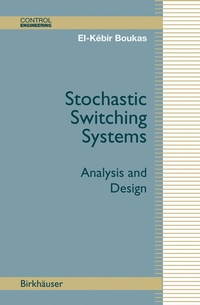
Stochastic Switching Systems
Description

Stochastic switching systems represent an interesting class of systems that can be used to model a variety of systems having abrupt random changes in their dynamics. Such systems may be found in the fields of manufacturing, communications, aerospace, power, and economics.
This work presents stochastic switching systems and provides up-to-date methods and techniques for the analysis and design of various control systems with or without uncertainties. An introductory chapter highlights basic concepts and practical models, which are then used to solve more advanced problems throughout the book. Included are many numerical examples as well as LMI analysis methods and design approaches to supplement the developed results.
Stochastic Switching Systems may be used as a supplementary textbook for graduate-level engineering courses, or as a reference for control engineers, graduate students, and researchers in systems and control. Prerequisites include elementary courses in matrix theory, probability, optimization techniques, and control systems theory.
Reviews / Votes
From the reviews:
"The text contains a large number of simple examples. The appendix collects together results from linear systems theory and probability, which may be helpful in understanding the material. The bibliography...is accurate and up-to-date. The treatment of robust stability and stabilization is carried out in parallel with the corresponding results for nominal systems models; this feature will be particularly useful to practicing engineers. Also, almost all of the results are expressed in terms of LMIs and/or their solutions; this is a unifying characteristic and is indeed advantageous on account of readily available complete catalog of the results in the area of MLSs; practicing engineers, in particular, will find it useful." -Mathematical Reviews
"Boukas defines a stochastic switching system as a linear control problem with dynamics partially determined by a finite-state Markov process. . the book may appeal to experts in control theory who already have intuition about linear control systems and may understand the results without needing to peruse the derivations." (Peter C. Kiessler, Journal of the American Statistical Association, Vol. 103 (481), 2008)
More details
Other editions
Additional editions
Content
3 Stabilization Problem (p. 61-62)
One of the most popular control problems, the stabilization problem consists of determining a control law that forces the closed-loop state equation of a given system to guarantee the desired design performances. This problem has and continues to attract many researchers from the control community and many techniques can be used to solve the stabilization problem for dynamical systems. From the practical point of view when designing any control system, the stabilization problem is the most important in the design phase since it will give the desired performances to the designed control system. The concepts of stochastic stability and its robustness for the class of piecewise deterministic systems were presented in the previous chapter. Most of the developed results are LMI-based conditions that can be used easily to check if a dynamical system of the class we are considering is stochastically stable and robustly stochastically stable.
In practice some systems are unstable or their performances are not acceptable. To stabilize or improve the performances of such systems, we examine the design of an appropriate controller. Once combined with the system this controller should stabilize the closed loop and at the same time guarantee the required performances.
In the literature, we can .nd di.erent techniques of stabilization that can be divided into two groups. The .rst group gathers all the techniques that assume the complete access to the state vector and the other group is composed of techniques that are based on partial state vector observation. For the class of systems under consideration, the following techniques can be used:
- state feedback stabilization,
- ,output feedback stabilization.
This chapter will focus on these two techniques and develop LMI-based procedures to design the corresponding gains. The rest of this chapter is organized as follows. In Section 3.1, the stabilization problem is stated and some useful de.nitions are given. Section 3.2 treats the state feedback stabilization for nominal and uncertain classes of piecewise deterministic systems. Section 3.3 covers the stabilization with the static output feedback controller. In Section 3.4, output feedback is covered. Section 3.5 deals with observer-output feedback stabilization. Section 3.6 develops the design of the state feedback controller with constant gain. All the developed results are in LMI framework, which makes the resolution of the stabilization problem easier. Many numerical examples are provided to show the usefulness of the developed results.
