

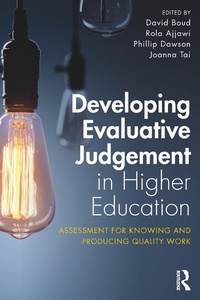
Developing Evaluative Judgement in Higher Education
Assessment for Knowing and Producing Quality Work
1st Edition
Published on 19. April 2018
218 pages
978-1-351-61251-7 (ISBN)
Description

A key skill to be mastered by graduates today is the ability to assess the quality of their own work, and the work of others. This book demonstrates how the higher education system might move away from a culture of unhelpful grades and rigid marking schemes, to focus instead on forms of feedback and assessment that develop the critical skills of its students.
Tracing the historical and sociocultural development of evaluative judgement, and bringing together evidence and practice design from a range of disciplines, this book demystifies the concept of evaluative judgement and shows how it might be integrated and encouraged in a range of pedagogical contexts. Contributors develop various understandings of this often poorly understood concept and draw on their experience to showcase a toolbox of strategies including peer learning, self-regulated learning, self-assessment and the use of technologies.
A key text for those working with students in the higher education system, Developing Evaluative Judgement in Higher Education will give readers the knowledge and confidence required to promote these much-needed skills when working with individual students and groups.
Tracing the historical and sociocultural development of evaluative judgement, and bringing together evidence and practice design from a range of disciplines, this book demystifies the concept of evaluative judgement and shows how it might be integrated and encouraged in a range of pedagogical contexts. Contributors develop various understandings of this often poorly understood concept and draw on their experience to showcase a toolbox of strategies including peer learning, self-regulated learning, self-assessment and the use of technologies.
A key text for those working with students in the higher education system, Developing Evaluative Judgement in Higher Education will give readers the knowledge and confidence required to promote these much-needed skills when working with individual students and groups.
Reviews / Votes
Effective evaluative judgment is essential for effective 21st century learning, employment and active citizenship, but traditional assessment practices are not always effective in constructing and further developing such capabilities among students. This comprehensive and thoughtful edited collection, authored by a stellar cast of Australasian contributors provides an original and pragmatic guide to using practices including self- and peer-assessment, rubrics and exemplars, and dialogic feedback to enhance learning in a digitally enabled world.?Sally Brown, Chair of the Association of National Teaching Fellows, Emerita Professor, Leeds Beckett University
This edited collection challenges and assists us to design assessments which systematically reduce student dependence on their teachers as they learn to accurately judge and thereby improve the quality of their work in academic and professional settings. It pins down in practical terms how familiar practices such as feedback, rubrics, peer assessment and working with exemplars can be effectively employed to help graduates succeed once the scaffolding of criteria, marks and tutors have been left behind at university. By adopting a refreshingly new perspective on assessment purposes as well as encompassing small and large scale approaches, this book is at the cutting edge of assessment theory and practice.
Sue Bloxham, Emeritus professor of Academic Practice, University of Cumbria
Books with a long taxi-rank of contributors all too often underwhelm: what follows can be a bumpy ride with too many stop-offs and no clear destination. Not so this sparkling newcomer to the field of assessment in higher education. Happily, there's a compelling unifying theme in David Boud's seedcorn notion of evaluative judgment, and an impressive line-up of authors, each with insights that light up fresh pathways to understanding. Necessary intersections are explored with issues of standards and quality, but good use is also made of vantage-points that extend from the disciplines of the academy into the graduate workplace. The resulting journey is a delight to the mind's-eye.
Dai Hounsell, Emeritus Professor of Higher Education, University of Edinburgh, Fellow of the Society for Research into Higher Education
The book provides educators with a toolbox of practice strategies, illustrating how common pedagogical activities (for example, rubrics, exemplars and feedback) can be adapted to enhance students' ability to evaluate what constitutes "good work" in their disciplines. These strategies will be useful for educators who wish to reframe their assessment designs for better development of students' evaluative judgements.
Jiahui Luo, Educational Review
More details
Edition
1. Auflage
Language
English
Place of publication
London
United Kingdom
Publishing group
Taylor & Francis Ltd
Target group
Professional and scholarly
Product notice
Reflowable
Illustrations
4 s/w Zeichnungen, 4 s/w Tabellen
4 Tables, black and white; 4 Line drawings, black and white
File size
1,33 MB
ISBN-13
978-1-351-61251-7 (9781351612517)
Copyright in bibliographic data and cover images is held by Nielsen Book Services Limited or by the publishers or by their respective licensors: all rights reserved.
Schweitzer Classification
Other editions
Additional editions
David Boud | Rola Ajjawi | Phillip Dawson
Developing Evaluative Judgement in Higher Education
Assessment for Knowing and Producing Quality Work
Book
04/2018
1st Edition
Routledge
€57.40
Shipment within 10-20 days
David Boud | Rola Ajjawi | Phillip Dawson
Developing Evaluative Judgement in Higher Education
Assessment for Knowing and Producing Quality Work
Book
04/2018
1st Edition
Routledge
€185.30
Shipment within 10-20 days
Persons
Professor David Boud is Foundation Director of the Centre for Research in Assessment and Digital Learning (CRADLE), Deakin University, Australia.
Dr Rola Ajjawi is Senior Research Fellow at CRADLE.
Associate Professor Phillip Dawson is Associate Director of CRADLE.
Dr Joanna Tai is Research Fellow at CRADLE.
Dr Rola Ajjawi is Senior Research Fellow at CRADLE.
Associate Professor Phillip Dawson is Associate Director of CRADLE.
Dr Joanna Tai is Research Fellow at CRADLE.
Content
List of figures and tables Acknowledgements List of Contributors Chapter 0: Introduction: what is evaluative judgement? Section 1: Conceptualising Evaluative Judgement Chapter 1: Conceptualising evaluative judgement for sustainable assessment in higher education Chapter 2: Evaluative judgement for learning to be in a digital world Chapter 3: Epistemic resourcefulness and the development of evaluative judgement Section 2: Alternative Theoretical Perspectives on Evaluative Judgement Chapter 4: Problematising standards: representation or performance? Chapter 5: Barriers to the cultivation of evaluative judgement: a critical and historical perspective Chapter 6: Limits to evaluative judgement Chapter 7: Understanding, assessing and enhancing student evaluative judgement in digital environments Section 3: Approaches to Developing Evaluative Judgement Chapter 8: Developing evaluative judgement: a self-regulated learning perspective Chapter 9: Understanding self-regulated learning in open-ended online assignment tasks Chapter 10: Exemplars, feedback and bias: how do computers make evaluative judgements? Chapter 11: Developing students' capacities for evaluative judgment through analysing exemplars Chapter 12: Designing for technology-enabled dialogic feedback Chapter 13: The practicalities of using assessment management to develop evaluative judgement Chapter 14: Strategies for fostering the development of evaluative judgement Section 4: Evaluative Judgement for Practice and Work Chapter 15: Prefigurement, identities and agency: the disciplinary nature of evaluative judgement Chapter 16: The role of peers in developing evaluative judgement Chapter 17: Building evaluative judgement through the process of feedback Chapter 18: Using workplace-learning narratives to explore evaluative judgment in action Chapter 19: Creating an agenda for developing students' evaluative judgement
