

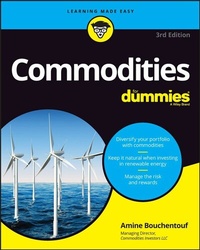
Commodities For Dummies
Description

Commodities For Dummies gives you a complete overview of the basics of investing in commodities. Step-by-step explanations, plus the most up-to-date market information and global events, make it easy to invest in the stuff the world is made of. This book helps you identify the most valuable commodities to add to your portfolio, use commodities as a safe haven in shifting economic times, and come out on top. Learn quick, with real-life examples, expert advice, and basic explanations to get you involved in energy, agriculture, and metals. Pick up this book, and you'll be ready to select the right investment vehicles for you, manage risk, and reap the benefits of investing in commodities--the Dummies way.
* Get a crash course in the basics of global commodity trading and investing
* Discover how recent global events have impacted commodity prices and supply chains
* Find the right balance of commodities for your portfolio--in any market weather
* Understand the importance of ESG and renewables in the commodity investing landscape
This is the perfect Dummies guide for investors who have a good grasp of the basics and want to continue to diversify their portfolio with--you guessed it--commodities.
More details
Other editions
Additional editions
Person
Content
Part 1: Commodities: Just the Facts 5
Chapter 1: Investors, Start Your Engines! An Overview of Commodities 7
Chapter 2: Earn, Baby, Earn! Why You Should Invest in Commodities 19
Chapter 3: Investing in Commodities: Only for the Brave? 37
Chapter 4: Feel the Love: Welcoming Commodities into Your Portfolio 51
Part 2: Getting Started with Types of Investment Vehicles 65
Chapter 5: Benefiting from Exchange-Traded Funds 67
Chapter 6: Making a Splash: Investing in Liquid Commodity Instruments 75
Chapter 7: Show Me the Money! Choosing the Right Manager 89
Chapter 8: Exploring Commodity Exchanges and Digital Assets 107
Chapter 9: Back to the Future: Getting a Grip on Futures and Options 127
Part 3: The Power House: How to Make Money in Energy 145
Chapter 10: Keeping It Natural: Investing in Renewable Energy 147
Chapter 11: It's a Crude, Crude World: Investing in Crude Oil 155
Chapter 12: Welcome to Gas Vegas, Baby! Trading Natural Gas 175
Chapter 13: Fuel for Thought: Looking at Alternative Energy Sources 189
Chapter 14: Totally Energized: Investing in Energy Companies 205
Part 4: Pedal to the Metal: Investing in Metals 223
Chapter 15: All That Glitters: Investing in Gold, Silver, and Platinum 225
Chapter 16: Metals That Prove Their Mettle: Steel, Aluminum, and Copper 243
Chapter 17: Weighing Investments in Heavy and Not-So-Heavy Metals 255
Chapter 18: Mine Your Own Business: Unearthing the Top Mining Companies 263
Part 5: Going Down to the Farm: Trading Agricultural Products 273
Chapter 19: Breakfast of Champions: Profiting from Coffee, Cocoa, Sugar, and Orange Juice 275
Chapter 20: How to Gain from Grains: Trading Corn, Wheat, and Soybeans 287
Chapter 21: Alive and Kicking! Making Money Trading Livestock 297
Part 6: The Part of Tens 307
Chapter 22: Ten Investing Resources You Can't Do Without 309
Chapter 23: Top Ten Market Indicators You Should Monitor 313
Chapter 24: Top Ten Commodity ETFs 319
Chapter 25: Top Ten Investment Vehicles for Commodities 323
Glossary 327
Index 335
Chapter 1
Investors, Start Your Engines! An Overview of Commodities
IN THIS CHAPTER
Finding out why you should invest in commodities
Defining the commodities markets
Determining the best ways to trade commodities
Identifying the major commodities
The commodities markets are broad and deep, presenting both challenges and opportunities. Investors are often overwhelmed simply by the number of commodities out there: more than 30 tradable commodities to choose from. (I cover almost all of them - 32, to be exact - more than any other introductory book on the topic.) How do you decide whether to trade crude oil or gold, sugar or palladium, natural gas or frozen concentrated orange juice, soybeans or aluminum? What about corn, feeder cattle, and silver? Should you trade these commodities as well? And, if you do, what's the best way to invest in them? Should you go through the futures markets, go through the equity markets, or buy the physical stuff (such as silver coins or gold bullion)? And do all commodities move in tandem, or do they perform independently of each other?
With so many variables to keep track of and options to choose from, just getting started in commodities can be daunting. But have no fear - this book provides you with the actionable information, knowledge, insight, and analysis to help you grab the commodities market by the horns. Maybe you've heard a lot of myths and fantasies about commodities. I shatter some of these myths and, in the process, clear the way to help you identify the real money-making opportunities.
For example, a lot of folks incorrectly equate commodities exclusively with the futures markets. Undoubtedly, the two are inextricably linked; the futures markets offer a way for commercial users to hedge against commodity price risks and a means for investors and traders to profit from this price risk. However, the futures market is only one planet in the commodities universe.
COMMODITIES THROUGHOUT HISTORY
The history of commodities tells the story of civilization itself. Ever since man first appeared on earth, his existence has been defined by a perpetual and brutal quest for control over the world's natural resources. Civilizations rise and fall, nations prosper and perish, and societies survive and subside based on their ability to harness energy, develop metals, and cultivate agricultural products - in short, based on their capacity to control commodities. It's interesting to note that prehistoric times are still defined today by the subsequent stages of man's mastery of the metals production process: the Stone Age, the Bronze Age, and the Iron Age. Nations that have been able to master natural resources have survived, while those that failed have faced extinction. This sobering reality has led to some of the most epic clashes among civilizations.
History reveals that the most devastating battles have been fought over crude oil, gold, uranium, and other precious natural resources (all covered in this book). When Francisco Pizarro's first expedition to South America in 1524 led him to the discovery of vast amounts of gold deposits, his conquistadors proceeded to wipe out the whole Inca civilization that stood between them and the gold. As a matter of fact, it's probably unlikely that Christopher Columbus would have come across to the North American continent in the first place were it not for an unquenchable desire to find the shortest and most secure route to transport spices and other commodities from India to Europe.
At the end of the 19th century, this continuous quest for commodities resulted in the deadly South African Boer Wars, which pitted the British Empire's armed forces against local fighters in a bloody battle over South Africa's precious metals and minerals. The 20th century, which heralded a new historical phase - the Hydrocarbon Age, shortly followed by the Nuclear Age - marks a turning point in humans' ability to utilize and exploit the earth's raw materials and the extent to which they will go to preserve this control. The Persian Gulf War of 1991, which, at its essence, was an effort to stabilize global oil markets after the Iraqi invasion of oil-rich Kuwait in the Middle East, is another manifestation of this historical reality. To this day, international players in the geopolitical world consider access to the world's vast deposits of oil, gold, copper, and other resources. Commodities have thus determined the fate and wealth of nations throughout history and will continue to do so in the future.
The equity markets are also deeply involved in commodities. Companies such as ExxonMobil (NYSE: XOM) focus exclusively on the production of crude oil, natural gas, and other energy products; Anglo-American PLC (NASDAQ: AAUK) focuses on mining precious metals and minerals across the globe; and Starbucks (NASDAQ: SBUX) offers investors access to the coffee markets. Ignoring these companies that process commodities isn't only narrow minded, but a bit foolish because they provide exposure to the same commodities traded on the futures market.
In addition to the futures and equity markets, a number of investment vehicles allow you to access the commodities markets. These vehicles include master limited partnerships (MLPs), exchange-traded funds (ETFs), and commodity mutual funds (all covered in Chapter 6). So although I do focus on the futures markets, I also examine investment opportunities in the equity markets and beyond.
The commodities universe is large, and investment opportunities abound. In this book, I help you explore this universe inside and out, from the open outcry trading pits on the floor of the New York Mercantile Exchange to the labor-intensive cocoa fields of the Ivory Coast; from the vast palladium-mining operations in northeastern Russia to the corn-growing farms of Iowa; from the Ultra-Large Crude Carriers (ULCC) that transport crude oil across vast oceans to the nickel mines of Papua New Guinea; from the sugar plantations of Brazil to the steel mills of China.
By exploring this fascinating universe, not only do you get insight into the world's most crucial commodities - and catch a glimpse of how the global capital markets operate - but you also find out how to capitalize on this information to generate profits.
Defining Commodities and Their Investment Characteristics
Just what, exactly, are commodities? Put simply, commodities are the raw materials humans use to create a livable world. Humans have been exploiting earth's natural resources since the beginning of time. They use agricultural products to feed themselves, metals to build weapons and tools, and energy to sustain themselves. Energy, metals, and agricultural products are the three classes of commodities and the essential building blocks of the global economy.
FOLLOW THE MONEY
Commodities have allowed nations to survive and thrive, but they've also given individuals tremendous wealth-accumulation possibilities. Some of the world's most enduring fortunes have been built around commodities. Mayer Rothschild, patriarch of the European Rothschild banking family, made a fortune during the Napoleonic Wars by storing and distributing gold bullion to fund the British side of the war effort.
Andrew Carnegie, the self-made industrialist and founder of the eponymous steel company that eventually became U.S. Steel, consolidated the American steel industry and, in the process, became the second-richest man of his time, behind only John D. Rockefeller, Sr. And what better illustration of the power of commodities as wealth-building vehicles is there than John Rockefeller himself, whose impact on the global oil industry through the creation of the Standard Oil Company is still felt today? (See Daniel Yergin's The Prize: The Epic Quest for Oil, Money and Power as well as Brian Black's book Crude Reality: Petroleum in World History.) Abdel-Aziz Al-Saud, Saudi Arabia's first monarch, consolidated and created an entire nation through the control of crude oil and natural gas riches.
To this day, individuals involved in commodities have been able to generate tremendous wealth. Legendary oilman T. Boone Pickens, for instance, made $1.4 billion in 2005 by betting on the price of oil and natural gas. Mukesh Ambani, who is chairman of Reliance Industries in India, is worth more than $85 billion (2022 figures) as a result of his activities in oil and gas. Clearly, individuals who have the foresight to invest in commodities have profited handsomely from this enterprise. You may not be able to build as much wealth as Rockefeller or Al-Saud, but I'm confident that you can benefit by opening up to investing in commodities.
For the purposes of this book, I present 32 commodities that fit a very specific definition, which I define in the following bulleted list. For example, the commodities I present must be raw materials. I don't discuss currencies - even though they trade in the futures markets - because they're not raw materials; they can't be physically used to build anything. In addition, the commodities must present real moneymaking opportunities to investors.
All the commodities I cover in the book meet the following criteria:
- Tradability: The commodity has to be tradable, meaning that there needs to be a viable investment vehicle to help you trade it. For example, I include a commodity if it...
