

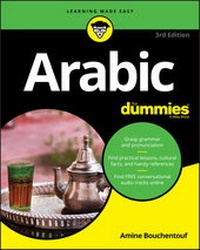
Arabic For Dummies
Description

Arabic For Dummies helps readers start speaking Modern Standard Arabic in no time. Whether you're a student, traveler, or work in business or government, you'll find this title to be packed with practical lessons, cultural facts, and handy references.
Inside, you'll find guidance on basic grammar, as well as the necessary vocabulary to make introductions and greetings, use proper etiquette, make small talk, make transportation arrangements, order food and beverages, ask directions, deal with money, shop, access recreation, and handle an emergency.
* Features new and revised content
* Offers a revamped, user-friendly design to both pedagogy and organization
* Includes expanded coverage of grammar, verb conjugations, and pronunciations
* Get free access to conversational audio tracks online
If you want to start speaking Arabic, this go-to book is packed with practical instruction, cultural facts, and handy references you won't want to be without!
More details
Other editions
Additional editions
Previous edition
Content
- Intro
- Title Page
- Copyright Page
- Table of Contents
- Introduction
- About This Book
- Foolish Assumptions
- Icons Used in This Book
- Beyond the Book
- Where to Go from Here
- Part 1 Getting Started with Arabic
- Chapter 1 The Arabic You Already Know
- Taking Stock of What's Familiar
- Discovering the Arabic Alphabet
- All about vowels
- All about consonants
- Speaking Arabic like a Native
- Chapter 2 Taking a Closer Look at the Arabic Alphabet
- Getting a Grasp on ????
- Figuring Out the Transcription
- Getting Better Acquainted with the Script
- Chapter 3 Tackling Basic Arabic Grammar
- Introducing Nouns, Adjectives, and Articles
- Getting a grip on nouns
- Identifying adjectives
- Discovering definite and indefinite articles
- Understanding the interaction between nouns and adjectives
- Creating Simple, Verb-Free Sentences
- To be or not to be: Sentences without verbs
- Building sentences with common prepositions
- Using demonstratives and forming sentences
- Forming "to be" sentences using personal pronouns
- Creating negative "to be" sentences
- "To be" in the past tense
- Working with Verbs
- Digging up the past tense
- Examining the present tense
- Peeking into the future tense
- Examining irregular verb forms
- Chapter 4 Getting Started with Basic Expressions
- Greeting People Appropriately
- Saying hello
- Bidding goodbye
- Asking how someone is
- Responding that you're doing well
- Making Introductions
- Asking "What's your name?"
- Responding with the possessive "My name is . . ."
- Saying "It's a pleasure to meet you!"
- Talking about Countries and Nationalities
- Asking "Where are you from?"
- Saying "I am from . . ."
- Shooting the Breeze: Talking about the Weather
- Chapter 5 Getting Your Numbers, Dates, and Measurements Straight
- Talking Numbers
- Referring to Days and Months
- Size Matters: Measuring in Arabic
- Chapter 6 At the Office and Around the House
- Managing the Office Environment
- Interacting with your colleagues
- Giving orders
- Supplying your office
- Life at Home
- Part 2 Arabic in Action
- Chapter 7 Getting to Know You: Making Small Talk
- Asking Key Questions
- Talking about Yourself and Your Family
- Making Small Talk on the Job
- Staying in Touch by Phone and Email
- Chapter 8 Asking Directions and Finding Your Way
- Focusing on the "Where"
- Asking "where" questions
- Answering "where" questions
- Getting Direction about Directions
- Asking for directions
- Could you repeat that?
- Using command forms
- Discovering Ordinal Numbers
- Chapter 9 Taking Care of Business and Telecommunicating
- Making a Call: Phone Basics
- Beginning a phone conversation
- Asking to speak to someone
- Planning while on the Phone
- Making social plans
- Making business appointments
- Leaving a Message
- Dealing with voice mail
- Leaving a message with a person
- Sending and Getting Emails
- Sending an email in Arabic
- Sending an email in English
- Following proper etiquette
- Chapter 10 This Is Delicious! Eating In and Dining Out
- Consuming Food: All about Mealtime
- Starting the day off with breakfast
- Eating lunch
- Supping at dinner
- Enjoying a Meal at Home
- Dining Out
- Perusing the menu
- Placing your order
- Finishing your meal and paying the bill
- Chapter 11 Going Shopping
- Going to the Store
- Browsing the merchandise
- Getting around the store
- Getting to know the verb "to search"
- Asking for a Particular Item
- Comparing Merchandise
- Comparing two or more items
- Picking out the best item
- More than a Few Words about Buying and Selling
- Shopping for Clothes
- Chapter 12 Hitting the Town
- Telling Time in Arabic
- Specifying the time of day
- Specifying minutes
- Visiting Museums
- Going to the Movies
- Touring Religious Sites
- A few rules to keep in mind
- The Hajj
- Chapter 13 Enjoying Yourself: Recreation, Music, and the Outdoors
- Starting Out with the Doing Verb
- Sporting an Athletic Side
- Going to the Beach
- Playing Musical Instruments
- Talking about Hobbies
- Part 3 Arabic on the Go
- Chapter 14 Planning a Trip
- Choosing Your Destination
- Picking the Right Time for Your Trip
- Tackling Packing
- Preparing Your Travel Documents
- Using a Travel Agency
- Chapter 15 Dealing with Money in a Foreign Land
- Going to the Bank
- Opening a bank account
- Making deposits and withdrawals
- Using the ATM
- Exchanging Currency
- Getting to know the currencies around the world
- Making exchanges
- Chapter 16 Getting Around: Planes, Trains, and Automobiles
- Traveling by Plane
- Making reservations
- Getting some legwork out of the verb "to travel"
- Registering at the airport
- Boarding the plane
- A brief departure on the verb "to arrive"
- Going through immigration and customs
- Getting Around on Land
- Hailing a taxi
- Taking a bus
- Boarding a train
- Chapter 17 Finding a Place to Stay
- Choosing the Right Accommodations
- Discussing minor room details
- Getting to know direct object pronouns
- Making a Reservation
- Figuring out the price
- Indicating the length of your stay
- Subjecting you to subjunctive verbs
- Checking In to the Hotel
- Checking Out of the Hotel
- Chapter 18 Handling Emergencies
- Shouting Out for Help
- A little help with the verb "to help"
- Lending a hand
- Getting Medical Help
- Locating the appropriate doctor
- Talking about your body
- Explaining your symptoms
- Getting treatment
- Acquiring Legal Help
- Part 4 The Part of Tens
- Chapter 19 Ten Ways to Pick Up Arabic Quickly
- Watch Arabic Television
- Use the Dictionary
- Read Arabic Newspapers
- Surf the Internet
- Streaming Services
- Listen to Arabic Music
- Sing Arabic Songs
- Make Arabic-Speaking Friends
- Watch Arabic Movies
- Eat at a Middle Eastern Restaurant
- Chapter 20 Ten Favorite Arabic Expressions
- ?????? ???
- ! ?????
- ????? ???
- ?? ??? ????
- !?????
- ???? ????
- ??????
- ?????
- ????
- ????? ????
- Chapter 21 Ten Great Arabic Proverbs
- ??????? ??? ??????
- ???? ????? ????? ?? ?????
- ?????? ????? ?? ????? ??? ?????
- ?? ????? ?? ?????
- ??????? ?? ????? ????? ??? ???? ?????? ??? ???? ????
- ??? ????? ???? ?? ????? ??? ??????
- ????? ??? ???????: ????? ????? ??? ????
- ????? ????? ?????? ?????
- ?? ??? ?? ????? ???? ?? ??????
- ???? ???? ????? ???? ?????
- Part 5 Appendixes
- Appendix A Mini-Dictionaries
- Appendix B Verb Tables
- Appendix C Answer Key
- Index
- EULA
Chapter 1
The Arabic You Already Know
IN THIS CHAPTER
Recognizing what you may already know
Introducing the Arabic alphabet
Talking Arabic like the locals
Getting acquainted with everyday Arabic
Let me ????? (mar.?ah.ba) (welcome) you to the wonderful world of Arabic! Arabic is the official language of 27 countries and is spoken by more than 420 million people across the globe. It's the language in which the Quran, the Holy Book in Islam, was revealed and written, and a large majority of the more than 1.3 billion Muslims across the world study Arabic in order to read the Quran and to fulfill their religious duties. By speaking Arabic, you get access to people and places from Morocco to Indonesia.
In this chapter, I ease you into Arabic by showing you some familiar English words that trace their roots to Arabic. You discover the Arabic alphabet and its beautiful letters, and I give you tips on how to pronounce those letters so that you can sound like a native speaker. Part of exploring a new language is discovering a new culture and a new way of looking at things, so in this first chapter of the third edition of Arabic For Dummies, you begin your discovery of Arabic and its unique characteristics, including the fact that it's written from right to left!
Taking Stock of What's Familiar
If English is your primary language, part of grasping a new ??? (lu.ghah) (language) is creating connections between the ????? (ka.li.mat) (words) of the language, in this case Arabic and English. You may be surprised to hear that quite a few English words trace their origins to Arabic. For example, did you know that "magazine," "candy," and "coffee" are actually Arabic words? Table 1-1 lists some familiar English words with Arabic origins.
TABLE 1-1 Arabic Origins of English Words
English
Arabic Origin
Arabic Meaning
admiral
???? ????? (a.mir al-ba?r)
ruler of the sea
alcohol
????? (al.ku?ul)
a mixture of powdered antimony
alcove
????? (al.qub.bah)
a dome or arch
algebra
????? (al.jabr)
to reduce or consolidate
almanac
?????? (al.ma.nakh)
a calendar
arsenal
??? ?????? (dar as.si.la?)
house of weapons
azure
???????? (al.la.za.ward)
lapis lazuli
candy
??? ????? (suk.kar al.qa.?ab)
cane sugar
coffee
???? (qah.wah)
coffee
cotton
??? (qu?n)
cotton
elixir
????? (ik.sir)
philosopher's stone
gazelle
???? (gha.zal)
gazelle
hazard
??? (zahr)
dice
magazine
?????? (al.makh.zan)
a storehouse
saffron
?????? (za'.fa.ran)
saffron
Sahara
??????? (a?.?a?.ra')
Sahara (desert)
sherbet
????? (shar.bat)
dessert
sofa
???? (?u.fa)
a cushion
sugar
??? (suk.kar)
sugar
zero
??? (?ifr)
zero
As you can see from the table, Arabic has had a major influence on the English language. Some English words such as "admiral" and "arsenal" have an indirect Arabic origin, whereas others, such as "coffee" and "cotton," are exact matches. The influence runs the other way, too, especially when it comes to relatively contemporary terms. For example, the word ??????? (ti.li.fiz.yon) (television) comes straight from the word "television." As is often the case with languages, Arabic and English tend to influence each other, which is what makes studying them so much fun.
Discovering the Arabic Alphabet
Unlike English and other Romance languages, you write and read Arabic from right to left. Like English, Arabic has both vowels and consonants, but the main vowels in Arabic aren't actual letters. Rather, Arabic vowels are symbols that you place on top of or below consonants to create certain sounds. As for consonants, Arabic has 28 different consonants, and each one is represented by a letter. In order to vocalize these letters, you place a vowel above or below the particular consonant. For example, when you put a ???? (fat.?ah), a vowel representing the "ah" sound, above the consonant representing the letter "b," you get the sound "bah" as in "ball." When you take the same consonant and use a ???? (kas.rah), which represents the short "i" sound, you get the sound "bih" as in "big."
To help you get a better grasp of the different letters in the alphabet, I explain vowels and consonants in the following sections.
All about vowels
Arabic has three main vowels. Luckily, they're very simple to pronounce because they're similar to English vowels. However, you need to realize that Arabic also has vowel derivatives that are as important as the main vowels. These vowel derivatives fall into three categories: double vowels, long vowels, and diphthongs. In this section, I walk you through all the different vowels, vowel derivatives, and vowel combinations.
Main vowels
The three main Arabic vowels are
- ???? (fat.?ah): The first main vowel in Arabic is called a ???? (fat.?ah). A ???? is the equivalent of the short "a" in "apple." Occasionally, a ???? also sounds like the short "e" in "bet" or "set." Much like the other vowels, the way you pronounce a ???? depends on what consonants come before or after it. In Arabic script, the ???? is written as a small horizontal line above a consonant. In English transcription, which I use in this book, it's simply represented by the letter "a," as in the words ??? (kalb) (dog) and ??? (wa.lad) (boy).
- ??? (?am.mah): The second main Arabic vowel is the ??? (?am.mah). This vowel sounds like the "uh" in "foot" or "book." In Arabic script, it's written like a tiny backward "e" above a particular consonant. In English transcription, it's represented by the letter "u," as in ???? (fun.duq) (hotel) or ??? (su.?ub) (clouds).
- ???? (kas.rah): The third main vowel in Arabic is the ???? (kas.rah), which sounds like the long "e" in "feet" or "treat." This vowel is written the same way as a ???? - as a small horizontal line - except that it goes underneath the consonant. In English transcription, it's written as an "i," as in...
