

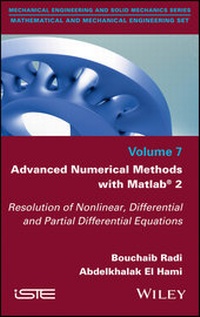
Advanced Numerical Methods with Matlab 2
Resolution of Nonlinear, Differential and Partial Differential Equations
1st Edition
Published on 23. May 2018
224 pages
978-1-119-52741-1 (ISBN)
Description

The purpose of this book is to introduce and study numerical methods basic and advanced ones for scientific computing. This last refers to the implementation of appropriate approaches to the treatment of a scientific problem arising from physics (meteorology, pollution, etc.) or of engineering (mechanics of structures, mechanics of fluids, treatment signal, etc.). Each chapter of this book recalls the essence of the different methods resolution and presents several applications in the field of engineering as well as programs developed under Matlab software.
More details
Other editions
Additional editions
Bouchaib Radi | Abdelkhalak El Hami
Advanced Numerical Methods with Matlab 2
Resolution of Nonlinear, Differential and Partial Differential Equations
Book
05/2018
1st Edition
Wiley-ISTE
€206.42
Shipment within 3-4 weeks
Content
- Cover
- Half-Title Page
- Title Page
- Copyright Page
- Contents
- Preface
- PART 1 Solving Equations
- 1. Solving Nonlinear Equations
- 1.1. Introduction
- 1.2. Separating the roots
- 1.3. Approximating a separated root
- 1.3.1. Bisection method (or dichotomy method)
- 1.3.2. Fixed-point method
- 1.3.3. First convergence criterion
- 1.3.4. Iterative stopping criteria
- 1.3.5. Second convergence criterion (local criterion)
- 1.3.6. Newton's method (or the method of tangents)
- 1.3.7. Secant method
- 1.3.8. Regula falsi method (or false position method)
- 1.4. Order of an iterative process
- 1.5. Using Matlab
- 1.5.1. Finding the roots of polynomials
- 1.5.2. Bisection method
- 1.5.3. Newton's method
- 2. Numerically Solving Differential Equations
- 2.1. Introduction
- 2.2. Cauchy problem and discretization
- 2.3. Euler's method
- 2.3.1. Interpretation
- 2.3.2. Convergence
- 2.4. One-step Runge-Kutta method
- 2.4.1. Second-order Runge-Kutta method
- 2.4.2. Fourth-order Runge-Kutta method
- 2.5. Multi-step Adams methods
- 2.5.1. Open Adams methods
- 2.5.2. Closed Adams formulas
- 2.6. Predictor-Corrector method
- 2.7. Using Matlab
- PART 2 Solving PDEs
- 3. Finite Difference Methods
- 3.1. Introduction
- 3.2. Presentation of the finite difference method
- 3.2.1. Convergence, consistency and stability
- 3.2.2. Courant-Friedrichs-Lewy condition
- 3.2.3. Von Neumann stability analysis
- 3.3. Hyperbolic equations
- 3.3.1. Key results
- 3.3.2. Numerical schemes for solving the transport equation
- 3.3.3. Wave equation
- 3.3.4. Burgers equation
- 3.4. Elliptic equations
- 3.4.1. Poisson equation
- 3.5. Parabolic equations
- 3.5.1. Heat equation
- 3.6. Using Matlab
- 4. Finite Element Method
- 4.1. Introduction
- 4.2. One-dimensional finite element methods
- 4.3. Two-dimensional finite element methods
- 4.4. General procedure of the method
- 4.5. Finite element method for computing elastic structures
- 4.5.1. Linear elasticity
- 4.5.2. Variational formulation of the linear elasticity problem
- 4.5.3. Planar linear elasticity problems
- 4.5.4. Applying the finite element method to planar problems
- 4.5.5. Axisymmetric problems
- 4.5.6. Three-dimensional problems
- 4.6. Using Matlab
- 4.6.1. Solving Poisson's equation
- 4.6.2. Solving the heat equation
- 4.6.3. Computing structures
- 5. Finite Volume Methods
- 5.1. Introduction
- 5.2. Finite volume method (FVM)
- 5.2.1. Conservation properties of the method
- 5.2.2. The stages of the method
- 5.2.3. Convergence
- 5.2.4. Consistency
- 5.2.5. Stability
- 5.3. Advection schemes
- 5.3.1. Two-dimensional FVM
- 5.3.2. Convection-diffusion equation
- 5.3.3. Central differencing scheme
- 5.3.4. Upwind (decentered) scheme
- 5.3.5. Hybrid scheme
- 5.3.6. Power-law scheme
- 5.3.7. QUICK scheme
- 5.3.8. Higher-order schemes
- 5.3.9. Unsteady one-dimensional convection-diffusion equation
- 5.3.10. Explicit scheme
- 5.3.11. Crank-Nicolson scheme
- 5.3.12. Implicit scheme
- 5.4. Using Matlab
- 6. Meshless Methods
- 6.1. Introduction
- 6.2. Limitations of the FEM and motivation of meshless methods
- 6.3. Examples of meshless methods
- 6.3.1. Advantages of meshless methods
- 6.3.2. Disadvantages of meshless methods
- 6.3.3. Comparison of the finite element method and meshless methods
- 6.4. Basis of meshless methods
- 6.4.1. Approximations
- 6.4.2. Kernel (weight) functions
- 6.4.3. Completeness
- 6.4.4. Partition of unity
- 6.5. Meshless method (EFG)
- 6.5.1. Theory
- 6.5.2. Moving Least-Squares Approximation
- 6.6. Application of the meshless method to elasticity
- 6.6.1. Formulation of static linear elasticity
- 6.6.2. Imposing essential boundary conditions
- 6.7. Numerical examples
- 6.7.1. Fixed-free beam
- 6.7.2. Compressed block
- 6.8. Using Matlab
- PART 3 Appendices
- Appendix 1 Introduction to Matlab
- A1.1. Introduction
- A1.2. Starting up Matlab
- A1.3. Mathematical functions
- A1.4. Operators and programming with Matlab
- A1.5. Writing a Matlab script
- A1.6. Generating figures with Matlab
- Appendix 2 General Approximation Principles
- A2.1. Standard results
- A2.2. Linear variational problems
- A2.3. Variational approximation
- A2.4. General result on an upper bound for the error
- A2.5. Speed of convergence
- A2.6. Galerkin method
- Bibliography
- Index
- Other titles from iSTE in Mechanical Engineering and Solid Mechanics
- EULA
